MARGAO
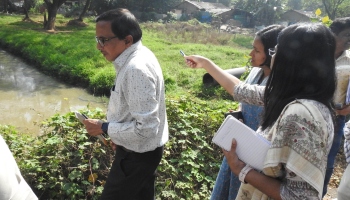
She came and saw for herself how as many as six stormwater nullahs carrying raw sewage flowed into the river Sal from Margao and Fatorda, but South Goa Collector Jyoti Kumari, IAS, has a task at hand “ how to go about stopping the wastewater discharge flowing from the commercial capital into the river Sal?
For, the joint inspection carried out by the Collector of the nullahs turned out yet another routine inspection for the officials representing various agencies, including the Goa State Pollution Control Board (GSPCB), Health, PWD, Sewerage Infrastructure Development Corporation of Goa Ltd (SIDCGL), Water Resources Department (WRD), Margao Municipal Council (MMC) et al.
Reason? There’s been no dearth of inspections of the nullahs as well as river Sal over the span of a year, with every inspection unearthing the stink and stench and the river contamination. Sadly, the ground reality hasn’t changed for the better to date with almost all the six stormwater nullahs carrying sewage into the river.
With all previous inspections coming a cropper, the Tuesday inspection has indeed thrown up a host of questions to the officials representing the agencies “ whether the Collector has any plan up her sleeves to plug the sewage discharge into the water nullahs and save the river.
Officials participating in the inspection said the Collector was taken aback over the extent of sewage from the city flowing into the as she along with the team descended in the fields of Ambaji before heading to the nullahs adjoining the Collectorate and the district hospital, old market and Comba ring road down to Khareband and Kharelem.
SIDCGL General Manager Prakash Pai was seen explaining to the Collector the ground reality and the ongoing sewerage works underway in the city.
Margao urban health officer Dr Soccoro Quadros as well as GSPCB officials also witnessed the extent of the pollution and the health hazard posed to the citizens. The moot question that has remained unanswered after Tuesday’s inspection is whether any action plan will be put in place to stop the rot and bring about a turnaround on the ground.
Sources pointed out that the MMC has got a clear direction from the Collector to step in and ascertain the sources of sewage discharge into the nullahs.
Sources said the MMC cannot alone change the situation when the burning issue calls for inter-departmental and coordinated action to take the inspection to a logical conclusion.
The officials, however, pointed out they are all waiting for directions on how to go about the job since the Collector has personally descended on the ground to ascertain the reality.
Tuesday's inspection assumes significance and comes against the backdrop of the high-level meeting chaired by PWD Minister Nilesh Cabral and attended by Chief Secretary Puneet Kumar Goel at the South Goa Collectorate last week.
MMC directed to ascertain sewage discharge sources
MARGAO
How would the Margao Municipal Council go about identifying the sewage discharge points into the nullah and plugging the sources of pollution?
This question may come to haunt the civic authorities as the South Goa Collector Jyoti Kumari is believed to have told the MMC officials to find out the sources of sewage points and plug them immediately.
For, this would only imply that the MMC goes about identifying the sources of pollution and issuing notices to the erring housing societies and commercial establishments.
An MMC official, however, pointed out that the civic body cannot alone solve the problem since the issue needs to be handled by agencies including the PWD and the Sewerage Infrastructure Corporation of Goa Ltd.
“When the team inspected the areas at Fatorda, we came across discharge points near the Collectorate and the district hospital building. There were some hotels which were found discharging sewage in the drains before the waters joined the main nullah. The municipality finds itself in a tight spot since the waste from the establishments is flowing into the nullah and at the same time the North main truck line is incomplete,” the civic official said.
In the past, the municipality had issued notices to around 104 establishments in Margao city for discharging waste and sewage into the drains. After issuing notices, the civic body later moved the Health department to disconnect the water supply of 54 units, but in vain.
A year after finding nullahs carrying sewage, authorities are still to act
MARGAO
When the Water Resources Department (WRD) inspected the sewage discharge points to river Sal in July 2021, officials came across 5-6 nullahs from Margao and Fatorda carrying wastewater.
A year later and another inspection, this time by the South Goa Collector, and the sewage flowing from the six nullahs into the river continued unabated.
Indeed, there’s no change in the ground reality since WRD senior officer Ankush Gaonkar compiled a report on the contamination of river Sal by the six nullahs.
That’s not all. The WRD report was submitted to the office of the South Goa Collector a little over a year ago, but no action had come from the district authorities to mitigate the situation by plugging the sewage discharge points.
An official in the know pointed out that after the WRD inspection over a year ago last, the Goa State Pollution Control Board (GSPCB) carried out an inspection exactly a month ago when the river Sal contamination hit the headlines. Sadly, the GSPCB report again confirmed that sewage flowed into the river from the six nullahs, indicating there’s no change in the ground reality for the repeated inspections.