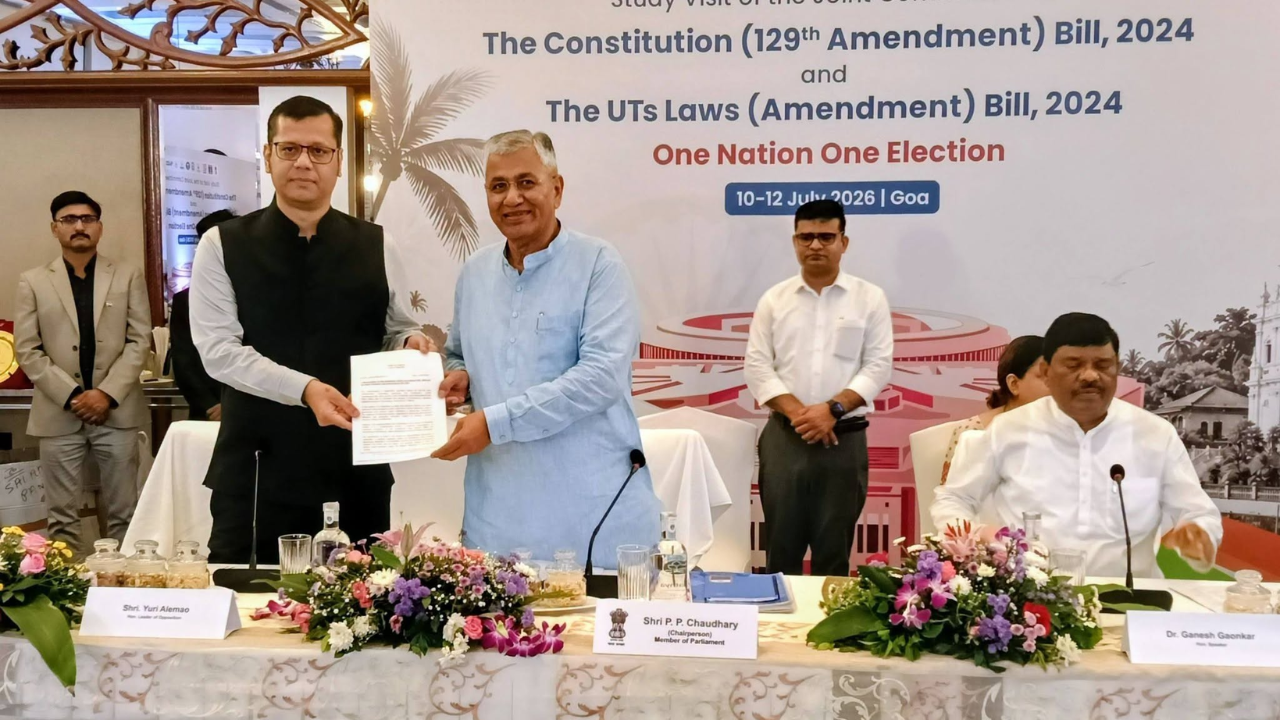
PANAJI: Goa's Leader of Opposition Yuri Alemao on Saturday said he has opposed the proposed One Nation, One Election initiative before the Joint Parliamentary Committee (JPC) examining the Constitution (129th Amendment) Bill, stating that the proposal is not in line with India's federal structure and could weaken regional parties.
Speaking to reporters after the JPC meeting, Alemao said he had submitted a memorandum to the committee detailing his objections to the proposal.
"Today, the Joint Parliamentary Committee debated the 129th Amendment to our Constitution, basically on One Nation, One Election. I have submitted a memorandum. I can't share it with you, but we've opposed One Nation, One Election because it doesn't align with our federal structure. It is a threat to our federal structure, especially to the state structure and regional parties," Alemao said.
He contended that conducting simultaneous Lok Sabha and Assembly elections would conflict with several constitutional provisions and undermine India's democratic framework.
"One Nation, One Election, if held simultaneously, violates several constitutional provisions. We need to understand that India was a healthy democracy from 1952 to 1967, when simultaneous Lok Sabha and Assembly elections were held. But it was the natural course of the Constitution and subsequent political developments, including the dissolution of Assemblies and Parliament, that brought simultaneous elections to an end," he said.
Alemao said the Congress had presented its concerns before the committee, maintaining that India's constitutional framework and democratic traditions must be preserved.
"We spoke before the honourable chairman and presented our views. India is united. India cannot be divided. The BJP wants to showcase everything as 'one'. One Nation, One Election, one religion, one caste and so on. We have objected to this proposal and submitted our memorandum because, in our vibrant democratic set-up, we must respect the Constitution that has guided the country for several decades," he said.
Echoing similar concerns, AAP Goa MLA Venzy Viegas said the proposal would undermine India's federal structure by allowing national issues to overshadow local and state-specific concerns.
"One Nation, One Election undermines the federal fabric of the country. Local and state issues will be overshadowed by national parties and their national narratives," Viegas said.
Stressing that elections are an important tool for public accountability, Viegas argued that staggered elections at different levels ensure governments remain answerable to the people throughout their tenure.
"Elections are about accountability. Panchayat, Zilla Parishad, and municipal elections provide people with regular opportunities to assess the government's performance. If all elections are held together, a government can ignore public issues for five years. Even if the price of a gas cylinder rises to Rs 2,000 or Rs 3,000, there would be no immediate electoral accountability," he said.
Viegas also pointed to the practical challenges of conducting simultaneous elections, saying the exercise would require enormous logistical arrangements, including the deployment of electronic voting machines, security personnel and election staff across the country.
Additionally, he raised concerns over the anti-defection law, saying the issue was discussed during the committee meeting. Referring to Goa's political history, Viegas said defections have repeatedly destabilised governments in the state.
"In Goa, defection ruins democracy and makes political stability very difficult," he said.
Claiming that the proposal would disproportionately impact smaller political parties, Alemao alleged that the move was aimed at consolidating political power at the expense of regional representation.
"I believe this is only being done to make sure that smaller parties and regional parties are weakened. This would be the end of regional parties, and that is why we have strongly opposed the proposal," Alemao added.