


MARGAO
Chief Minister Pramod Sawant on Tuesday has said that Goa has articulated a clean energy roadmap with a vision to transition towards 100 per cent renewable energy by 2050.
Being a coastal State, he further said that Goa is committed in advancing both green and blue economies.
Addressing the delegates at the India Energy Week 2026 that began at the sprawling ONGC complex, Betul on Tuesday, the Chief Minister reminded that under the leadership of Prime Minister Narendra Modi, India has emerged as a global voice of solution, capabilities, confidence and commitment.
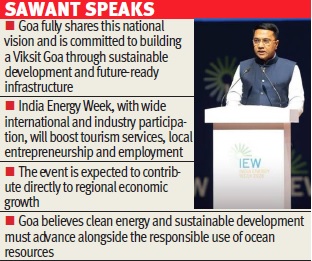
Saying that India’s progress towards Viksit Bharat depends on reliable energy, power that is available affordable and resilient, the Chief Minister said Goa fully shares this national vision, and is committed to building a Viksit Goa supported by sustainable development and future infrastructure. “Goa has articulated a clean energy roadmap with a vision to transition toward 100 per cent renewable energy by 2050. With wide international participation and strong industry presence, the India Energy Week will support tourism services, local entrepreneurs and employment, contributing directly to the regional growth,” he said.
He added: “The event not only generates discussions within the hall, but creates opportunities beyond, benefitting the local community and strengthening Goa’s position as a global destination for dialogue and development in green and blue economy, Goa’s dual responsibility.”
Saying the State believes that clean energy and sustainable development must progress together with responsible use of ocean resources, the Chief Minister said this balance will define our future where economic progress support the environmental protection and developmental strength and resilience.
Delivering the keynote address, Union Petroleum Minister Hardeep Singh Puri highlighted India’s steady and resilient progress towards energy security, self-reliance and climate justice under the leadership of Prime Minister Narendra Modi. He noted that India Energy Week has rapidly evolved into a trusted global forum, bringing together policymakers, producers, consumers, technology providers and investors to navigate a period of unprecedented transition and volatility in the global energy system.
Puri emphasised that the global energy transition is fundamentally about “energy addition” rather than replacement, underscoring the need for sustained investment across oil, gas, biofuels, green hydrogen, LNG and clean cooking fuels. He outlined India’s reforms-driven approach to ensuring availability, affordability and sustainability.
He added that India’s rapid expansion of LPG coverage, clean cooking access and diversified energy mix reflect the country’s commitment to inclusive growth and equitable energy access.
Addressing the gathering, Sultan Ahmed Al Jaber, Minister of Industry and Advanced Technology of the United Arab Emirates and Managing Director and Group CEO of ADNOC, underlined that global energy demand is entering a phase of transformation at scale, which is driven by emerging markets, digitalisation and the integration of diverse energy systems. He noted that India sits at the heart of these megatrends and will be a decisive driver of global energy demand in the decades ahead.
Across the inaugural addresses, India Energy Week 2026 underscored India’s positioning as a responsible global energy leader offering practical, scalable and inclusive solutions. Strong emphasis was laid on international cooperation, innovation and investment mobilisation as critical enablers for accelerating the global energy transition.


