MAPUSA
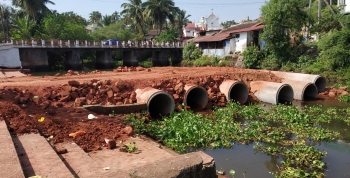
It’s back to the old and obscene ways. Circular concrete pipes, mud and rubble are being dumped in the river to construct a temporary road until a new four-lane bridge comes up across the Tar river in Mapusa.
Last week, the GSIDC appointed contractor had begun placing the circular concrete pipes in the river and dumping mud and rubble over it in a bid to construct temporary access for vehicular traffic across the river.
Once the temporary road is complete, the contractor is expected to demolish the existing two-lane bridge and construct a new 40-metre long four-lane bridge across the river.
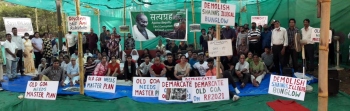
Activists and citizens have condemned the quick fix method used by the contractor to build the temporary road, as the concrete pipes will further block the free flow of water in the already choked Tar river.
“It’s the most stupid and unscientific way to go about. This is a shortcut they are using. The simplest thing they could do is put a Bailey bridge across the river,” said Dr Antonio Mascarenhas, a former scientist with the NIO.
He said this was a river where there was a tidal influx and the pipes block the flow of the water.
“The tide should come in and flow out freely. There should not be any obstruction whatsoever if the rivulet should survive the way it should. If plastics and other material are flowing in the river, they are bound to get clogged and then the flow will be reduced totally,” he opined.
The GSIDC has said that the new bridge was expected to be completed within nine months but the contractor could complete the work much earlier. The construction of the minor bridge has been contracted to M/s PRN Infratech.
Last month, Chief Minister Pramod Sawant along with Mapusa MLA, Joshua D’Souza laid the foundation stone for the new bridge costing around Rs 10.30 crore.
According to the coordinator of GOACAN, Roland Martins, the Tar river was earlier getting choked because the bridge across the river along the present NH66 (earlier NH17) was built on similar circular concrete pipes which restricted the flow of water.
During the ongoing expansion of the national highway, the concrete pipes were done away with and a concrete bridge has been constructed across the river.
“There should be a wider discussion whether this is the correct form to build a temporary road or just because the elections are approaching they are using some quick-fix options. They want to show that work is getting done. And if it does not get completed then who will take the responsibility of the environmental impact,” said Martins, who is a resident of Mapusa.
He said there was no guarantee that the contractor would finish the work in a time-bound manner and a similar work carried out by GSIDC in Cuncolim had resulted in flooding of the village there.
“It is too risky going on some premise that we will finish the work quickly. An impact assessment should be done first before going for such a thing,” he said.
However, a resident of Mapusa, Minguel Braganza said the ongoing work was better than dumping mud in the river and it would not create a problem during the post-monsoon period.
“This is better than ‘backfilling’. I do hope this is temporary access for the construction of a cantilever bridge. No problem in the post-monsoon period. The river is going to be dredged as part of the National Waterway #68 already notified by the Government of India,” Braganza said.
Bailey bridge an option: Experts
MAPUSA:
Instead of using concrete pipes and mud, the GSIDC should have explored the option of constructing a Bailey bridge to build temporary vehicular access across the river, the experts said.
“A Bailey bridge would be a better option. Assemble a Bailey bridge on the banks of the river, lift it with a crane and place it across the river. Once the work is over, dismantle it. The cost will be almost the same,” said Dr Antonio Mascarenhas, ex-NIO scientist.
A resident of Mapusa and GOACAN coordinator, Roland Martins also wondered whether the authorities had a look at the Bailey bridge option.
“Whether they are willing to look into other options is a question mark and whether they have taken local people into confidence. Most of the problems occur because they have not taken the local people into confidence. People who know the flow of river…they know how things work,” he said.