
MARGAO
With less than a week remaining before the commencement of the new fishing season on August 1, fish meal and fish processing units operating from the Cuncolim Industrial Estate are expected to be gearing up for full-scale operations.
However, for residents of Cuncolim, the countdown to the season has once again revived concerns over whether the authorities are prepared to ensure that the fish processing activity does not come at the cost of public health and the environment.
At the centre of these concerns is the Goa State Pollution Control Board (GSPCB), with local residents asking a critical question: Is the Board fully geared up to ensure that fish transported to the industrial units and the processing activities undertaken there strictly comply with the pollution control norms laid down by the regulator?
The question assumes significance against the backdrop of a series of stringent directions issued earlier this year by the GSPCB under the leadership of Chairman Levinson Martins and Member Secretary Geeta Nagvenkar.
The directives, issued to fish meal as well as fish processing units operating in the Cuncolim Industrial Development Corporation (IDC), were aimed at addressing longstanding complaints of foul odour, improper handling of fish and environmental pollution.
Directions to contain pollution
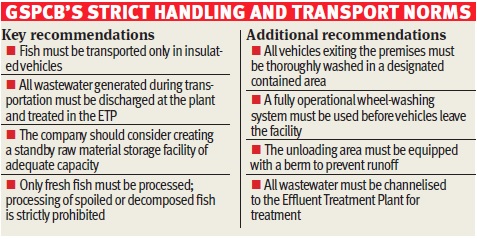
Among the key directions, the Pollution Control Board made it mandatory that fish be transported only in insulated vehicles to prevent deterioration during transit. The Board also directed that all wastewater generated during transportation should be discharged only at the processing plants and treated in the respective Effluent Treatment Plants (ETPs), instead of being released along roads or into drains.
Significantly, the Board also prohibited the processing of spoiled or decomposed fish, making it clear that only fresh fish should be accepted and processed by the units. The directive was intended to tackle one of the major grievances repeatedly raised by residents, who have alleged that the processing of decomposed fish has been a major source of the unbearable stench emanating from the industrial estate during the fishing season.
While residents have welcomed the GSPCB’s directions on paper, they remain sceptical about their implementation on the ground. Cuncolkars who have been waging a sustained battle against pollution at the industrial estate for years are now asking whether the Board has put in place an effective enforcement mechanism to ensure that every directive is implemented in both letter and spirit.
Challenges before GSPCB
The challenge is particularly significant considering the extensive supply chain feeding the processing units. Fish is transported to the Cuncolim Industrial Estate from the Cutbona fishing jetty, various fish landing centres along Salcete’s coastline and several other landing points across Goa. Monitoring the quality of fish and the mode of transportation across multiple locations presents a daunting task for the regulatory authorities.
This has raised a pertinent question: Does the Goa State Pollution Control Board have a concrete plan to deploy dedicated manpower at the Cuncolim IDC to monitor the arrival of fish consignments, inspect transport vehicles and verify whether only fresh fish is being accepted for processing?
Residents point out that unless there is continuous on-site monitoring, there is every possibility that the directives may remain confined to official files. They argue that random inspections alone may not be sufficient during the peak fishing season when hundreds of tonnes of fish are transported daily to the processing units.
Concerns over manpower shortage
The concern is further reinforced by an admission made by GSPCB Chairman Levinson Martins earlier this year. While announcing the directions to the fish meal plant, Martins had acknowledged that the Board was grappling with manpower constraints, making it difficult to ensure strict compliance with environmental norms.
With the fishing season set to begin on August 1, residents are now keenly watching whether the Board has addressed those shortcomings. They want to know whether additional monitoring teams will be deployed at the Cuncolim Industrial Estate to enforce the directions, conduct regular inspections and initiate prompt action against violators.
For the people of Cuncolim, the coming fishing season will not merely test the preparedness of the fish meal and fish processing units. More importantly, it will test the resolve of the Goa State Pollution Control Board to translate its directives into effective enforcement and reassure residents that environmental safeguards will not be compromised in the face of industrial activity.
Cuncolim fish units face effluent compliance test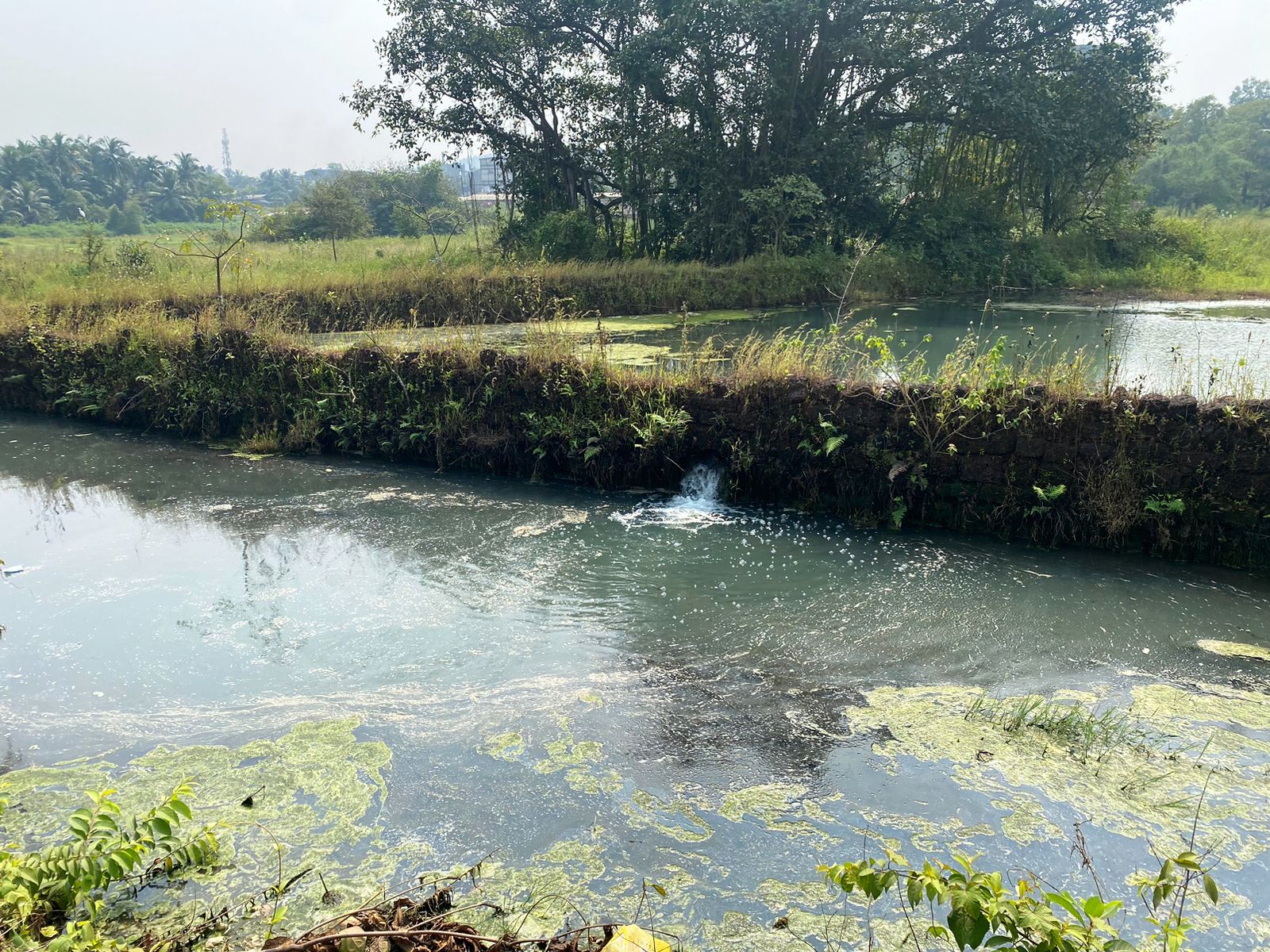
File photo of effluents finding its way from the IDC to adjoining water bodies.
MARGAO: The issue of pollution allegedly caused by fish meal and fish processing units has once again come under the spotlight. Earlier, a panel of the Goa State Pollution Control Board (GSPCB) had recommended the installation of an Online Effluent Monitoring System (OEMS) to enable continuous monitoring of effluent quality and ensure compliance with prescribed discharge standards.
This raises a key question: Have all fish meal and fish processing units complied with the GSPCB’s recommendation by installing the Online Effluent Monitoring System?
The concerns do not end there. In the absence of a Common Effluent Treatment Plant (CETP) at the Cuncolim Industrial Estate, questions are also being raised over whether the individual Effluent Treatment Plants (ETPs) installed by the units meet the pollution control norms laid down by the authorities.
In the past, fish processing and fish meal units had proposed transporting treated wastewater to the adjoining steel units operating within the industrial estate for reuse. However, in the wake of repeated allegations by local residents that effluents from the industrial estate are finding their way into nearby nullahs and water bodies, fresh concerns have surfaced over the effectiveness of the monitoring mechanism.
Questions are now being asked whether a fool proof system is in place to monitor the water consumption of individual units, the quantity of effluents generated, the efficiency of the treatment process, and the final disposal or reuse of treated wastewater. These issues assume significance amid growing demands for greater transparency and stricter enforcement of environmental norms at the industrial estate.