


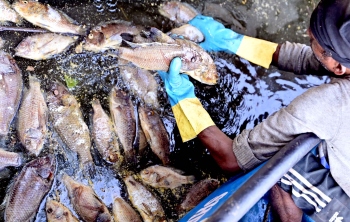
 Dead fish being cleared from the Mala lake on Monday. Captured by : Narayan Pissurlenkar
MAPUSA
Days after hundreds of dead fish surfaced in Mala lake, sending a foul stench across the locality, early findings from water samples collected by the Goa State Pollution Control Board (GSPCB) are beginning to point towards a familiar but troubling cause “ a possible crash in dissolved oxygen levels, often linked to pollution and stagnation.
While officials say a detailed laboratory analysis is still underway, preliminary assessments indicate that the fish kill may not be an isolated incident but a symptom of deeper stress in the urban water body.
“We are analysing multiple parameters, including dissolved oxygen, biochemical oxygen demand and presence of contaminants. The exact cause will be confirmed once results are finalised,” a senior GSPCB official said.
In a significant development, a joint inspection was carried out at the site on Monday by officials from the Goa State Pollution Control Board (GSPCB), the National Institute of Oceanography (NIO), and the Fisheries Department to conduct a detailed assessment and scientific analysis of the incident.
Pollution under scrutiny
The incident has turned the spotlight on potential pollution sources feeding into the lake. Residents have long complained about untreated sewage inflows, storm water runoff carrying waste and increasing urban pressure in the surrounding areas.
GSPCB officials confirmed that they are examining whether any direct or indirect discharge into the lake may have triggered the sudden drop in water quality.
“If there are any unauthorised discharges or violations, action will be taken as per law,” the official added, without specifying whether any sources have been identified so far.
The official said such fish kills are often linked to eutrophication “ where excess nutrients from sewage or waste lead to algal blooms that deplete oxygen in the water.
Was this preventable?
The episode has also triggered a larger question “ whether warning signs were missed.
Urban lakes typically show gradual deterioration before such events, including declining oxygen levels, visible pollution, or fish distress. Experts say routine monitoring and timely intervention could prevent sudden ecological collapse.
When asked whether Mala lake was under regular surveillance, GSPCB officials maintained that monitoring is carried out periodically but did not specify recent readings or trends.


