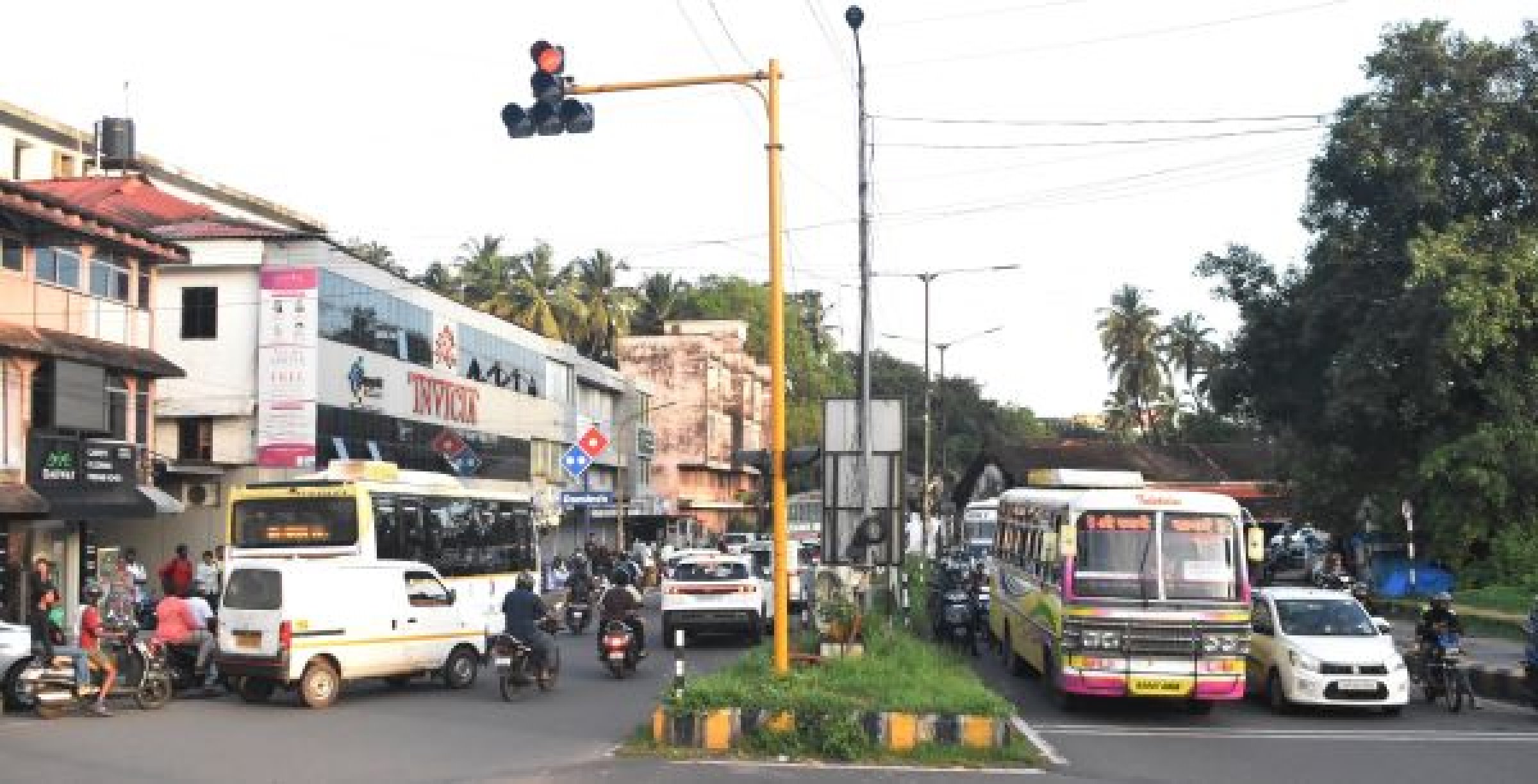
 The Old market circle junction at Margao being manned by the AI-powered traffic surveillance system. Santosh Mirajkar
MARGAO
Parents ferrying their children to and from schools on two-wheelers have begun feeling the heat of the AI-powered traffic surveillance cameras installed at key traffic junctions in and around the commercial capital.
While the cameras, introduced to detect traffic violations and ensure stricter enforcement of road safety rules, have caught a number of two-wheeler riders allegedly carrying three persons, others have reportedly started exploring alternative routes to avoid coming under the lens of the automated surveillance system.
The AI-powered enforcement drive has particularly left parents worried, as many of them routinely use two-wheelers to drop and pick up their children from school. For several families, the practice is less a matter of convenience and more an economic necessity, as hiring vehicles or using four-wheelers every day can significantly increase their monthly expenditure on fuel and transport.
The issue has assumed greater significance among families where both parents are working or where children are studying in different schools. In such cases, parents often plan their school trips in a manner that allows them to drop or pick up two children on the same journey.
However, with AI-powered cameras now automatically detecting triple riding, parents say they are being forced to reconsider an arrangement that had become part of their daily routine.
The problem is particularly acute during the morning school rush. A parent riding a two-wheeler with two school-going children may now face a traffic challan, leaving the family with little option but to either take the car out of the garage or make separate trips to drop the children.
Both alternatives, parents point out, come at an additional cost. For those with children studying in different schools, the situation becomes even more complicated in the afternoon. Parents who previously collected one child and waited for the other school's dispersal time before taking both children home together may now have to make separate journeys to remain within the rules.
The additional trips mean higher fuel consumption and more time spent on the road, adding to the financial and logistical burden on families.
Triple riding once
a common sight
Triple riding during school hours had, for years, been a familiar sight on the city's roads, particularly in the morning. Parents would often carry two children on a two-wheeler while dropping them at school.
Sources said the practice had largely been overlooked in the past, partly because of the practical difficulties faced by families who could not afford hired vehicles or did not own a car.
“By the time the police and the RTO assume office after 8 am, the parents used to drop their wards to school. Or, the police and the RTO officials used to turn a blind eye to triple riding considering the ground reality when parents cannot afford to send their wards in hired vehicles,” sources said.
With the cameras now monitoring important junctions such as Old Market Circle, the area near Nehru Stadium, Arlem Junction and the Power House Junction, riders violating provisions of the Motor Vehicles Act are finding it increasingly difficult to escape detection.
The enforcement has already resulted in a number of challans being issued to two-wheeler riders for triple riding.