


PANAJI
At a time when the State government has laid its focus on reviving Goa’s traditional salt pans, recent research revealing that the State’s natural solar salt is highly contaminated with microplastics (MPs) has raised serious concerns.
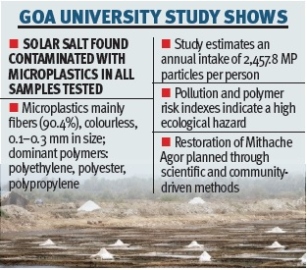
A study “Microplastic in solar salt: baselines contamination assessment from Goa, India” by the researchers from the Goa University, have concluded that on an average a person’s MP intake from salt consumption is around 2,457.8 particles.
The study said that there is critical evidence of MP contamination in natural solar salt and underscore the need for targeted mitigation strategies to minimise human exposure.
The research has been undertaken by Shritesh Mhapsekar, Niyati Kalangutkar of school of Earth, Ocean and Atmospheric Sciences and Nitesh Joshi of School of Chemical Sciences. The study has assessed MP contamination in salt harvested from solar salt pans downstream of Mandovi estuary.
According to the researchers, despite MPs in food pose potential health risks, their occurrence in solar salt remains underexplored.
During the course of their study, the experts analysed total eight salt samples, collected from the saltpan, using density separation, filtration, and FTIR spectroscopy. “MPs were detected in all samples, with concentrations ranging from 64.00 ± 1.89 to 106.67 ± 10.37 particles/ 100 g (mean: 84.17 ± 14.47 particles/100 g),” the study said.
The majority of MPs were within the 0.1“0.3 mm size range (49.21%), predominantly fibres (90.40%), and colourless (64.30%). The researchers observed that the Polyethylene (29.2%), polyester (20.8%), and polypropylene (16.7%) were the dominant polymer types found in the salt.
"The pollution load index (1.16) and polymer risk index (PRI > 1000) indicated a high ecological hazard (Level V),” it said further.
“Estimated annual MP intake from salt consumption was 2,457.8 particles per person. These findings provide critical evidence of MP contamination in natural solar salt and underscore the need for targeted mitigation strategies to minimise human exposure,” the study concluded.
The Goa Legislative Assembly had debated over the need to protect and revive the traditional salt pans and accordingly, the government announced its plan to draft a comprehensive policy to revive the State’s traditional salt pans “ locally known as Mithache Agor. It said that its restoration would be undertaken through scientific and community-driven collaboration.
The salt pans are also notified as biodiversity heritage.


