MAPUSA
With the Assembly elections less than eight months away, Goa has entered what can best be described as the season of political awakening.
Individuals who have spent years away from public issues are suddenly discovering a deep concern for the welfare of the people. Welfare offices are being inaugurated, cricket tournaments are being sponsored, promises are being made and lofty visions are being unveiled.
Like mushrooms that sprout overnight after the first rains, election aspirants are appearing across constituencies, each eager to convince voters that they alone hold the key to solving problems that have plagued their towns for decades.
Mapusa has become the latest stage for this familiar political theatre.
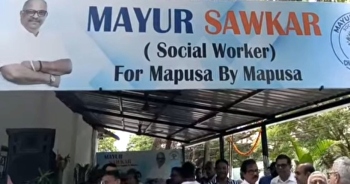
Former customs officer Mayur Sawkar has begun making all the right noises expected from a prospective candidate. Having recently organised a cricket tournament for the youth of Bardez, he on Monday inaugurated a welfare office in Mapusa in the presence of a few councillors, former councillors and supporters.
The message is clear: election preparations have begun.
At the inauguration, Sawkar highlighted issues that every resident of Mapusa already knows by heart “ traffic congestion, lack of parking, deteriorating infrastructure and the absence of a Ravindra Bhavan for over a decade. He also attempted to paint a picture of a constituency left behind while neighbouring areas marched ahead.
But the obvious question is: where were these concerns until now?
The problems of Mapusa did not emerge yesterday. The town has struggled with parking shortages, traffic chaos, crumbling infrastructure and poor planning for years. Yet it is only on the eve of elections that these issues suddenly become rallying points for aspiring politicians seeking public attention.
Perhaps the most ambitious promise was the claim that land has already been identified for a parking project and that the issue would be resolved if elected. Such declarations may sound attractive to frustrated residents, but they conveniently ignore the realities of governance. Finding a vacant plot on paper and actually creating a parking facility in a densely populated urban centre are two entirely different matters.
Land ownership disputes, government clearances, financial allocations and bureaucratic hurdles have derailed far simpler projects in the past.
Election-time promises are easy. Implementation is where reality begins.
The criticism of road conditions was equally predictable. According to Sawkar, roads remained neglected for four-and-a-half years and are being repaired only because elections are approaching. While there may be some truth in the observation, it is also a well-worn political script employed by challengers across the country every election season.
As elections draw closer, voters can expect a parade of aspiring candidates suddenly opening offices, sponsoring events, distributing assistance, highlighting civic issues and presenting themselves as saviours of the constituency.
For the electorate, the challenge is to separate genuine commitment from election-season opportunism.
The true measure of public service is not the number of welfare offices opened a few months before elections, nor the number of tournaments sponsored, nor the promises made from temporary stages. It is sustained engagement with public issues long before votes are sought.
Unfortunately, every election season produces a fresh crop of self-proclaimed messiahs who discover the people's problems only when they begin searching for the people's votes.