


the goan I network
PANAJI
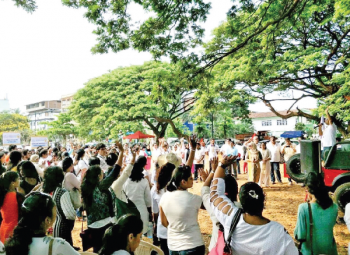
In solidarity with their national counterparts, the All Goa Government Recognized Unaided Schools Association (AGGRUSA) on Saturday held a peaceful rally in the capital city calling for a reform in education.
Stakeholders including educationists, parents and students joined the rally from various towns and culminated at the Parade ground in Panaji to raise a collective voice in support of reform in education policies.
“An issue that hasn’t affected Goa yet, but it has affected schools across the country, which will also be implemented in Goa in the future is the 25% reservation of seats rule. We are not running away from our responsibility. It is a good initiative, but if a school blocks 25% of the seats, it messes up the whole system,” Abhay Mathur, Principal, Sunshine Worldwide School said.
He added, “It will mean the other children will have to cover the cost of education for the children who cannot afford education and it puts pressure on finances. Schools may not be able to invest in their own up-gradation. 25% seats have to be reserved, but let the cost be refundable.”
On Saturday morning, over one lakh education stakeholders representing government recognized unaided schools from across the country united and gathered in New Delhi, to call on the Prime Minister of India, Narendra Modi and voice their collective concerns on the education sector.
Deepak Khaitan, founder member of AGGRUSA and Aparna Palyekar, president, AGGRUSA are representing Goa at the national gathering of stakeholders in New Delhi.
“It is not easy to run a school. Documentation is extensive. There are several documents and permissions required and in some cases documents that are required need to be changed as the norms change. We are in a country where we require schools. We request the government to please create a single window clearance where work can be done in a time-bound manner. There should be one rule which applies to all schools,” said Nirmesh Tyagi the director of Edify School.
“The second issue is the choice of boards. Every school from any board requires re-recognition after every three years. Schools follow the norms of the board, yet why is re-recognition required every three years? The process requires a lot of paperwork and follow-ups. We request the government to look into these two issues that schools face,” Tyagi added.


