MAPUSA
For many Goans, particularly those living in tourism-heavy belts like Calangute, Baga, Anjuna, Vagator, Siolim and Morjim, rash driving by tourists has almost become a seasonal hazard.
Residents frequently complain of tourists speeding on narrow village roads, riding motorcycles without helmets, driving on the wrong side, overtaking dangerously and, in several cases, allegedly driving after consuming alcohol.
Ironically, while Goa’s tourism economy thrives on mobility and easy transport access, the unchecked growth of the rent-a-car and rent-a-bike sector appears to have created a dangerous grey area where enforcement often struggles to keep pace with violations.
Questions are now being raised whether the State government needs to seriously revisit the policy governing self-drive rental vehicles before more innocent lives are lost.
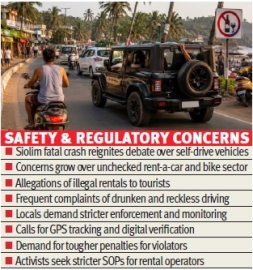
The latest Siolim fatal accident has reignited concerns because allegations suggest that the Thar involved may have been illegally handed over for tourist use.
Significantly, this is not the first such case reported from the same belt.
In October last year, another tourist-driven rented Thar allegedly rammed into a scooter in Siolim, injuring a woman and sparking outrage among locals, who claimed the occupants were drunk and had been driving recklessly.
Demands for stricter scrutiny
Such recurring incidents have intensified demands for stricter scrutiny of rent-a-car operators. While many operators function legally, concerns persist over unauthorised rentals, vehicles being handed over without proper verification, and inadequate monitoring of drivers once vehicles are rented out.
Several locals argue that some tourists treat Goa’s roads like “holiday playgrounds”, often ignoring traffic rules that they would otherwise follow in their home states.
“As people often say, many tourists come to Goa believing they can get away with anything. For the government they may be treated as ‘Atithi Devo Bhava’, but for locals, drunk and reckless tourists on the roads have increasingly become a nuisance and a threat to our lives,” said Elvira Fernandes, a resident of Siolim.
The issue also exposes a deeper enforcement challenge. Despite periodic traffic drives and nakabandis, drunken driving continues to remain rampant in several coastal areas, especially during weekends and late-night hours. Police regularly conduct checks, yet many believe enforcement still lacks the deterrence necessary to instill fear among habitual violators.
Road safety activists say Goa may need a stronger regulatory framework specifically for self-drive tourism vehicles. Suggestions being increasingly discussed include mandatory GPS monitoring for rent-a-cars, stricter digital verification of renters, compulsory breathalyzer checks in nightlife zones, blacklisting of repeat offenders and suspension of licences of operators found violating norms.
There is also growing sentiment that penalties for drunken and rash driving involving tourists should be made far more stringent. Locals argue that unless arrests, licence suspensions, heavy fines and fast-track prosecution become routine, reckless driving will continue unabated.
“The rent-a-car and rent-a-bike sector requires far stricter regulation and monitoring. The Transport Department must introduce proper SOPs to ensure accountability and tracking of vehicles. Simple measures like installing dash cameras in rental vehicles can help record driver behaviour and improve enforcement,” said Roland Martins, Coordinator of GOACAN and a member of the State Road Safety Committee.
Joint efforts to tackle menace
Martins further said that the responsibility of addressing the issue should not rest solely with the Transport Department. He stressed that local panchayats, the Tourism Department and other stakeholders must also be involved in framing policies and enforcement mechanisms to tackle the growing menace of reckless tourist driving in Goa.
The larger concern is that innocent road users “ many of them local residents commuting for work or daily errands “ are paying the price for weak enforcement and regulatory loopholes.
Goa’s roads, particularly in tourist hotspots, are increasingly witnessing a dangerous mix of heavy traffic, high-powered rented vehicles, alcohol consumption and inadequate road discipline.
Tourism remains Goa’s economic backbone, but residents insist that tourism cannot come at the cost of public safety.