MAPUSA
In a State where construction, loading, shifting and other manual jobs increasingly depend on migrant labour, some village panchayats have begun taking an unusual step – fixing daily wage rates for labourers and publicly displaying them.
But the move has raised a larger question: do panchayats have the legal authority to fix labour wages, or are they stepping into an area governed by the State’s labour authorities?
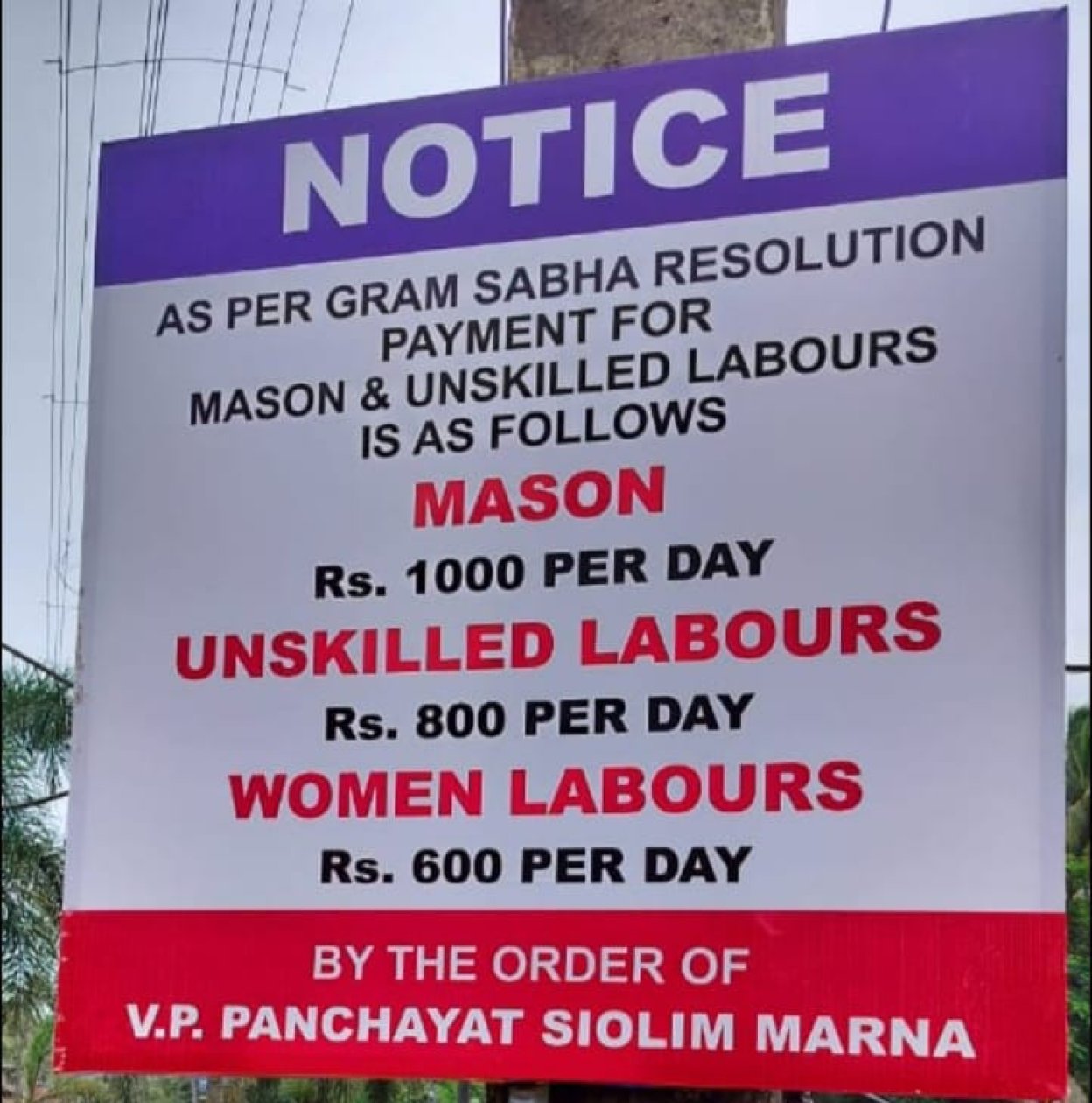
Siolim-Marna is among the panchayats that has put up public notice boards displaying daily wage rates for labourers. One such board has been installed at the Old Theatre Junction and another at the Church Junction, informing residents and workers about the rates decided by the panchayat.
The issue of labour rates is discussed at gram sabhas, following which resolutions are adopted and the rates displayed publicly.
The practical and legal implications of the exercise, however, came under scrutiny at Sunday’s gram sabha.
Local resident Gregory D’Souza sought to know whether the panchayat had consulted the Labour Commissioner before fixing the rates.
“Have you taken the Labour Commissioner’s view on fixing the daily wage rates?” D’Souza asked.
Deputy Sarpanch Sandesh Hadfadkar said the panchayat had written to the Labour Commissioner several weeks ago seeking his views, but was yet to receive a response.
The issue assumes significance in Goa where the availability and cost of manual labour has become a growing concern for residents, builders and contractors. With very few Goans engaged in several forms of manual labour, the construction and other sectors have come to rely heavily on migrant workers.
The result has been a largely informal labour market in which wages are often negotiated directly between workers and employers and can vary depending on the nature of work, demand and availability of labour.
Against this backdrop, the panchayats’ decision to display locally fixed wage rates raises questions over whether such boards can actually regulate what a worker can charge or an employer can pay.
While the boards may serve as a reference for residents and help bring some transparency to wage negotiations, their legal enforceability and relationship with the minimum wages prescribed by the competent labour authority remain unclear.
The Siolim-Marna gram sabha’s decision to seek the Labour Commissioner’s opinion could therefore prove significant, particularly if more panchayats across Goa are adopting similar resolutions.