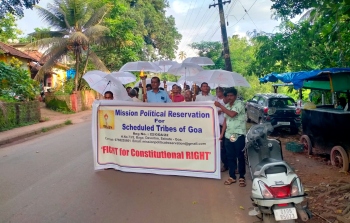
The issue of political reservations and a quota of seats from the 40 in the Goa legislative assembly for the Scheduled Tribe communities have evoked much debate and discussion over the last couple of months. The Goa legislative assembly even passed a resolution espousing the demand unanimously. Yet, more than 20 years after they got the status of Scheduled Tribes, the community is still languishing without their Constitutional right of a quota of seats at the highest political level -- the State Legislature. The Goan dissects the issue, its history and the likely way forward for the ST communities to achieve the goal of political reservation before the next assembly election due in 2027.
PANAJI
It was in 2003, when the Schedule Tribe (ST) status was granted to three communities “ Gawda, Kunbi and Velip from Goa. As per the Census 2011, 10.23 per cent of the State population comprises of STs and as such the community is entitled to four seats in the 40-member State Legislative Assembly as per Article 332 (3) of the Constitution of India, that clearly defines that reservation of seats in the State Assemblies must be made on the basis of the percentage of the population of the STs in the particular State.
Despite their Constitutional Rights, the ST community has been deprived of political reservation for the last 20 years. Even after several representations, protests, their voices have remained unheard with any tangible action from the State government.
The latest communication from the Legislative Department “ Government of India informing about freezing the reservation policy till 2026 has sparked debate with uncertainty loomed over the political reservation to STs for now.
Further, the 84th Constitutional amendment with regards to all the reservations and readjustment of seats for other classes being freezed till the figures of the next census is out after 2026, has led experts differing their views on its interpretation and whether it can have impact on what ST’s are demanding in Goa.
Article 330 of the Indian Constitution
Provides for the reservation of seats for Scheduled Castes and Scheduled Tribes in the House of the People.
Article 332 of the Indian Constitution
Seats shall be reserved for the SC and ST in the legislative assembly of every State.
84th Amendment of the Indian Constitution
The 84th Amendment of the Indian Constitution was brought about on February 21, 2002. It brought the amendment of articles 55, 81, 82, 170, 330, and 332 of the Indian Constitution. The constitution was specifically amended not to have inter-state delimitation of constituencies till the first census conducted after the year 2026. Thus, the present constituencies carved out on the basis of the 2001 census shall continue to be in operation till then.
According to the 84th Amendment Act, the constituency borders were frozen until the first census after 2026, or at least until after 2031.
Opportunities lost by State
According to the tribal leaders, soon after the 2011 census that counted over 49,200 ST people the Government had an opportunity to recommend reserving seats in the 2012 Assembly election. However, no steps were initiated despite efforts from the tribal community.
It is also learnt that in August 2013, the President of India promulgated an Ordinance titled ‘Readjustment and Reorientation of Scheduled Caste (SC) and Scheduled Tribes (STs) in Parliamentary and Assembly Constituencies (Second) Ordinance 2013’.
Based on the aforesaid Ordinance, the Election Commission of India (ECI) had started the process to give political reservation to STs of Goa. However, the State government did not follow up on the implementation of the Ordinance and it eventually lapsed. Because of this, the ECI of India failed to notify the ordinance for Goa.
In January, this year, the Parliamentary Committee on Welfare of Scheduled Caste (SC) and Scheduled Tribes (ST) recommended that five of the 40 constituencies in Goa Assembly be reserved for STs and two for Scheduled Castes (SC). Though the State government was asked to submit the proposal to this effect at the earliest, it was only in May that the State Tribal Department recommended reserving four seats for ST in the Goa assembly by constituting a delimitation commission, based on the 2011 Census data.
According to Adv John Fernandes, the advisor to ST community group, following a writ petition filed in 2007 by tribal leader and former MLA Late Antonio Gauncar, the Supreme Court had directed the Election Commission of India (ECI) to consider and decide on petition prayers for reservation within eight months.
He also pointed out that following 84th Constitutional amendment, Supreme Court in case of Uttar Pradesh had stated that it is their constitutional right to get political reservation and hence the government should not wait for delimitation for its implementation.
Experts differ on what lies ahead
1) Only Further Constitutional Amendment way forward
Former law Commissioner and Union Minister Ramakant Khalap, who studied the 84th amendment in detail, opines that the Parliament will have to further amend the Constitution, for Goa and consider it as a special case.
“I don’t think any Ordinance or Resolution by Goa Assembly will have any standing as far as Constitutional Amendment is concerned. What I could see is, if there is a political will, both Lok Sabha and Rajya Sabha should unanimously bring in a Constitutional Amendment, to keep Goa out of the purview of 84th Amendment as a special case,” he explained.
“With Lok Sabha polls coming soon, I don’t think opposition parties will have any issue,” he added.
He said that through 84th Constitutional amendment, all the reservations and readjustment of seats for other classes are freezed till the figures of the next census is out after 2026. There has been an amendment to Article 330 and 332.
“These amendments are not related to only readjustment of seats or delimitation of seats but also with regards to reservation of seats within the existing number of seats,” he said.
2) If “Mere Notification” can work for J&K, Nagaland and Arunachal Pradesh, Why not Goa?
Adv John Fernandes, the advisor to Mission Political Reservation for ST, informed that Legislative Department “ Government of India had issued a notification on March 6, 2020 under Section 3 of the Delimitation Act 2002 to form a Delimitation Commission and grant reservation to ST community there. The notification was issued, over-powering the 84th Constitutional Amendment.
“Why can’t a similar principle be applicable to Goa? We are not even asking for readjustment of seats. What we are asking is reservation within 40 Assembly seats,” he said.
“I don’t understand why constitutional crises arise when it comes to Goa and not in the case of these North Eastern States? If we are a law abiding nation, then Law needs to be equal to all,” he said.
He said that when the Legislative Department can grant reservations to these States based on the 2011 census, then why Goa has to wait for census data to be conducted after 2026?
In 2014, delimitation and reservation was done in UP and in 2020 in J&K while the process is on-going for Assam, as the ECI has commenced the process just this year.
The reservation was also given in the north-eastern States like Arunachal, Assam, Manipur and Nagaland through notifications post 2002.
3) Political Reservation can be decided rationally through Delimitation Commission & will have to wait till it is set up
According to former State Election Commissioner Prabhakar Timble, the political reservations in the State Assembly are to be rationally decided by the Delimitation Commission, which is an independent body and has similar powers to that of Election Commission of India.
The Commission has to be set up to arrive at the number of seats to be reserved and identify the constituencies to be reserved, based on the ST population in those assembly seats.
The last Delimitation Commission, which was constituted in 2002, to fix the boundaries for State Assembly constituencies and Parliamentary seats, lasted until May 31, 2008.
The delimitation orders issued by the Commission were given effect from 19 February 2008 for most states and union territories and 20 March 2008 for Tripura and Meghalaya, by a presidential order. At that point, the delimitation of four North-Eastern States was deferred due to security risks by four separate presidential orders.
The final report of the Delimitation Commission takes five years, following which it has to be approved by the Cabinet and the President. The findings of the Commission are placed in Lok Sabha and concerned State Assemblies.