


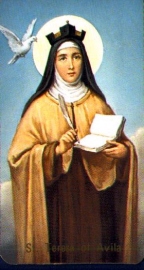
The Catholic Church celebrates the feast of St Teresa of Avila on October 15. While proclaiming her as the first woman Doctor of the Church on September 27, 1970, Pope Paul VI selected one of her many titles as the basis for conferring that honour on her: Teresa of Avila, Teacher of Prayer.
Her vocation and mission was prayer and her spirituality have inspired many in Goa through the centuries.
Then Archbishop of Goa, Dom Cristobal de Sa Lisboa, had a deep devotion to Blessed Teresa of Jesus and permitted the Carmelites in Goa in 1620 at the request of Carmelite Fr Leander of the Annunciation, who lived in the life time of St Teresa. He was the first superior of the Convento Do Carmo at Old Goa.
During one solemn celebration, the archbishop wanted statues of saints to be carried in the Procession of Saints at Goa Velha and the statue of Teresa of Jesus, who had been beatified in 1614, was included in the procession.
St Teresa reformed the ancient Carmelite Order and became the foundress of the Teresian Carmelite, besides founding 17 Cloistered Carmels.
There is a Cloistered Carmelite convent in Chicalim and three communities (Margao, Xellim and Mapusa) of the Carmelite Friars, who live the spirituality of St Teresa.
The Pilar Monastery also has a side altar dedicated to Our Lady of Mount Carmel, where a statue of St Teresa of Jesus is placed by the side. It is probable that the statue might have placed by the Carmelites Tertiaries.
The Canacona Church is also dedicated to St Teresa of Jesus. The Carmelite Seminary at Peddem-Mapusa has St Teresa of Jesus as its patroness.
Life of prayer
In all her major writings, The Life, The Way of Perfection and The Interior Castle, she teaches people how to pray. Her teaching flows from her own experience and not from books on prayer, as she began writing on prayer at the age of 47.
In the first two books, ‘The Life’ and ‘The Way of perfection’, St Teresa concentrates on the ascetical grades of prayer, but in ‘The Interior Castle’, she describes the mystical grades of prayer.
After realising that all of us do not travel by the same path to perfection and that, God leads us by different paths, St Teresa gives us different grades of prayers so that we can grow in relationship with the Almighty.
In her first book ‘The Life’, St Teresa explains the grades of prayer by using the symbol of "four waters."
The first method is by drawing water from a well by means of a bucket attached to a rope. This first stage of prayer includes vocal prayer and discursive meditation. The individual is active, exercising the faculties and getting benefits he/she can through one's own efforts.
The second method of watering a garden is by means of a waterwheel, to which dippers are attached. St Teresa explains that this stage is the Prayer of Quiet and signals to an entrance into supernatural prayer.
The third type of watering a garden is by irrigation by means of a running stream. It doesn't call for human effort, as in two previous methods. Prayer at this stage is mystical, that is, all faculties are centred on God.
The fourth and final method for watering a garden is by means of falling rain. This stage of prayer is totally mystical, meaning that it is infused by God and is not attained by human effort.
In ‘The Way of Perfection’, St Teresa tries to distinguish between prayer of active recollection and prayer of infused recollection.
Even in the book, ‘The Interior Castle’, St Teresa identifies seven stages of prayer which consists of ascetical prayer and various degrees of mystical prayer.
(The writer is a member of Karnataka-Goa province of the Order of Discalced Carmelite and based at the Carmelite Monastery, Margao)


