GUILHERME ALMEIDA
MARGAO
The implementation of the Solid Waste Management Rules, 2026, faces a crucial test in Goa’s commercial capital and the outskirts of Salcete as the taluka-level and district-level committees, constituted in compliance with Supreme Court directions, prepare to hit the ground.
Beginning Monday, the taluka-level teams will launch inspections of illegal waste dumping sites and other garbage black spots across the taluka. The teams have been mandated to issue directions for the immediate removal and scientific disposal of waste found at such locations.
The inspections are part of a drive to strengthen the enforcement of the Solid Waste Management Rules, 2016, and the Amendment Rules, 2026. Operating under the supervision of the taluka-level and district-level committees, the teams will monitor compliance with the waste management regulations and recommend corrective measures wherever necessary.
Besides inspecting illegal dumping sites, the committees will also assess the functioning of Material Recovery Facilities (MRFs) and other waste management infrastructure in their respective jurisdictions to ensure compliance with the prescribed norms and improve the overall waste management system.
In Salcete, the taluka-level team will be headed by Sub-Divisional Magistrate and Deputy Collector Ganesh Barve. The panel comprises the Taluka Mamlatdar, Block Development Officer and other officials from the concerned departments.
The inspections will be undertaken simultaneously in both South Goa and Kushavati districts, following a decision taken at a review meeting chaired by South Goa District Collector Egna Cleetus last week.
Speaking to The Goan, Salcete Taluka-Level Committee Chairman Ganesh Barve said the team would fan out across the taluka to inspect identified black spots and illegal dumping sites.
“The committee will inspect various locations, identify garbage black spots and illegal dumping grounds, and submit a detailed report to the district-level committee for further action,” Barve said.
The constitution of these committees has raised hopes that a coordinated enforcement mechanism, backed by the Supreme Court’s directions, could finally provide a much-needed push towards addressing the long-pending issue of indiscriminate waste disposal and improving solid waste management across the State.
31 bulk waste generators under
scanner; MMC yet to crack whip
MARGAO: Whether due to political interference or administrative inertia, the Margao Municipal Council (MMC) has failed to act on a list of bulk waste generators compiled more than a year and a half ago.
In accordance with the Solid Waste Management Rules 2026, which define a bulk waste generator as an establishment producing 100 kg or more of solid waste per day, the civic body has now identified 31 bulk waste generators operating within the commercial capital. The list includes two hospitals, among them the Hospicio South Goa District Hospital.
A closer look at the list reveals that the majority of the identified bulk waste generators are hotels and restaurants, besides the two hospitals. Sources said that some of these establishments generate more than 150 kg of solid waste daily, well above the threshold prescribed under the rules.
Although the MMC has completed the exercise of identifying the bulk waste generators, the civic body is yet to ensure compliance with the Solid Waste Management Rules, which mandate that such generators collect, transport and process the waste generated by them in an environmentally sound manner.
The delay in enforcing the rules has raised questions in the corridors of the Municipal building, with officials and observers asking when the civic body will finally crack the whip on the identified bulk waste generators and ensure that they fulfil their statutory obligations.
Who are bulk waste generators
Bulk waste generators include entities with a floor area of 20,000 square metres or more, or water consumption of 40,000 litres per day or more, or solid waste generation of 100 kg per day or more. These include Central and State government departments, local bodies, public sector undertakings, institutions, commercial establishments and residential societies, among others.
4-bin rule raises question: Who will foot the bill?
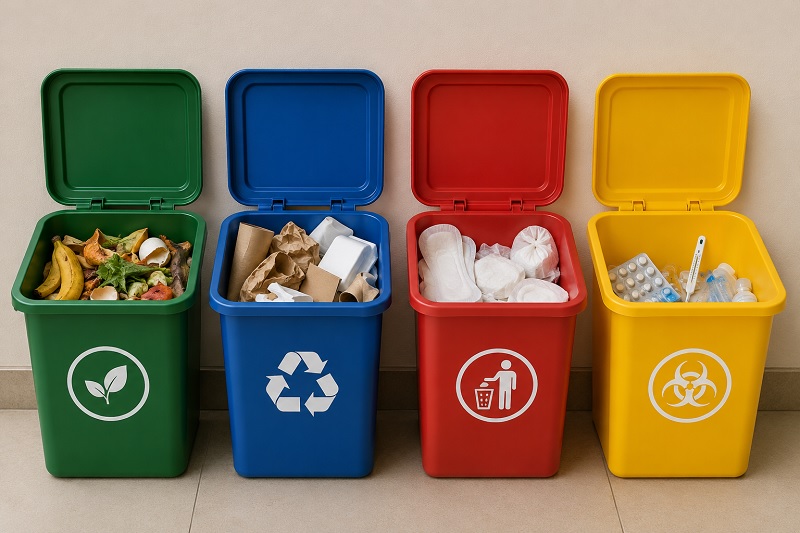
MARGAO: With the four-stream segregation of solid waste at source—wet waste, dry waste, sanitary waste and special care waste—made mandatory under the Solid Waste Management (SWM) Rules, 2026, a key question has emerged: Who will bear the cost of providing separate bins for every household?
The issue came to the fore during a recent PowerPoint presentation by a Goa State Urban Development Agency (GSUDA) resource person before civic officials and stakeholders at the Margao Municipal Council.
When asked whether the municipal body would provide separate bins or whether households would have to purchase them, the resource person made it clear that individual households would be responsible for arranging the bins at their own expense.
The response triggered a debate among those present, with several questioning whether residents would be willing to invest in multiple bins, especially when bins distributed free of cost by GSUDA in the past were not used for their intended purpose.
During the tenure of former Director of Municipal Administration Elvis Gomes, GSUDA had procured and distributed thousands of bins to households to facilitate the segregation of wet and dry waste at source. However, the initiative failed to achieve the desired results, with many households either not using the bins for waste segregation or eventually disposing them as scrap after years of wear and tear.
The discussion has now raised a larger question over the implementation of the SWM Rules, 2026. If households are reluctant to purchase separate bins, will the government once again step in to supply them free of cost to ensure effective segregation at source, or will the burden rest entirely on citizens?
Benaulim approves CCTVs to tackle roadside dumping
MARGAO: Even as the taluka-level inspection team prepared to inspect black spots and waste dumping sites across Salcete, members of the Benaulim gram sabha on Sunday raised serious concerns over the persistent problem of roadside waste dumping by unscrupulous elements in the village.
Describing the issue as alarming, several gram sabha members strongly advocated the installation of high-end Closed Circuit Television (CCTV) surveillance cameras at vulnerable locations to deter offenders and curb indiscriminate dumping.
Responding to the growing concern, the gram sabha approved the procurement of around 20 CCTV cameras in the initial phase to cover waste dumping hotspots across the village’s 11 wards.
Despite the panchayat having established a wet waste collection facility near the panchayat ghar, members pointed out that mixed waste continues to be dumped at the site almost every day, undermining waste segregation efforts.
Speaking to the media after the meeting, gram sabha member Rudolf Barretto said the demand for surveillance cameras had come from residents across the village.