


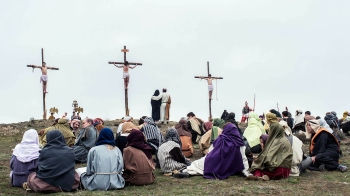
Good Friday renews the Old Testament where animal sacrifice was the way out for the atonement of sins of humanity. Our salvation was paid for by Jesus’ death on the cross once and for all, and through his blood (Matt 26:28) He has reconciled us with the Father. For God so loved the world that he gave his one and only Son, that whoever believes in him shall not perish but have eternal life” (Jn 3:16). As early as the first century, this day is observed as a day of penance and fasting; there is no Eucharistic celebration, instead, the church marks the sombre day with a service of the Passion of Our Lord at 3 pm - the time that Jesus died on the cross at Golgotha. Altars are left bare and the door of the empty tabernacle stands open, to emphasise the grief over the sacrifice of Christ.
The service has three parts: the Liturgy of the Word, the Veneration of the Cross, and Holy Communion. The priests robed in purple arrive for the service silently and they then make a full prostration. In the first part, readings from the Old and New Testaments are taken, followed by the rendition of the passion of Jesus taken from the Gospel of St John. This is followed by a homily on the sufferings of Christ. After the service, the crucifix, which until this time has been covered with a cloth, is unveiled and the faithful come in a procession to venerate it, a tradition that is being followed since the 7th century. Finally, the Holy Communion is distributed to the congregation.
In many Churches, a custom followed since Portuguese times called a paraliturgical service is held. A purple curtain behind the altar is drawn apart and the congregation gets a view of a life-size statue of Christ nailed to the cross. Two deacons dressed in old Jewish costumes, climb ladders to the top of the cross and unfasten and lower the body which is placed in a casket, and the faithful move from the Church in an orderly procession. The members of the confraternity take up the casket on their shoulders; others shoulder a statue of Mother Mary and follow the people. The environment is solemn with faithful reciting the rosary followed by the singing of Motets - mournful hymns narrating the crucifixion and death of Christ. After the procession returns to the church, there is another sermon called Sermao de Soledade (solitude) - the one that focuses on Mary and her standing alone at the foot of the cross watching her son breathe his last on it. The service ends with devotees kissing the body of Christ and Mother Mary.
The Procession of Capas Magnas
Good Friday has a lot of traditions and rituals. Among them is the “Procession of Tails” or Capas Magnas, which was started in 1534 by the Chapter of the Se Cathedral- a magnificent structure in Tuscan architecture built by the Dominicans in the early 17th century. Ordered to be built by Dom Alfonso de Albuquerque to commemorate his victory over the Bijapur Sultanate on the feast day of St Catherine of Alexandria (25 November 1510), Se Cathedral is the church of the Archbishop of Goa. The procession is unique, it is held nowhere else in the world except in the Se Cathedral in Old Goa and at St Peter’s Basilica in Rome.
The archbishop and Canons (Cónegos in Portuguese) of the Chapter of the Cathedral or Cabido wear black cowled robes with tails that trail two metres behind them in what is officially called the “Procissaum das Capas Magnas” (Procession of the Great Capes). The cloaks also have pink hoods which are worn by the canons giving them a sombre look. Only the canons’ face is visible below the hood. The long cloak resembles a tail which in Konkani is called ‘xempdi’ and that’s how the procession gets its name Xempddechem Pursanv.
During the service of the Passion of Christ, the rattle of wooden clappers announces the procession. Since no bells are tolled from the evening of Maundy Thursday, a wooden clapper with iron rings rattling is used to announce the rituals. The procession starts from the sacristy and the body of Christ is brought to the altar. In the background, the choir sings motets/ penitential hymns - vocal compositions of the sufferings of Jesus. The devotees line up on either side while the procession winds its way past the four corners of the Cathedral. The procession moves slowly recounting the ordeal Jesus went through at Calvary and how he suffered and was crucified at Golgotha. The devotees pay obeisance and kiss the shroud on the cross or the body of Jesus placed in the coffin carried by the Confrads on their shoulders.
The procession ends near the tomb at one of the altars where the coffin is placed at the foot of the wooden cross. The Archbishop and canons kiss the feet of Jesus and the others follow at the end of this service. The devotees are mostly from the surrounding villages that throng Old Goa to witness the procession on Good Friday.


