International Literacy Day
The world has moved from paper to screens, from queues to clicks and from phone calls to apps. But while technology has made everyday tasks faster, it has also created a new learning curve, particularly for those who did not grow up with it. As we mark International Literacy Day, literacy is no longer limited to knowing just how to read and write. Being able to send and receive messages, make a digital payment, or even dial a number and make a call are all part of navigating today’s digital world. Goa was declared a 100 per cent literate state in May 2025, but while its population may be able to read and write, a different concern emerges as more everyday functions move online. From banking and government services to shopping, making appointments and sending gifts across the world, digital services are becoming an increasingly integral part of everyday life. For those who did not grow up with smartphones and the internet, however, keeping pace with this shift can be a challenge.
Ageing population
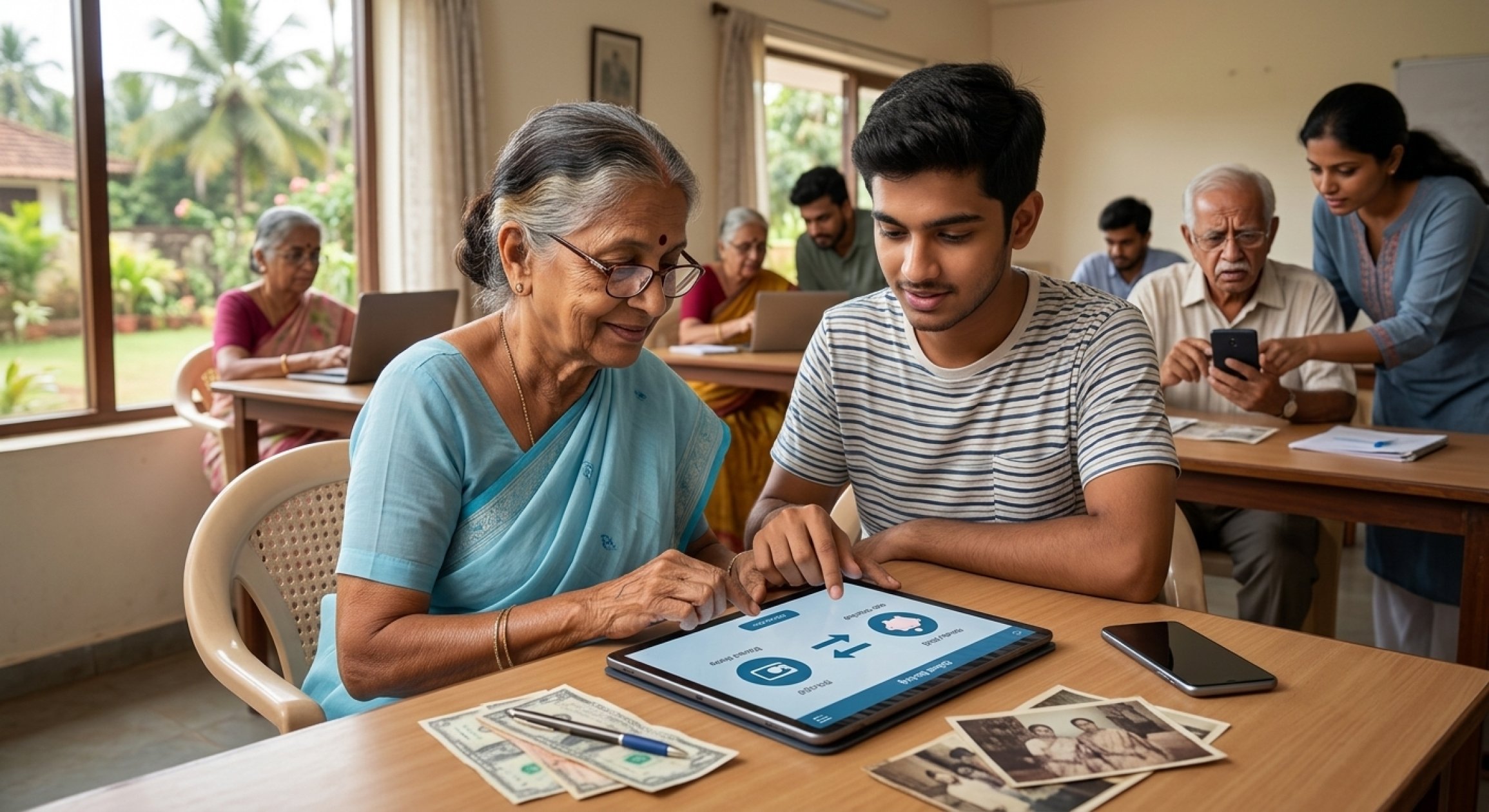
With Goa’s ageing population, the question of digital literacy among senior citizens needs closer attention. As more services move online, not knowing how to navigate the digital world can leave the elderly more vulnerable to scams and fraud. Often, lacking the knowledge or someone to turn to for help can lead to consequences that are difficult to undo. So, while Goa may have been declared 100 per cent literate, the question remains: is the state digitally literate enough to protect its elderly from being drawn into bigger and more dangerous problems?
The simple answer is perhaps no. While various efforts, including workshops and digital support initiatives, are being undertaken, the challenges continue to persist. A 2025 HelpAge India report found that while 71 per cent of elders surveyed used basic mobile phones, only 41 per cent owned smartphones, while just 13 per cent used computers, the internet or social media. Although they are not specific to Goa, the scenario is not very different.
Seeking assistance
Daya Bhobe, who is part of the recently started Matruseva, which offers services for senior citizens, observes that many elderly people continue to depend on their children or others for their digital needs. “I have mostly observed that many times, their (the senior citizens’) children handle their digital tasks, or the senior citizens go to do the task physically,” she remarks. According to her, the number of senior citizens who independently handle their digital tasks remains very small. “Barring exceptions, they usually prefer to actually go there physically and complete it,” she says.
This dependence is also evident when senior citizens have to deal with routine payments and other essential services. Roland Martins, Coordinator of GOACAN and member of the Goa State Consumer Protection Council, shares similar observations. “Senior citizens have to pay various bills, electricity, water supply, among others. They do not know how to do it, and many struggle,” he explains. He adds that he has often seen senior citizens seeking help from strangers at ATMs, bill payment counters, and other places simply to understand what they need to do.
Fear of fraud
For some, however, the hesitation goes beyond simply not knowing how to use technology. “I have a phone, but if I have to use it, someone needs to teach me first. I think that will be an inconvenience for everybody, so I tell my grandson to do it,” says Savita Pai, a senior citizen from Panaji. “And you hear so many scams in the news these days, so I feel scared sometimes to use the phone,” she adds. Her fear also points to another concern, with senior citizens unfamiliar with online banking and other digital services being more vulnerable to cyber fraud. “When senior citizens use online banking services, they are more exposed to fraudsters who are active online,” says Martins. He suggests having a nodal official to assist senior citizens at banks and government departments, along with greater awareness programmes on cybercrime at village panchayat and municipal levels.
Bridging the gap
Bhobe observes that awareness created through various media has made many senior citizens cautious, but it has not necessarily made them digitally independent. “Many of the elderly people do not respond to messages and calls from unknown numbers due to fear.” Martins, however, feels more needs to be done to bridge this gap. “The funds available with Government Departments & Corporations for conducting ‘digital literacy programs with a focus on capacity building’ are not being spent on senior citizens of the rural areas of Goa,” he says. “Considering the higher percentage of senior citizens in Goa, it is important that this gap is addressed on priority,” he reckons.
For Goa’s senior citizens, going digital is not simply about learning how to use a smartphone. It is about having the confidence to make a payment, access a service or respond to a message without having to depend on someone else. As more aspects of everyday life move online, bridging this gap will require patience, awareness and support that reaches beyond the cities and into Goa’s villages. Being fully literate may be an achievement, but ensuring that senior citizens can confidently navigate the digital world is the next challenge.