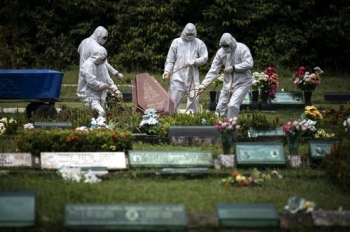
The pandemic has reached a grim milestone: one million people have now died of Covid-19, according to Worldometers. And after so many months, however, we have merely skimmed the surface of all there is to know about this perplexing pathogen. So much remains a mystery. Here are some key questions that yet remain unanswered.
How did Sars-CoV-2 enter the human population?
We must understand how Sars-CoV-2-like viruses jump into humans if we are to stop the next pandemic, as we do for influenza. Although originally thought to have emerged in the Huanan Seafood Wholesale Market in December 2019, the earliest patient had no link to the market suggesting the virus had emerged before then. How did this happen?
Also, Sars-CoV-2 has already spread to cats, dogs, tigers and mink. With increased contact between humans and wildlife, zoonoses are becoming an ever-growing threat.
How can we tell if someone is protected from Sars-CoV-2?
The immune response to Sars-CoV-2 aims to eliminate the virus from the body. Many studies have carefully described the various stages of the immune response after initial infection, but we do not know which aspects of immunity are essential for preventing repeat infections. What are the relative roles of different types of antibodies, or the importance of different T cell subsets?
The ability to measure an accurate correlate of protection would be valuable for two reasons. First, it could tell us whether someone who has recovered from COVID-19 is likely to get re-infected. Second, identifying an easily measurable correlate of protection would be helpful for vaccine trials “ it could speed up the evaluation of vaccine efficacy.
However, this has proven notoriously difficult.
How can we explain extreme geographical variation in mortality rates?
Cumulative deaths from Covid per million of population (dpm), are very unevenly distributed across continents, notably south-east Asian countries. Could the populations of low mortality countries have some cross-immunity to Sars-CoV-2 generated by recent exposure to another coronavirus “ the obvious candidates being the milder “common cold” coronaviruses: 229E, NL63, OC43 or HKU1?
We urgently need more lab studies to understand how much cross-immunity coronaviruses confer on each other, while population studies are needed to determine the prevalence of coronavirus antibodies, not just to Sars-CoV-2 but also its milder yet potentially significant cousins.
What does vaccine success look like ?
The endgame to the pandemic requires the identification and manufacture of a safe and effective vaccine and subsequent global immunisation campaign.
The biggest question is, what is the duration of protection? If it is short-lived, then how do we boost immunity back to protective levels? How do we figure this out without relying on a traditional empirical approach? If there isn’t short-term success, then how do we ensure that global commitment is maintained to prevent Sars-CoV-2 vaccines from ending up in the same situation as terminated vaccine efforts for Sars? There will be another pandemic; we need a long-term vision and commitment to have short-term future success.