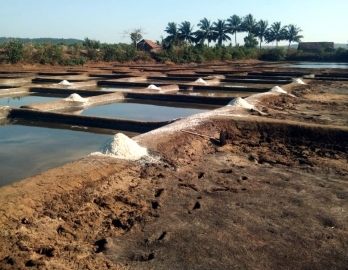
The 2025“26 salt-making season in Goa has emerged as one of the most difficult in recent years, exposing the vulnerability of the state's traditional salt industry to changing climatic conditions.
Unseasonal rains, prolonged humidity, mist, fog, and the early onset of the southwest monsoon significantly affected salt production across Goa. However, the impact has varied considerably between Batim in Tiswadi taluka and Agarvaddo in Pernem taluka, highlighting differences in labour systems, community involvement, and government support.
Traditionally, salt production in Goa begins after the monsoon recedes and reaches its peak during the dry summer months.
CLIMATIC SETBACKS
The salt makers, however, faced a series of climatic setbacks in 2025“26.
According to local producers, the monsoon of 2025 lingered unusually late, with intermittent rains continuing until November. The delayed withdrawal of the rains postponed the preparation of salt pans and reduced the effective working season.
The challenges continued during the winter months. Persistent mist and fog during December 2025, January 2026, and February 2026 reduced sunlight and slowed the process of evaporation that is essential for salt crystallisation.
Salt makers depend on intense sunlight and dry conditions to produce high-quality solar salt. The prolonged moisture in the atmosphere delayed crystallisation and reduced overall productivity.
SITUATION AT BATIM
The situation at Batim in Tiswadi was particularly difficult. Unlike some other parts of Goa, salt production in Batim is now largely dependent on migrant labourers, many of whom come from neighbouring Karnataka for seasonal employment. These workers spend a few months maintaining the salt pans, managing water flow, and harvesting salt. The work is physically demanding and highly dependent on weather conditions.
When monsoon showers arrived unusually early in mid-May 2026, several salt pans were flooded before the season's final harvest could be completed. The premature rains washed away partially formed salt crystals and brought production to an abrupt halt.
Since the workers in Batim are seasonal migrants, many were content to return home after earning what they could during the shortened season. Their primary objective is to earn income during the dry months and return to their families in Karnataka before the monsoon intensifies.
SITUATION AT AGARVADDO
A different picture emerges from Agarvaddo in Pernem taluka. Here, traditional salt-making continues to be practised by members of the Mithgauda community, who are directly involved in managing and operating their salt pans. Their long-standing knowledge of the craft, combined with a strong attachment to the occupation, has helped sustain the industry despite adverse weather conditions.
Government support has also played a significant role in strengthening the resilience of salt makers in Pernem. Under a state assistance programme, twelve active salt makers received financial support of Rs 1 lakh each.
Additional salt pan owners whose names are recorded in the Form I & XIV land records and whose pans had become defunct are expected to receive assistance in the future. This support has encouraged the continued maintenance and revival of traditional salt pans.
Despite heavy rains in mid-May, the Mithgaudas of Pernem refused to abandon the season. Instead, they repeatedly pumped water out of the pans, waited patiently for sunny intervals, repaired damaged bunds, and resumed production whenever conditions allowed.
Their perseverance enabled them to continue harvesting salt until the first week of June, well beyond what many observers thought possible.
THE UNCERTAINTIES
The contrasting experiences of Batim and Pernem demonstrate that while climate change and weather uncertainties pose serious challenges to Goa's salt industry, community commitment and institutional support can make a crucial difference.
As traditional salt making faces an uncertain future, the resilience shown by the Mithgaudas of Pernem offers an important lesson in adaptation, perseverance, and the preservation of Goa's unique cultural and ecological heritage.
[The writer, an Associate Professor of Sociology, Government College of Arts, Science and Commerce, Quepem, has been conducting research on salt makers of Goa since 1992]