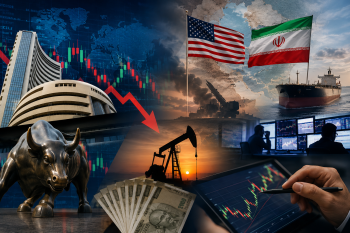
The Indian stock market is entering an important week as investors closely watch developments surrounding possible peace talks between the United States and Iran. Mixed signals over whether an agreement can be reached are likely to keep global markets on edge.
Another major factor is the sharp fall in crude oil prices, which recorded their biggest weekly decline in six weeks. This is expected to influence investor sentiment when trading resumes on Monday.
Sharp Fall in Indian Markets
Indian equities came under heavy selling pressure on Friday afternoon. The benchmark indices Sensex and Nifty dropped by more than 1 per cent, largely due to passive fund movements linked to the latest MSCI index reshuffle.
The Sensex fell by over 1,090 points to close at 74,776, while the Nifty 50 declined nearly 359 points to 23,547. The sell-off erased close to Rs 6 lakh crore from the combined market value of companies listed on the BSE, reducing it to around Rs 465 lakh crore.
Uncertainty Over Iran Continues
Tensions in West Asia remain a key concern despite efforts to maintain a fragile ceasefire.
US Defence Secretary Pete Hegseth stated that the United States is prepared to resume military action against Iran if nuclear negotiations do not succeed. At the same time, he emphasised President Donald Trump’s preference for a diplomatic solution that would prevent Iran from developing nuclear weapons.
Meanwhile, Iran is taking steps to strengthen its authority over the Strait of Hormuz. Lawmakers are expected to vote on new regulations governing the vital shipping route. Iranian military officials have also indicated that ships may be required to follow routes approved by Tehran and obtain clearance from the IRGC Navy.
Will Oil Prices Fall Further?
Crude oil prices dropped to their lowest level in seven weeks after reports suggested progress towards a possible peace agreement involving the United States, Israel and Iran.
Lower oil prices have eased concerns about inflation driven by rising energy costs. However, important differences remain between Washington and Tehran on several aspects of the proposed deal.
Market participants believe that if an agreement is reached, disruptions in the Strait of Hormuz could ease significantly. The waterway carries nearly one-fifth of the world’s oil and gas supplies, making it critical to global energy markets.
Foreign Investors Remain Concerned
Foreign Portfolio Investors (FPIs) were major sellers in Indian equities on Friday, withdrawing a net Rs 20,637 crore in a single trading session. This was one of the largest one-day outflows seen in recent years and was largely linked to the MSCI index rebalancing.
According to Jefferies, Foreign Institutional Investors (FIIs) have pulled out nearly $53 billion from Indian stocks since late 2024. While domestic institutional investors have provided support to the market, continued foreign selling has weighed heavily on large-cap stocks.
As a result, MSCI India has fallen around 8 per cent between September 2024 and May 2026, significantly underperforming the broader MSCI Emerging Markets Index.
Rupee Shows Signs of Strength
The Indian rupee gained 53 paise on Friday to close at 95.05 against the US dollar, compared to the previous close of 95.69. This was its strongest single-day rise since early April.
According to Ponmudi R, CEO of Enrich Money, the USD-INR pair has moved below the Rs 95 level after touching nearly Rs 95.9 during the week. The rupee benefited from improving global risk sentiment and a softer dollar.
Technical indicators suggest that the pair is near an important support zone. Resistance is seen around Rs 95.2, and a sustained move above this level could lead to a recovery towards the Rs 95.4-Rs 95.6 range.
Technical Indicators Remain Weak
Market experts say the Nifty continues to trade below its key moving averages. These averages have flattened, indicating that the market currently lacks a strong directional trend.
Sudeep Shah, Head of Technical and Derivatives Research at SBI Securities, noted that indicators such as the Relative Strength Index (RSI), Stochastic Oscillator and Average Directional Index (ADX) all point to weak momentum and a sideways market.
Friday’s late-session sell-off has further increased uncertainty about the market’s near-term direction.
What Investors Should Watch
The coming week is expected to be driven by geopolitical developments, especially progress in US-Iran negotiations and broader events in West Asia.
Crude oil prices will remain a major focus, as any breakthrough in diplomatic talks could improve energy supplies and support market sentiment. However, investors are likely to remain cautious until there is greater clarity on whether a final agreement can be reached.