


 As Goa’s traditional brass and copper craftsmanship awaits recognition through a Geographical Indication (GI) tag, artisans struggle to preserve its legacy amid changing tastes and declining demand
THE GOAN I PANAJI
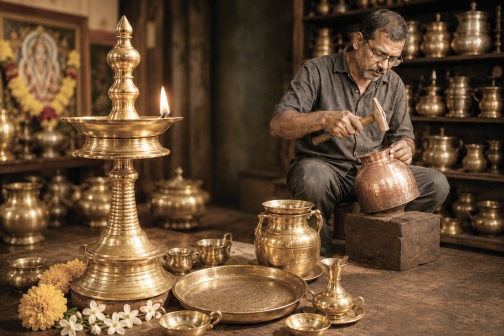
As the fragrant aroma of camphor fills the festive home, a flickering flame from the traditional Laman Diva casts a warm glow across the room. While it often goes unnoticed amid celebrations, the humble lamp carries a rich history rooted in Goa’s traditions. Yet, the Laman Diva is just one of the many traditional brass and copper artefacts that form an integral part of Goa’s rich cultural and artisanal heritage. From ritual objects and household utensils to decorative pieces, these handcrafted items have been woven into Goa’s cultural fabric for generations.
Brass and copper artefacts continue to hold a special place in Goan households, particularly among Goan Hindu families, from government functions and religious ceremonies to marriage gifts and housewarming celebrations. Goa’s traditional brass and copper craft has been proposed for a Geographical Indication (GI) tag, recognising its unique cultural and artisanal significance. Yet, even as efforts are made to preserve the craft, artisans fear the legacy is fading.
A Family Legacy
For families involved, the craft is not merely an occupation but a legacy passed down through generations. Pravin Shinde, proprietor of Shantaram Govind Shinde and Sons, traces his family’s involvement in brass craftsmanship back several decades. “We have records of our family making these items from 1951, but I believe our ancestors were involved in this long before that. The demand has reduced significantly, especially after the COVID-19 pandemic,” he says.
Salil Tivrekar, who manages Sadanand Emporium, points out that traditional brass and copper items were once an essential part of village life. “Earlier, artisans would travel to annual village jatras across Goa to sell these items. Those fairs provided an important marketplace for traditional brass and copper products. But as demand decreased over the years, production has naturally suffered as well,” he says.
Crafted by Hand
The craft itself remains labour-intensive and deeply rooted in traditional techniques. According to Shinde, creating each item involves several intricate steps. “Sometimes, customers bring old brass or copper items that they want replaced. We melt the metal, prepare moulds through sand casting, and shape them into the desired design. Depending on demand, we can make around 10 to 12 pieces at a time. But with rising material costs, production has reduced considerably,” he explains.
Modern Challenges
One of the biggest challenges they face today comes from changing lifestyles and competition from machine-made products. “Traditional brass and copper items remain important symbols of our culture, but people’s preferences have changed. Most consumers today prefer modern decor and machine-made products over handcrafted traditional pieces,” Shinde remarks.
Tivrekar adds that many consumers fail to recognise the difference between handcrafted and mass-produced items. “Machine-made products often use mixed metals; our products use pure metal. These items last for generations. Many pieces that come to us for polishing are 80 to 100 years old and remain intact. Mixed metal products can develop cracks and deteriorate over time.” He also worries about the declining understanding of traditional metals. “People today think the shinier an object looks, the better its quality. Brass is a living metal and is easily affected by environmental conditions,” he says, emphasising the importance of its proper care.
Keeping the Craft Alive
Ironically, Shinde says social media has helped attract customers from outside Goa, while many locals remain unaware of the craft’s existence. “After our work was uploaded online, people from outside Goa started contacting us,” he says. Both artisans believe greater support is essential for the survival of Goa’s traditional brass and copper craft. They feel that government initiatives can create awareness and encourage younger generations to carry the tradition forward. As modern lifestyles reshape cultural practices, artisans believe preserving this craft requires protecting not just the objects, but also the knowledge and craftsmanship behind them. Thus, the next time you light a Laman Diva at your grandmother’s home, spare a thought for the generations of artisans whose hands have kept Goa’s traditions glowing.


