Atika Modassir
For The Goan
Walking the streets of Istanbul, I came across a wise old dervish telling stories of his city’s antiquities. He asked for nothing more than time, and your reward lay in the revelation his stories proffered. Every time I see our central library, I am reminded of him. Renowned as India’s oldest public library, Goa’s Central Library (CL) is our cherished hometown chronicler of the shifting sands of time. Its own transformation over the last 194 years tells us the story of how dominion commands knowledge—what books are compiled and collected and whose voices are conserved. From a name that portrayed Goa’s status as a Portuguese colony to one celebrating a liberated democratic state, few organisations mirror Goa’s journey and cultural identity as evocatively as the CL.
Its story begins as Publica Livraria, established in 1832 by Viceroy Dom Manuel de Portugal e Castro. Taking root within the Academia Militar de Goa, it mirrored the priorities of a colonial administration that placed great importance on military know-how. Fortune, though, had bigger plans for it, which were set in motion as Portugal underwent liberal reforms and the new administration in 1834 decreed the abolition of many religious orders throughout Portugal and its territories. As a result, monastery and convent properties were confiscated and their libraries transferred to the state. While these libraries were centres of learning for religious orders, their collections extended beyond theology, housing centuries of accumulated scholarship. Goa’s library became a beneficiary of this handover and, by 1836, it was rebranded Bibliotheca Publica to represent this absorption of intellectual inheritance and higher learning. What was once the domain of priests and savants came into the fold of a public collection. The next title, Bibliotheca Nacional de Nova Goa (1897), highlighted its elevation to a National Library named after the new capital, Nova Goa (after Old Goa ceded the role). Another rechristening came about as Biblioteca Nacional Vasco da Gama (1925), reaffirming its alignment with Portuguese heritage. The subsequent renaming as Biblioteca Nacional de Goa (1959) presaged a shift in positioning under the Education and Health Services, serving readers across the territory rather than a single cultural institution. Liberation transformed the library, heralding it as a democratic public institution and expanding its collection, welcoming Konkani, Marathi, English and other Indian languages. Circa 2006–07, public libraries were transferred to the Directorate of Art & Culture, reflecting a broader recognition of libraries as custodians of literary and cultural heritage. In 2012, a new premises was inaugurated at Patto, making it known as the Krishnadas Shama Goa State Central Library—a tribute to the 16th-century founder of Konkani prose. Its modern purpose-built facilities allowed for climate-controlled preservation and more shelves.
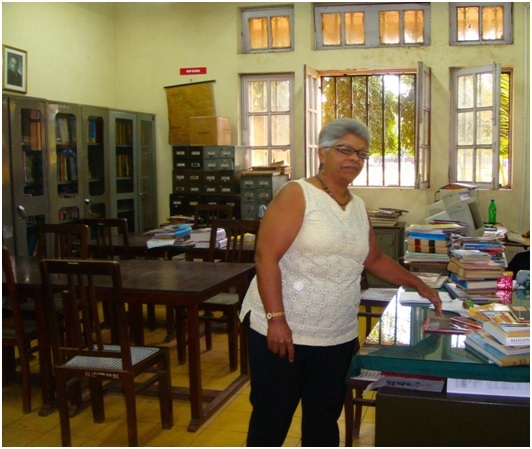
While the locations changed, the CL continued igniting the minds of its visitors. One such visitor was a little ten-year-old girl named Maria de Lourdes Bravo da Costa. Her relationship with the CL spans a lifetime—from a child exploring its shelves to retiring as Assistant State Librarian, entrusted with preserving its legacy. From taking notes in her ‘caderno’ as a youngster to winning the State Cultural Award and recognition from the Konkani Itihas Parishad, she has made a significant contribution to the study of Goa’s Indo-Portuguese past. I asked her, as someone who has been both a beneficiary and a custodian of the State’s literary treasures, what jewel in the crown all Goans should know about beyond the library’s celebrated Indo-Portuguese collection. Brace for the pro tip—it is the rare books collection of 16th-century imprints. In a world where reading risks becoming cursory browsing, Dr Maria reminds us that a state library is not simply organised as an institution but as a people’s library; it is organised around their civilisation. It is their repository in which everything finds safe harbour for future generations—newspapers, government gazettes, a local writer’s first book, a children’s story or a research paper.
Given her experience, I asked her what sets the true erudite apart from the merely bookish. True scholars, she says, share one quality: tenacity. She remembers an Italian who learnt Tamil and a Japanese scholar who learnt Konkani to access original research sources—a testament to the lengths true scholarship will go in pursuit of an answer. She has curated books spanning Latin to Portuguese, guided scholars from Brazil to Japan and welcomed luminaries such as Nobel laureate Orhan Pamuk and state guests. Dr Maria naturally dismantles the notion of librarianship as a solitary profession by sharing how she has nurtured an intricate social web of knowledge for decades, long before the prevalence of the internet. Earnestly sustaining exchanges with academics, writers, scientists and students, she has connected researchers worldwide by dint of goodwill and a penchant for knowledge. Presenting the kind of acumen that comes from standing at the confluence of books, people and ideas, she recounts connecting two Japanese researchers in Osaka who were pursuing a line of inquiry, each unaware of the other. With an introduction made across continents, she brought them together, promoting their common interest. Herein lies the quiet potency of librarianship—not simply knowing the shelves, but appreciating how ideas and those pursuing them can reform the world together.
[The writer is a Human Capital Strategist and Educationist; meaning she invests in humans like blue chip stocks and teaches them how not to crash the market]