Dr Alvarinho J Luis
Beyond its beaches, cuisine and architecture, Goa’s rural villages preserve a fascinating legacy of history, faith and tradition. Continuing with the letter M, Malar, also known as São Mathias, is a historic village on Divar Island, Tiswadi, which is a quiet village featuring heritage homes and narrow lanes.
Malar’s Bonderam
Malar is best known for the vibrant Bonderam festival, celebrated in the third week of August and attracting thousands of locals and visitors. The festival has its origins in historic disputes over village boundaries. During the Portuguese period, the Comunidade used flags (Bandeira in Portuguese and Bonderam in Konkani) to demarcate boundaries, particularly in an agrarian society where land disputes were common. Over time, the practice evolved into the colourful Bonderam procession, transforming a history of conflict into a celebration of community, music and culture.
Today, it is organised in active partnership with the St Mathias Sports Club, with Bonderam increasingly evolving into a platform for community participation, skill development and small-scale entrepreneurship. Each ward of the village presents a decorated float, accompanied by music and youngsters in colourful attire, creating a lively carnival atmosphere. A traditional heritage walk or Pasoi opens Divar’s annual Bonderam festival, where families welcome visitors with Goan food, sweets and stories. A highlight is Bonderachem Jevon, which features traditional Goan delicacies such as local rice, bedeanchikodi, kismoor, etc.
Another distinctive tradition is the Potekar festival, celebrated across Divar for three days before Lent. Young people don homemade masks and costumes, adorn themselves with cowbells, and move around the village, seeking snacks and drinks while playfully frightening children. The village’s religious heritage includes the historic St Mathias the Apostle Church - a 16th-century church built by the Portuguese between 1590 and 1597. The church remains an important landmark and is believed to have given the village its name.
The icons
Sao Mathias has produced notable personalities. Bishop Mathias Fernandes was appointed Bishop of Mysore in 1963 and consecrated in 1964, becoming the first native to hold the position. Armando Menezes, born in Sao Mathias in 1902, was a distinguished poet, writer, academic, and civil servant who later settled and died in Bombay. A living legend is Marius Fernandes, known as Goencho Festakar, who is a prominent cultural revivalist.
Mulgao: A village of Temples
Mulgao, in Bicholim taluka, lies within Goa’s traditional mining belt. Although the closure of mining operations affected the livelihoods of many people, the environmental impact has been far more extensive. Mulgao has a rich religious heritage, with 52 temples spread across the village. Among its most important shrines is the Shree Kelbai Temple at Gaonkar Wada, dedicated to the village’s principal deity. Kelbai is traditionally regarded as one of a group of sister deities associated with different parts of Goa and neighbouring regions. The annual Pethechi Zatra, held around March–April, is an important village festival. The Sateri Temple, one of Mulgao’s oldest shrines, attracts devotees during its annual zatra in December. Other important temples include Maruti Devasthan, Vithoba Rukmini Devasthan, Dattatreya Devasthan, Ravalnath Mahalaxmi Devasthan, Shri Dahim Devasthan and the Sateri and Kelbai temples.
Mulgao also became a refuge for deities displaced during the early Portuguese period, when conversions led communities to move sacred images from places such as Cumbharjua and Moira. Among these are Shantadurga Kumbharjuvekarin and Moideshwar, whose presence adds to the village’s distinctive religious heritage. Among Mulgao’s heritage landmarks is the Parab ancestral house at Gaonkar Wado, believed to be more than 250 years old and regarded as the village’s oldest house. The village also retains a rich agricultural tradition through its kulagars, with around 20 farms growing nutmeg, cardamom, areca nut, betel leaf, cashew, mango, coconut, and pepper.
Nature and community life remain closely intertwined. The Manas, a scenic sluice gate at Manasbag Wado opposite the tollem, is a popular spot for fishing and birdwatching. The nearby Tollem, a traditional village water body at Bag Wada, assumes special significance during Ganesh Chaturthi, when villagers gather for Visarjan.
The Intruz of Mandur
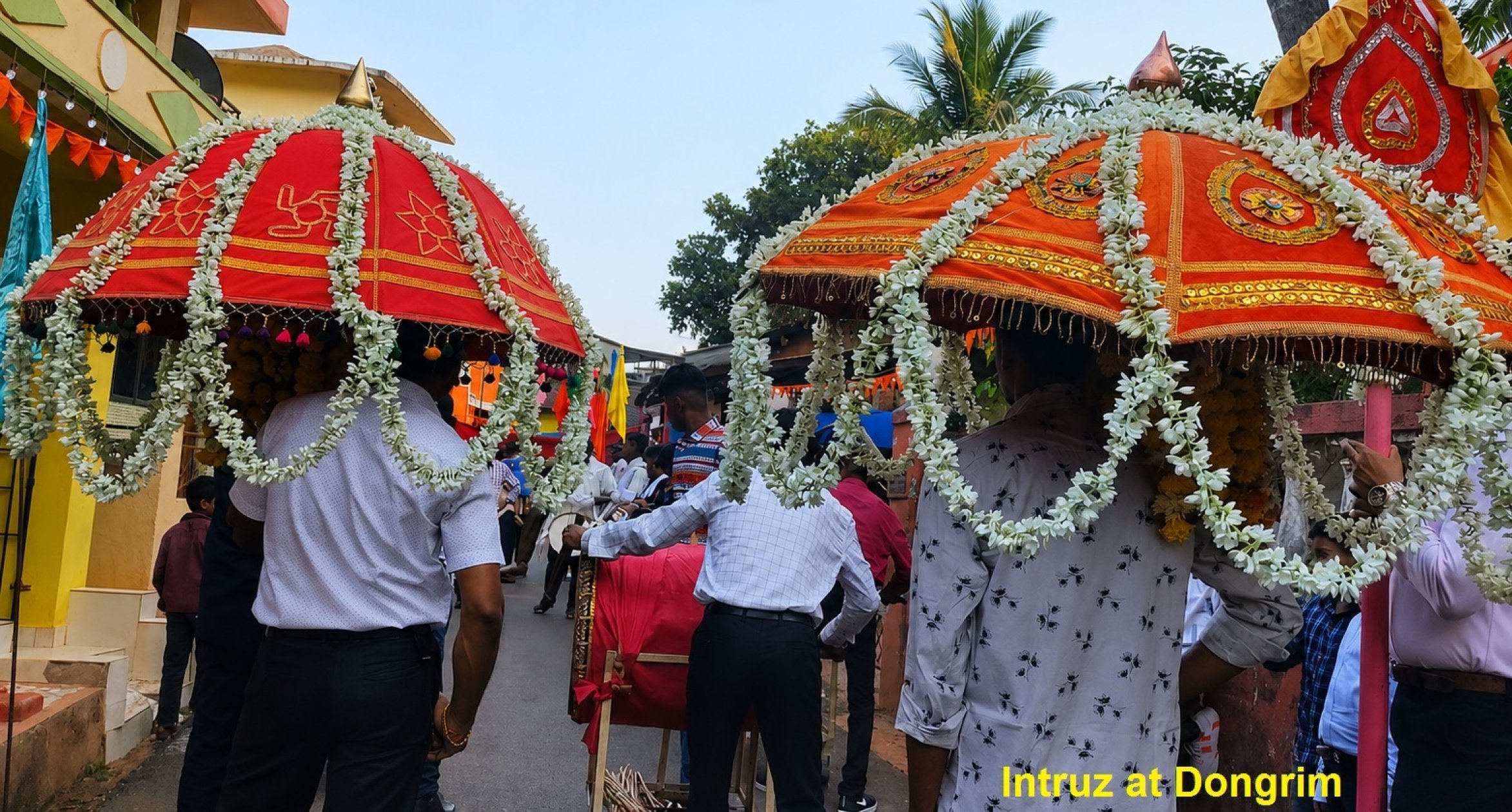
Mandur, historically recorded as Mandura, is situated near Neura and Dongrim along the northern banks of the Zuari River. One of Mandur’s most distinctive cultural traditions is Intruz, the unique five-day celebration observed in the hamlet of Dongrim. Held around the time of Carnival, Intruz blends elements of Goa’s Hindu and Catholic traditions. According to local accounts, villagers obtained permission from the Portuguese authorities to hold Intruz by presenting it as a Christian celebration. They subsequently used the occasion to celebrate Shigmo in a different form.
Beginning in the month of Magh, Intruz features colourful processions, folk dances, songs, and traditional music performed on instruments such as the ghumot, shamel, kansalem, dhol, and tasso. A distinctive feature is the ceremonial umbrella, which moves from house to house through Dongrim, Azossim and Neura. During Sunwari, five wards of Dongrim traditionally come together as a Mel, carrying umbrellas and singing as they proceed towards the temple of Sati Shantadurga to seek blessings.
The celebrations include the traditional Suvari Vaadan, umbrella dances, performances at different mandaps, a palki procession, Romtamel accompanied by dhol, nagaro (a form of a drum) and tasso, and the colourful gulaal festivities. Folk dramas and performances add to the entertainment. Intruz has thus evolved into a vibrant expression of community identity, music, faith and folk culture.
Mandur also possesses important religious heritage. The Church of Our Lady of Refuge was founded in 1710 at the initiative of local gaunkar Dionísio Ribeiro and his wife, Angelica Rodrigues, and was elevated to parish status in 1717. Its distinctive architecture, including shell-like decorative features, makes it an interesting example of 18th-century Goan ecclesiastical heritage.
(Dr Luis is a scientist, freelancer, and a son of the soil from Taleigao)