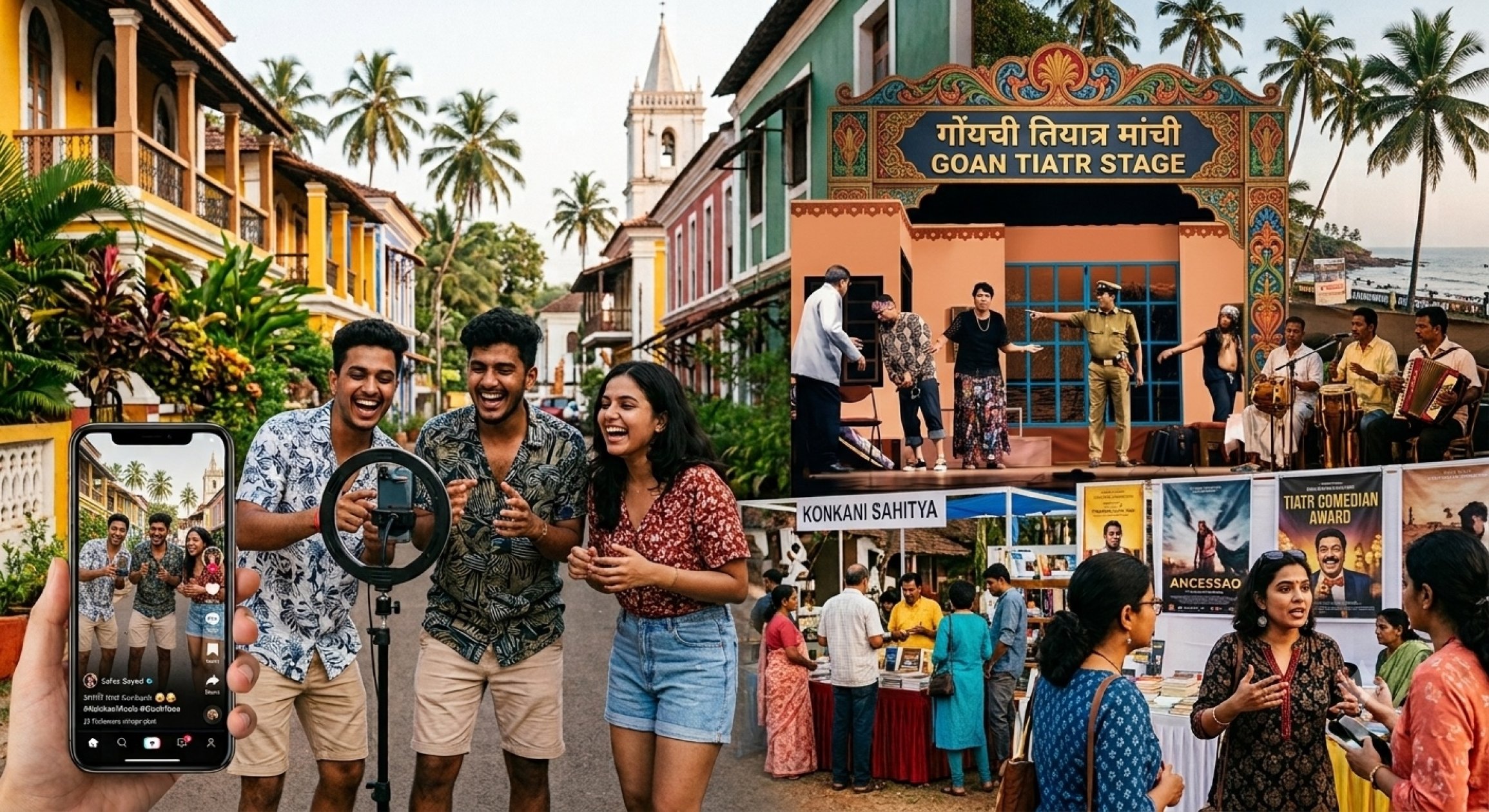
Scroll through social media and, between reels in Hindi and English, a funny Konkani reel suddenly appears, and the familiar language immediately draws you in. A young creator is making people laugh in it, another is singing in it, while someone else is using it to tell stories that might otherwise go unheard. What was once largely confined to conversations at home is now finding its way onto a much wider stage. Beyond social media, theatre artists, writers and literature enthusiasts too continue to hold on to their Konkani identity and, in doing so, a part of Goa.
More recently, the Konkani film Ancessao received accolades at the International Film Festival of South Asia in Toronto. Goa’s 133-year-old Konkani musical theatre tradition, tiatr, has also been officially recognised as the 56th element in India’s National Inventory of Intangible Cultural Heritage. Thus, when a regional language finds recognition on a larger stage, what do such moments mean to those back home who continue to create, perform and work in the language?
Safaz Sayed, who first began making reels in Hindi and English, says the response changed when he shifted to Konkani. “But then when I shifted to Konkani, the response seemed better, so I continued making them.” While his reels are filled with humour, banter, and sarcasm, the language itself often becomes the highlight. Roshani Ramesh Marathe and Prathamesh Pradeep Shirodkar have also been consistently crafting humorous Konkani content that often leaves their audience in splits. “We noticed that we weren’t seeing enough of ‘amchiea bhasha’ on social media, so we thought, why not use the language we speak to make funny content?” says Marathe. They began making one reel at a time, not to become famous, but with the hope that someone watching would listen and immediately realise, “Arrey, he amche bhaxen uloita!” (They are speaking our language!)
And perhaps that is exactly what makes it special. Seeing Konkani artists take the stage away from home and perform for a houseful shows is a moment of pride for many Goans. Vedika Walke, a theatre artist and homoeopath, believes Konkani is indeed receiving the recognition it has always deserved. “The audience is now appreciating regional cinema. For someone who is watching it from another state, there is always the emotion of ‘te majhe.’ The belongingness to the language remains,” she remarks.
For Marathe, Goa’s Konkani is like a thali, with every region adding its own flavour. Bardeskar, Saxtti, Antruz and Romi Konkani may sound different, but all have their own sweetness, she explains. “If we only speak one type of Konkani, we will lose so many beautiful words and expressions. Preserving dialects is like preserving memories. I try to do this too,” she says. Sometimes she uses South Goan slang and sometimes words her grandmother used. “If we pass these dialects to our children, they will grow up with a richer, more colourful Goa,” she states. “Yet, often, Konkani is mistaken for a dialect of Marathi, but that is not the case,”
Walke clears the air, pointing out that Konkani is a separate and independent language in its own right. While English is spoken globally and Hindi is understood by a large section of Indians, she believes Konkani too deserves its own space and pride in Goa. “Research has also shown that when we learn basic concepts in our mother tongue, we tend to understand them better,” she says. And so, while artists and creators continue finding new ways to make media in Konkani, sustaining the language cannot be their responsibility alone. It is something that society as a whole needs to carry forward. “After all, Goa became a state partly because it was a place where the majority spoke Konkani,” she reckons.
With the influx of people from outside the state, Konkani speakers may at times appear fewer simply because they now share Goa with speakers of many more languages. Yet, the need to preserve Konkani remains. Every accolade, every packed theatre show and every reel that reaches beyond Goa is also a reminder that a language can travel far without leaving its roots behind. Goa’s history and statehood remain deeply tied to Konkani. And perhaps the next generation does not need to carry the language in the same but they need to keep carrying it forward.