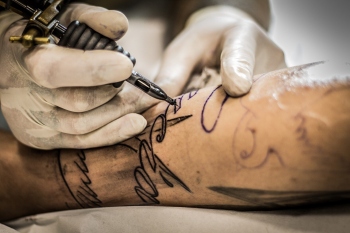
In the sci-fi novel “The Diamond Age” , body art has evolved into “constantly shifting mediatronic tattoos” “ in-skin displays powered by nanotech robopigments. In the 25 years since the novel was published, nanotechnology has had time to catch up, and the sci-fi vision of dynamic tattoos is starting to become a reality. The first examples of color-changing nanotech tattoos have been developed over the past few years, and they’re not just for body art. They have a biomedical purpose.
Now scientists are looking at tech tattoos from a different angle “ sensing external harms such as ultraviolet radiation. UV exposure in sunlight and tanning beds is the main risk factor for all types of skin cancer.
To help address this problem, they developed an invisible tattoo ink that turns blue only in UV light, alerting you when your skin needs protection. The tattoo ink contains a UV-activated dye inside of a plastic nanocapsule less than a micron in diameter “ or thousandth of a millimeter “ about the same size as an ordinary tattoo pigment.
Temporary high-tech tattoos
Temporary transfer tattoos are also undergoing a high-tech revolution. Wearable electronic tattoos that can sense electrophysiological signals like heart rate and brain activity or monitor hydration and glucose levels from sweat are under development. They can even be used for controlling mobile devices, for example shuffling a music playlist at the touch of a tattoo, or for luminescent body art that lights up the skin.
The advantage of these wearable tattoos is that they can use battery-powered electronics. The disadvantage is that they are much less permanent and comfortable than traditional tattoos. Likewise, electronic devices that go underneath the skin are being developed by scientists, designers and biohackers alike, but they require invasive surgical procedures for implantation.
Tattoos injected into the skin offer the best of both worlds: minimally invasive, yet permanent and comfortable. New needle-free tattooing methods that fire microscopic ink droplets into the skin are now in development. Once perfected they will make tattooing quicker and less painful.
Ready for everyday use?
The color-changing tattoos in development are also going to open the door to a new kind of dynamic body art. Now that tattoo colors can be changed by an electromagnetic signal, you’ll soon be able to “program” your tattoo’s design, or switch it on and off. You can proudly display your neck tattoo at the motorcycle rally and still have clear skin in the courtroom.
As researchers develop dynamic tattoos, they’ll need to study the safety of the high-tech inks. As it is, little is known about the safety of the more than 100 different pigments used in normal tattoo inks
So far, there is no evidence that tattoos cause cancer, and one study even found that black tattoos protect against UV-induced skin cancer. Still, many tattoo inks contain or degrade into substances that are known to be hazardous, and health complications including infection, allergy and granuloma have been found in about 2% of tattoos. More research is needed to understand the long-term effects of nano- and microimplants in the skin in general.