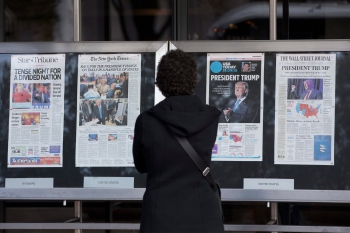
The Press, often referred to as the Fourth Estate, for the influence that it holds and its ability to bring change, is vital to a functioning democracy.
The media plays a big role in highlighting issues and holding people responsible. But what happens when people do not trust the media? The question doesn't exist in the realm of 'what if' anymore, as countries across the world have witnessed a declining trend in trust over the years.
According to a Reuters Institute study from 2022, 41% of Indians trust news most of the time which was a three point increase from 2021. India was among a few countries that saw a marginal increase in trust but the overall picture isn't great.
Among major countries, only 34% of the UK's citizens believe the media, while Germany (50%), France (29%), Japan (44%), Australia (41%), Brazil (48%), US (26%) and Canada (42%) have a trust factor of either 50 per cent or less.
With numbers like these, or in other words, if the public is less trusting of the media then bringing about change is a difficult endeavour.
Indians are often under the impression that the West and other leading countries are doing a much better job at propagating the news but that clearly isn't the case as per the data.
It also raises another question, as to how the Indian media, known for sensationalising stories and with some of its reporting also being equated to Yellow Journalism, has a better score than the United States and the United Kingdom.
Just because a story is well-packaged, well written or a TV news host isn't getting into a shouting match with the panel, doesn't necessarily mean that the content is good.
Another important aspect often overlooked is the role of the news agencies. These entities, also known as news wires, produce stories and content which is then sold to subscribers (print media and news broadcasters).
In most cases, whenever stories by agencies are republished, they are not vetted. Take for example the recent story of parents in Pakistan locking the graves of their dead daughters due to increasing cases of necrophilia. The story, initially reported by the Daily Times was reproduced by the news agency ANI (Asian News International) and was then subsequently picked up by major Indian outlets.
The story gained huge traction and the picture of a grave having a padlock went viral. Hours later, the story was flagged by Alt-news fact-check Mohammed Zubair. It was revealed that the image was from Hyderabad and the grille was installed by the son of a woman as a precautionary measure to prevent people from stepping into the grave as it was located next to the doorway.
Now, a story like this doesn't have huge implications but stories that fall under the hard news category such as politics usually do.
The world may not be black and white but if one has a good understanding of the political spectrum and the state of affairs in any country, a cursory glance is enough to know the political hue of the headline and whether it has a negative or positive spin.
Since the headline is often the most read component of a story, it's just about enough to create the required impression for or against a political party in the mind of the reader.
Avid readers and political enthusiasts will be able to tell whether a story is potentially deceptive or is towing the lines of a particular political party, something that the common man will not be able to differentiate, thus creating echo chambers that mostly affect the lower rungs of society.
A recent AP-NORC poll has indicated that Americans fault the news media for dividing the country. According to the survey, three in four Americans believe that the media has played an active role in polarising the country while less than half have little to no trust in its ability to report fairly and accurately. This is a blueprint that countries should strive to avoid. It is also worth noting that most of the major news agencies belong to countries where their own citizens are sceptical about the reporting.
However, news agencies are critical to smaller newspapers and broadcasters that do not have correspondents in a particular region. These agencies have reporters and cameraman on their payroll covering stories from all over the world which are then picked up by their subscribers.
The only caveat that comes to subscribing to agencies is that publishers, especially the print division, don't often have the time to verify stories and hence it is the job of news agencies to be absolutely bullet-proof and independent before publishing stories or reports.
Faults by wires will only further erode trust in the Fourth Estate which plays a vital role as a watchdog to the Executive, Legislature and Judiciary.