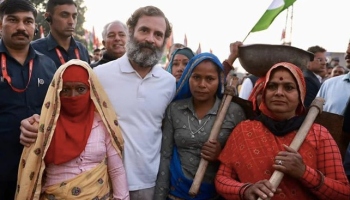
The BJP is running scared. They cannot quite figure out how much impact Rahul Gandhi’s yatra is garnering. The masses have signified their support and joined in with optimism. The yatra has people marching with passion and hope. It is a movement for togetherness and comes in the context of the escalating ‘politics of hate’ that is gripping the country. Bharat Jodo Yatra defies and contradicts the immorality of the politics of division, antagonism, and intimidation which stems from insecurity of the ruling formation. Eight years of the BJP has resulted in the people feeling peeved.
Rahul Gandhi’s persona comes across as an affable one, easy to relate to. He puts his arms around rank strangers, older people, and youth. He conveys his message in unambiguous terms. There is nothing ‘Pappu’ about him. It is inventive and genuine. He ties children’s shoelaces and takes selfies with them. No spectacular populism. Everything is about substance and all this combined is setting the cat among pigeons for the BJP. Mainstream television may ignore the yatra. The yatra, in its own way, has outdone television TRP ratings by colossal margins. Rahul touches a chord: ‘Replace “Naphrath ka bazaar” with “Mohabbat ki dukaan”, he calls out. An icon, especially for youth “ that is Rahul.
Little wonder, the BJP invoked fear of Covid and demanded Covid protocols be followed. Meanwhile, the BJP adopted double standards. They have mass assemblies and yatras and these fears were not reviewed as risks. Why, for example, did they not demand that Satish Poonia apply protocols for the 'Jan Aakrosh Yatra' in Rajasthan?"
In a recent interview, Shashi Tharoor warned that the BJP could easily lose 50 seats in 2024. The economy is fading, unemployment levels are swelling, law and order is collapsing, prices are escalating, and minorities live in dread of oppression. Religion is the only card left in the hands of the BJP, and the ruling party has brought religion back to centre-stage of its political discourse.
Promoting hate is a failed exercise in the long term. The very fact that the BJP is not making inroads even in that political sphere scares their wits. The Indian polity generally rejects majoritarianism and affirms pluralism. In a recent book: ‘Politics of Hate’ (Harper and Collins), A Faizur Rahman, Secretary General, Islamic Forum for the Promotion of Moderate Thought, writes on the challenges and impulses to combat hate with constructive politics of ‘pro-existence’. His article ‘”Muslimophobia in India, Reasons and Remedy”, he introduces revealing statistics which the Sangh Parivar would find thorny to digest. Rahman quotes a survey from the Centre for the Study of Developing Societies in 211 parliamentary constituencies according to which nearly 75 per cent of Hindus who use social media selected an India that was pluralistic. Rahman also quotes a Pew Research Survey which shows that 85 per cent of Hindus are convinced that respecting all religions is being truly Indian in essence. 80 per cent Hindus say that religious co-existence is an important component of their religious identity.
The expression ‘majoritarianism’ is gaining new currency. A small political faction (in comparison to the totality of Hindu population) may have ‘Muslimophobic’ tendencies. In realpolitik, people of different faiths rub shoulders in the market place, in public transport, in offices, in theatres, and fares and fetes, in religious parades, in carnivals, in commerce, trade, and, yet, there are minority factions in every religion that are extremists and carry political nuisance value. The dominant numbers by far choose the aspiration of a shared sense of common humanity.
Bharat Jodo Yatra is a historic political moment in the life of the nation for the Congress which its opponents wish to write off. The Congress will not go under just because some random groups want to wish it away. Everyone is gathering together to celebrate India’s unity. One single political force threatens to tear it apart. The yatra has been successful in transcending differences of caste, class, religion, and ethnicity and is asserting: “Pluralism first”.
Nor is the yatra naive for it takes on political questions head-on. It amplifies voices against divisiveness be they political, economic or social. Rahul Gandhi is a strident and consistent critic of Hindutva, and is committed to plurality, federalism and social transformation as three important ideological fundamentals. His yatra has put breaks on the Hindutva engine. People see a visible alternative in the secular-socialist platform. Rahul Gandhi, once dismissed as rudderless and prone to sporadic political actions, has proven that he has the stamina and content for sustained political mobilization. The yatra has demonstrated his fortitude. Even the media has full access whenever they want access.
Congress must now bond together the political assets acquired in the yatra with Congress’ inherited organizational structures and history. Congress voters were once anxious about the party’s fortunes. Those who were disillusioned by defeat-after-defeat, now see light at the end of the tunnel. The yatra is the stimulus for a vibrant electoral challenge from the Congress. When that happens, India’s politics will yield political pluralism and the country will no longer limp with a single political force. The country needs to reclaim its democratic traditions and dump the risks of a virtual one-party State.
The elections in Gujarat, Delhi, and Himachal Pradesh offered a profile of how things are spawning out. The BJP won in one State and lost the remaining two. The fears of a political monolithic format have receded.
The Goa Congress must now do its own yatra. Perhaps, a peoples’ yatra! This will test its ability to mobilize masses as well as to convey to the BJP that the majority it now claims is a false and monetarily procured construct. It will also put the fear of God into Goa’s godless defectors.