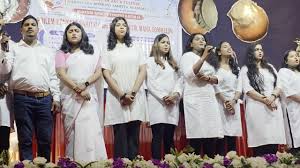
Goa has recently seen the conclusion of what has been called the First All India Literary and Cultural Maha Sammelan. Konkani conferences, following trends among other language groups across India, have been active since the 1940s, if not earlier. So why was this one was different?
What was new here was that the event held at the Ratzinger A/C Hall, Verna, was marked by calls against Big Brotherism by Devanagari against other scripts. In particular, it marked an open show of strength and also a coming together of two other prominent scripts, Romi and Kannada.
In terms of numbers, it was a fair success. Organising was well done. Mangaluru students lent a whole lot of vibrancy by way of song and dance; troupes from Goa also lent their own contribution. Even the food smacked of typical Salcete hospitality. For those who haven't been there, check up the hall too, built in the memory of the popular priest Savio Gama, who died in a tragic accident some three decades ago.
It was a good idea to have a Devanagari counterpoint at the event (in the form of the outspoken and dogmatic-on-Devanagari Catholic priest, Mousinho de Ataide, who supports that cause). It brought in the chance for some debate, and a head-on-head clash.
One opportunity missed by the organisers was to somehow rope in the Malayalam and Perso-Arabic scripts into their campaign. Of course, that they didn't manage to do so is partly understandable, being caught up netting the other fish in a sea where a lot of work needs to be done.
With some representatives of these two, it would have made a strong point that nobody wants to jettison a tradition they have long grown up in. This point itself was articulately made especially by the Kannada-script participants who spoke at the event. Check out most of the deliberations here: https://archive.org/details/all-india-konkani-sammelan
Konkani has a unique place among languages of the world. It is written in five scripts (some claim in Gujarati too, but we have not seen that). This is not a Tower of Babel, it is a rich reflection of diversity. Even tolerance and acceptance.
Konkani’s many scripts and dialects can easily be seen as living records of the language’s diverse histories, communities, migrations and cultural worlds spanning diverse regions and religions.
Worldwide, Konkani is perhaps the champion for being written, concurrently: five. Punjabi uses two (Gurumukhi and Shanmukhi) and Roman online. Serbian uses two, Cyrillic and Latin. Santali is written in Ol Chiki, Devanagari, Bangali, Odia and Roman. Kashmiri uses four scripts (Perso-Arabic, Devanagari, Sharada and Roman). Hindustani (not to be confused with Hindi) uses Devanagari, Perso-Arabic and Roman.
Even Sanskrit, due to its wide spread, has been written in many different scripts at different points of time. Close to two dozen, even Perso-Arabic and Roman transliteration in modern scholarship and printing. Today, ironically, we are told that because Konkani is from the Indo-Aryan family, and its relation to Sanskrit, Devanagari is its natural script.
Much ire was targeted at the Sahitya Akademi, India's 'national academy of the letters' blamed for privileging one script over the rest.
It is citing a decades-old decision, when its board members were mostly Devanagari supporters (they still largely are), to lay down that it will view Konkani literature and cultural production through the Devanagari prism alone.
Obviously, any such protests to the Sahitya Akademi will probably get the response that the issue should be sorted out by its Konkani advisory board. This is a Catch 22 situation, as the board is itself long dominated by those convinced of the standardisation-through-Devanagari approach.
Going beyond that, there is a huge agenda waiting to be fulfilled by various Konkani scripts, to keep traditions alive. Languages should somehow stay relevant to daily life.
For this, there are many tasks. Like creating affordable and regular publishing (in various genres); children's material; building the digital infrastructure; and having a wider presence in the social media, some of which it already has.
Cross-script accessibility is a key task. So is building low-cost printing ecosystems (community presses or local bookshops); volunteer archives and digitisation; institutions; and teacher and volunteer training.
Romi and Kannada could gain from cultural production beyond literature (tiatr, music are already vibrant... but what about subtitles, stand-up comedy, gaming, dubbing, etc?) Writers, translators, editors, YouTubers, performers and publishers working in these scripts need ways to earn at least modest income. Pure volunteerism rarely sustains ecosystems long term.
Local library networks, research and documentation, and the need to avoid 'purity politics' (excessive battles over "correct" Konkani) are also pieces of this jigsaw. School collections can keep small-script publishing visible even with limited commercial sales.
Research and documentation is needed, including dictionaries and oral history projects. Under-documented variants need study. Goa needs to find better ways to involve its Diaspora (or Daizpora) in Konkani, as its Bombay-settled folk once intensely did.
An open digital repository, of freely accessible e-books, magazines and audio archives, could really make a difference. It would boost discoverability for the youth.
Romi also needs to look at the AI and technology age. All scripts need representation in speech recognition, translation and OCR (optical character recognition) tools and language models.
In the case of Malayalam script and Perso-Arabic, the situation is more fragile though. The challenge is no longer simply growth but just ensuring basic continuity. These ecosystems are so fragile that even a single lost generation of readers, writers or archivists could create irreversible breaks.
What's needed here is emergency-scale documentation combined with practical transmission. Many suggestions and ideas are on hand. But we can't wait till the evasive funding shows up to start on this tall task.