According to the World Health Organization, every year, around 7 million people die prematurely from disease caused by air pollution. That tallies to about 800 people every hour, or 13 every minute, dying because of the dirty air they breathe. Approximately, 4 million of these deaths occur in the Asia-Pacific region.
The Global Assessment Report on Disaster Risk Reduction 2019, elaborates how threats such as air pollution and climate among other pressing phenomena lead to an exacerbation of the impact on human health and the environment.
As per the 2019 Report of the UN: “People and assets around the world are being exposed to a growing mixture of hazards and risks, in places and to an extent previously unrecorded. Heatwaves mixed with drought conditions can trigger intense wildfires that cause high levels of air pollution...a perfect storm is created by the complex interlinkages of different natural and anthropogenic events and processes.”
The UN Report further observes: “As one of the most significant environmental hazards after climate change, air pollution contributes to the global burden of disease through atmospheric concentrations of greenhouse gas emissions and their precursors, particulate matter, heavy metals, ozone and associated heatwaves...”
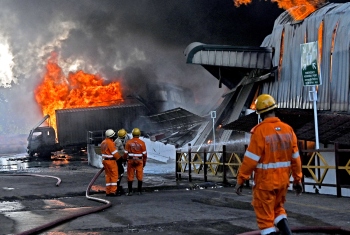
In relation to the fire at the paint factory in Pilerne, it needs to be noted that when paints, solvents and other chemicals stored in industrial tanks catch fire, they affect large areas and reduce the health of a large number of
people.
The toxic haze which could be seen travelling around the region of the industrial estate and the neighbouring rural and urban areas consequently has triggered long-lasting air pollution crises in North Goa.
Pollutants usually get released into the environment through cycles that flow between air, land and water, until they are buried in rivers, lakes, ponds and even as deep sea sediments.
For example, the environmental pollutant Methyl-Mercury ” a highly toxic form of mercury that degrades in high temperature fires and releases gasesous Mercury into the air when Industrial Fires occur. When inhaled, the gasesous mercury vapour tends to affect the nervous, digestive and immune systems, lungs and kidneys, and may be fatal upon prolonged exposure.
While the fire at the paint manufacturing factory in Pilerne are being treated as a Disaster, it needs to be acknowledged that these industrial activities were initiated and sustained in order to further the commercial interests of a private limited company.
Hence, the polluter would need to be held responsible for the lapses and the negligence that eventually led to the fire at the manufacturing facility.
There could exist a situation wherein the company failed to take reasonable care. ‘Care’ is an abstract term therefore, the question is: how do we know if sufficient care was taken or not? In order to determine whether reasonable care was taken or not it becomes important to know the degree of relation between the act of negligence and the accident.
It is important to know that if the party was truly not negligent and had exercised care, then the said incident would not have taken place. Thus, reasonable care has to be determined by looking at the degree of damage caused.
Reasonable care can only be exercised if the risk is known and the harmful events could have been foreseen. Thus, reasonable care will be measured with respect to the risk taken and the degree of harm caused to the victims. Even otherwise, upon a broader understanding of the Law of Torts and its applicability to the environment, a nuisance is said to be created when an owner or occupier of land unreasonably uses that land in a way that substantially interferes with the rights of others in the area.
A government department, such as the GSPCB, traditionally brings a suit to enjoin a public nuisance under the Air (Prevention and Control of Pollution) Act, 1981.
While the by-products are an inevitable part of the manufacturing process, legal principles such as the ‘precautionary principle’ and ‘polluter pays principle’ serve as constitutional mandates seeking to curb the degradation of the environment.
The ‘polluter pays’ principle essentially holds the polluter liable for the pollution caused to the environment. The polluter would be liable for every damage caused to the environment. So according to the ‘polluter pays principle’, the polluter has to not only compensate the victims of pollution but also compensate for the restoration of environmental degradation caused.
Under 1972 and 1974 OECD Recommendation(1)(2), the measures to be taken by the polluter for controlling the pollution is decided by public authorities so that the environment is in acceptable state post the industry operation.
Therefore, the polluter bears the cost of health hazard caused to the public as well as the cost of restoration of the environment. In other words, the costs of the measures should reflect on the cost of the goods and services, the production and/or consumption of which led to pollution.
Article 21 of the Indian Constitution emphasises right to life and personal liberty. Polluting the surroundings of a locality would take away the basic right from the inhabitant.
According to Section 20 of the National Green Tribunal Act, 2010, the Tribunal can apply the principles of sustainable development, the polluter pays principle and the precautionary principle while passing any order, award or decision for balanced development without harming the immediate environment.