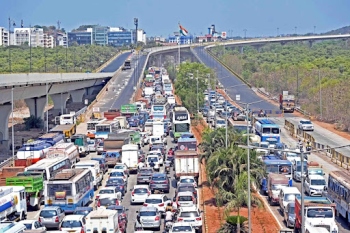
As per the World Health Organisation (WHO), road crash is the eight leading cause of death with more than 1.3 million fatalities and 20 to 50 million serious injuries globally.
The Federation of Indian Chambers of Commerce and Industry (FCCI) in their report titled ‘Road Safety in India - Navigating through nuances’ released on 18th July, 2023 observed:
“1st rank in road fatalities is held by India (11 per cent share in the world). Every year we lose a number of people the size of the population of Estonia,”
Vivek Ogra, Partner, Ernst and Young, commented that:
“Road safety is a complex, multi-dimensional problem that needs all stakeholders to come together. Data is of essence for being the single source of truth and provide deep insights to solve the issue of road safety. The road safety issue needs to be treated like an epidemic with each citizen playing the role of a watchman or a Good Samaritan “ adopting ‘see something, say something’ approach, strengthened by strong policies and a robust implementation by the Government and industry.”
From a global perspective
The United Nations Road Safety Collaboration (UNRSC) is an informal consultative mechanism whose members are committed to efforts and in particular to the implementation of the recommendations of the World report on road traffic injury prevention.
The major focus of the Collaboration is on raising awareness of the issue around the world, through events such as the 1st UN Global Road Safety Week in 2007; World Day of Remembrance for Road Traffic Victims etc., as well as by providing technical support to countries and guidelines on best practice.
Members of the UNRSC have published guidance on how to set up and monitor programmes around helmet wearing, drinking and driving, speed management, seat-belt and child restraint usage as well as how to set up and maintain optimal road safety data systems and road safety management systems.
In hypothetically presuming the relative ease by which Alcoholic beverages can be procured in the State of Goa, the UNRSC efforts against drinking and driving would be of importance in order to generate awareness about the causes behind drunken driving.
According to Walsh et al. (2004) in their research article titled: Drugs and driving published in the Traffic Injury Prevention Journal:
“Driving under the influence (DUI) is the offense of driving, operating, or being in control of a vehicle while impaired by alcohol or drugs (including recreational drugs and those prescribed by physicians), to a level that renders the driver incapable of operating a motor vehicle safely.”
Torry Mastery in her article titled: “Common Reasons Why People Drink and Drive” which was published on the Dotcom Magazine, has enumerated the reasons succinctly:
There are several reasons why people drink and drive, but the most common ones are to try and escape their problems or to feel more confident behind the wheel.
There are many ways people might convince themselves that they’re safe to drive after consuming alcohol. The most common ones include:
Habitual Drunk Drivers:
Some people drink and drive so often that they develop a habit of it. They tell themselves that they know what their limits are, but in reality, they have no idea how intoxicated they really are.
Peer Pressure:
Driving after drinking can be a way to fit in with friends or feel more accepted by them. This is especially common among young people, as they want to hang out with their friends.
Escaping Problems:
Driving after drinking is sometimes done to escape one’s current problems. This could be because they feel overwhelmed by what’s going on, and something else to think about or focus on might make them feel better.
Alcohol Dependence:
People who drink heavily regularly can develop an addiction that makes them more likely to seek out drugs or alcohol when faced with stressful situations or emotions.
Social Drinkers:
People who only drink occasionally may not think they’re in danger of getting a DUI, but even small amounts of alcohol can affect someone’s ability to drive safely.
WHO, in collaboration with international partners, launched the SAFER initiative in 2018.
According to the SAFER intiative:
An effective road safety transport policy should be in place to address drink“driving, together with road safety measures to reduce the severity and risk of drink“driving crashes. Such measures might, for instance, address infrastructure and speed limits.
Legislation should stipulate upper BAC limits for drivers at a maximum of ≤ 0.05 g/dL or lower for the general population, and at 0.02 g/dL or lower for novice and commercial drivers.
Legislation should specify the penalties for violation of such limits, allow for roadside testing (typically of breath) with approved and calibrated equipment, make it an offence for drivers to refuse a roadside breath test, and allow test results to be used as evidence in court.
Penalties should include a combination of administrative sanctions (e.g. driving licence suspension) and criminal ones (e.g. mandatory minimum fines) of adequate severity.
BAC limits are most effective when enforcement is consistent and highly visible, when detection of violation results in penalties that are certain, swift and sufficiently severe, and when supported by effective public education campaigns.
The enforcement of drink-driving laws must be accompanied by strong public awareness campaigns, using mass media and other strategic communications, on the risks of drink-driving and the presence of enforcement activities.
Effective enforcement of drink“driving laws requires a significant amount of police time for conducting and processing random breath-testing activities and sobriety checkpoints, and resources are required in the judicial system to process cases.
Resources are also needed to pay for breath-testing equipment. It is important that the police and judicial system have adequate resources for effective enforcement. The fines collected could be used to finance police activity.