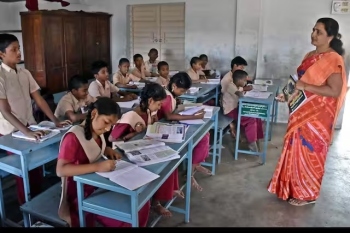
In its recent judgement, the Patna High Court last week expressed deep concern over the State’s insipid approach to providing teachers to the government-run blind residential school. This school was run just by a single music teacher, the HC making sharp observations against government functioning, observed that ‘it appears that the government is interested only in teaching music to the visually impaired students’.
Out of the 11 sanctioned posts of teachers, as many as ten are vacant in the said school. A sorry state of affairs in the State! Worst, indicating apathy over the State government functioning, the Division Bench of the Patna HC showed a need for judicial monitoring of providing teachers and other requisite infrastructure to such schools through day-to-day hearings.
The persistent deficit of teachers afflicts schools even in the national capital, New Delhi. The records from the Delhi UT show that at least a third of the seats across teacher categories at the pre-primary, primary and secondary sections are reported to be vacant. Further 84% of the posts of principals in government schools in the national capital and 34% of vice-principal posts too are vacant. The State of Bihar is one of many lagging States..
In India, as many as 1.1 lakh schools are single-teacher entities. In rural areas approximately, the number is as high as 69%. Further, around 19%, or 11.16 lakh teaching positions in schools, lie vacant in the country.
The above trend is all pervasive in the country. A UNESCO report titled '2021 State of the Education Report for India: No Teacher, No Class' has observed a disturbing shortage of over one million school teachers in India. Simply put, India needs ten times that number to meet the shortfall. The other most striking information is that fewer than one in four schools in India have internet access.
The data from Unified District Information System for Education Plus (UDISE+) for 2020-21 shows that though India someway meets the recommended target of the Pupil-Teacher Ratio (PTR) of 26:1, there are wide regional disparities, especially within the densely populated states and across all education levels, that need to be addressed. There is also a need to improve working conditions for teachers in remote and rural areas. Further, the basic infrastructure needs about digitisation need improvement, with much room for training to equip teachers with the necessary tools to succeed in the classroom.
The region-wise analysis shows that States like Uttar Pradesh (with over one lakh teaching vacancies), followed by Bihar and Madhya Pradesh, recorded the highest number of teacher vacancies. Moreover, over 60% of vacancies in India are in rural areas, with UP topping the list at 80%, while Madhya Pradesh has 21,000 single-teacher schools, the highest in the country.
Almost 8% of India’s schools have only one teacher. A total of 700 government-run primary schools in Gujarat are managed by a single teacher, teaching all students of classes 1 to 8. In the tribal talukas of Himachal, the government primary schools are on ventilators and many with a single teacher. In the backward district Nuh, in Chandigarh, there are 17 primary schools with 1501 enrollments but zero teachers. The same is the case in Karnataka and Jharkhand as per the report prepared by the Gyan Vigyan Samiti in Jharkhand.
Over 12,000 teaching posts in Kendriya Vidyalayas, 4,425 in Indian Institutes of Technology (IITs), and 6,180 in central universities are vacant, the Minister of State for Education said in the ongoing Lok Sabha session. According to the ministry data, 3,271 teaching posts in JNVs, 2,089 in National Institutes of Technology (NITs), 484 in Indian Institutes of Management (IIMs), 353 in Indian Institutes of Science (IISc) and Indian Institutes of Science Education and Research (IISER), 61 in School of Planning and Architecture, and 314 in other institutes are currently lying vacant.
The minister was replying to a Parliament question regarding the number of teaching and non-teaching posts vacant in KVs, Jawahar Navodaya Vidyalayas (JNVs), and higher education institutions in the country.
The report of the National University of Education Planning and Administration (NUEPA) titled ‘Involvement of Teachers in Non-teaching Activities and its Effect on Education’ reveals that teachers spend around 80% of their time in non-teaching activities such as elections, census, disaster relief duties, social enumeration, health dosages, and Block Level Officers (BLO) work.
Although teacher availability is improving in India, secondary school pupil-teacher ratios are still adverse. Private and early childhood education teachers are vulnerable, with many working at low salaries and without benefits. The need for more teachers on the roll has made the workload balance lopsided. The above issues require the government to improve teachers’ employment terms and give them more professional autonomy. There is also a need to improve working conditions for teachers in remote and rural areas; In contrast, even the basic infrastructure needs improvement; a simultaneous focus is needed on training to equip teachers with the necessary tools to succeed in the classroom.
Despite all efforts, our indicators like student-teacher ratios, the number of single-teacher schools, and the number of schools with internet connections are shorter than desired. This indicates that there’s still plenty of room to raise education standards in India, but the beginning has to be made by recruiting the needed teachers. Thus a substantial increase in the education budget is necessary to ensure that more teachers are hired and to stop allocating non-academic activities for teachers in the next couple of years.
A combination of investments in the quality and capacity of teachers, extensive use of technology and relieving teachers from non-teaching activities is required to bring in fundamental reforms in the Indian education system.