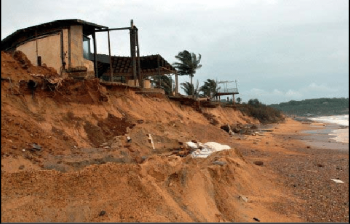
Goa undergoes variable degrees of shoreline changes, erosion and accretion (SEA). While sands could accrete in one area there would be erosion in another area so that a natural equilibrium is established. These natural events in a dynamic marine environment cannot be halted but can be minimised to protect properties and people and their livelihood residing along the coasts.
The SEA is influenced by increased wave activities, storm surges, recurrent tropical cyclones, change in sea-level, climate change and so forth. And by sand mining and constructing temporary and permanent structures along the beaches.
Along India’s 7,500 km (9 coastal States and nearby islands) coastline, 26% of the total population reside. Reportedly, 15% (1,144 km) of India’s coast is eroding resulting in a loss of 3,680 hectares (ha) of land and 4,042 ha is gained by accretion.
According to the National Centre for Sustainable Coastal Management (NCSCM), Goa’s 105-km long coastline, from Querim (Keri) in the north to Polem in the south, is 35% rocky and 20% stable. In March 2023, the Indian Space Research Organisation identified 21.7 km of the coast and 28.8 ha area to be eroded, while accretion occurred along 7.1 km and 13.6 ha area was added. Goa lost about 15.2 ha with severe erosion along the Candolim-Calangute stretch, perhaps due to the grounded merchant vessel ‘River Princess’ as it drastically altered wave and sediment movements for more than a decade.
Protective measures
The SEA is a major concern as Goa is largely dependent on beach tourism and fisheries. There are several ways to protect the coasts such as by using tetrapod, gabion walls, retention walls, geobags and geotextiles. These methods are not fool-proof but help to reduce the SEA, depending on the sites and oceanographic processes. The Water Resources Department (WRD), Goa utilises some of these methods to arrest erosion along the coast.
This author and his co-author had suggested that another protective technique could be to build concrete walls embedded with coconut shells with husks placed in the interstices. The wall could be covered with fine-meshed galvanised steel wires to bear the wave impact. Coconuts being tough and long-lasting resources could be used in a sustainable way to protect our coasts. Also the cost of such a seawall built would be less than the other methods and thousands of shells of raw and ripe coconuts and husks could be better used instead of them ending up in the drainage and heaped in waste collection centres.
Vegetations such as coconut trees, mangroves along the river banks and sand dune friendly plants need to be grown so that the beach sand is not carried away offshore or by longshore movement.
New method to nip erosion: A pilot project called ‘Sand Motor’ is in the offing to protect the coastline in South Goa i.e., from Majorda to Betalbatim, which are about 4 km apart. Prior to implementation Deltares, an independent knowledge organisation in the Netherlands, would be paid Rs 32 lakhs to evaluate the causes for erosion. There would be a three-day site visit by two Deltares staff and a study of the previous works carried out by other agencies. Deltares would provide a report that would detail and confirm erosion, approaches to stop erosion, assistance to a local agency for morphological modelling and interpretation of the results and quantification of the sediment transport rates.
The above is like re-inventing the wheel! Similar and if not more detailed works, have been carried out by the Indian Space Research Organisation (ISRO), National Institute of Oceanography (NIO), NCSCM and National Centre for Coastal Research (NCCR). These premier Indian organisations have collected enormous data through satellite and ground-truthing, identified erosional hot-spots and recommended the different ways to protect Goa’s coast. Their reports may be referred by Deltares when it makes its own!
Sand Motor intervention
An experiment called Sand Motor developed by Deltares may be used to arrest erosion. This ‘mega-nourishment’ approach was first introduced along the Delfland Coast, and involves extraction of a large quantity of offshore sand in a single operation and depositing it along the coast. This could create a strategically shaped peninsula and in due course of time the sand would be redistributed by natural processes and act as a buffer against extreme events. On paper the proposal looks fine but India’s coast in general and Goa’s in particular, is tricky, considering the variable morphology and two monsoon seasons “ southwest (summer) and northeast (winter).
Needed clarifications
How can offshore sand be extracted in one go and deposited along the coast? What kind of machineries would be operated for this purpose? Are they going to create a tsunami-like scenario? Would Deltares’s feasibility report encompass environmental parameters and how to mitigate or reduce the effects? Offshore sand extraction for coastal protection is not legalised by the Ministry of Mines (MoM), hence it would be impossible to carry out the beach nourishment work.
Presuming that MoM approves the work, the Goa government may have to spend crores of rupees to execute the project. Most importantly, the government needs to ponder the consequences of such an experiment. For example, the offshore and onshore geomorphology, sand characteristics, mineralogical changes, biodiversity, and ecosystems would drastically change. Dangerous rip currents could develop due to slope changes along the beach and in the offshore. Beach tourism, shacks and buildings could be affected because of the dumped and redistributed sand.
Theoretically, the sand motor experiment may appear to be ‘attractive’ and feasible but there are long term concerns and unforeseen circumstances which could upset the project of shoring Goa’s coast with sand from the offshore. Beach nourishment may not halt erosion but the excess sand that is dumped by humans would be eroded along with the existing sand from the beach! Incidentally, a gabion wall which was erected and tetrapods that were placed a few months at Keri beach have already developed cracks. Since January 2023 the WRD has undertaken a repairing job at a cost of Rs17.5 crore only and hopefully the work would be completed by March 2024. When such sturdy materials could not withstand the fury of nature, what is dumped sand for her? Considering the vagaries of nature, the sand motor project should not be a wash-out exercise in futility!