This is an untested, speculative theory: if Goa has 800 people who focus on doing something positive, their tiny State could be a rather different place to live in. With or without our politicians. Especially the latter, given all the negatives our political class is capable of.
Before you ask where this figure of eight hundred comes from, let me concede that there's no answer to this. The figure could be 200 or 1,200, but this is just a number from the top of my head. But it seems a large enough figure, to wreck sufficient good on a region the size of Goa.
There is also no evidence to suggest this 'theory' could work, too. We do not have hard, comparable evidence from elsewhere, nor is one aware of relevant scholarly research that supports such a concept.
It is true however that Goa has long been a very communitarian society. 'Communitarianism' lays stress on the connections between individuals and the community. It can be seen as the opposite of individualism; it opposes laissez-faire policies that don't place an emphasis on the stability of the overall community.
Take some proof: look at the enviable not-for-profit, non-government social network Goa still has till date. Or the kudds (residential clubs) that sheltered early Goan migrants to Bombaim. Or, the gaonkari system (of communal land ownership), festivals and religious unity, village-level comunidades, tiatr and folk performances that brought so many together, even mutual aid shared for weddings and funerals.
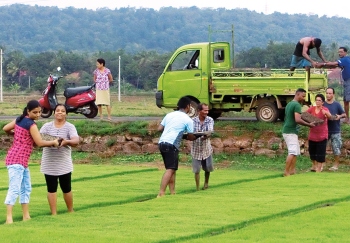
Extended families and clans often came together to help during festivities, ceremonies and even agri activities like sowing or harvesting. Community fishing is something we are fast forgetting. Local markets were not just trading spaces, but social hubs where people interacted and met one another's needs. Coop societies have also played their role since recent decades.
Likewise, there are deep shared heritage practices and traditions. Religious monuments have also been maintained on a communitarian spirit. Villagers are even today quick to respond to a call to clean up their place of worship.
Festivals like the Carnaval, Shigmo or even the Bonderam have held out deep meanings, though these have been fast changing and made into a spectator-sport in recent years. Villagers even shared duties to take the vaddo's cattle or goats for grazing. They did so by volunteering to serve on some days of the week.
Given this background, it should not be too difficult to recognise the role that do-gooders have to play in our society. As a journalist with the chance to meet a range of people, one has encountered many of this kind. Each has their own dream, very different from the others, but it all adds up.
An engineer who studies art decor buildings, another expat who focuses on the work of noted singer Alfred Rose, and so many trying to rebuild the comunidade (gaonkari) system which survived over the centuries. One returned expat who invented a number of modern festivals, now being organised all over Goa.
Or, for that matter, the age-old generation of the 1970s and 1980s, who built the first roots of environmental concerns across Goa. Then, the students' activist generation, starting from the 1970s. They have gone on to play so many diverse roles after graduating, mostly of a positive kind.
There are others in the field of environment too, with young farmers clubs and the like, changing what seems like a hopeless situation of fallow fields and unrenumerative agriculture. More institutionised NGOs have also played their role in this field, pun intended. Silently, and sometimes misunderstood, a band of animal rights' campaigners have been playing their own role.
In the field of books and libraries, a small number of active groups have come up in recent years. Before we start a celebration on the same, clearly a lot more needs to be done.
There are groups working on specific issues, like khazans, the low-lying reclaimed riverside lands. Needless to say, these are critical to Goa, more so in a world threatened by global warming and sea level rise. Don't let a smug US President-elect Donald Trump convince you that this is not a serious issue, with the incorrect statistics he leans on. We have already seen its impact in some coastal and riverine areas in recent years.
Heritage, social justice, and the care for orphans or handicapped and the elderly, are fields where Goa has taken initiatives of its own. Without waiting for government, and often sans official grants. In fact, the latter can act as a dampener on social initiatives, and even go on to discourage the same.
The attempts by single NGOs to take care of street destitutes and the homeless needs to be seen to be appreciated. More so, as we retract into our shell, and don't show much concern for the less fortunate. It's a hard and depressing job, one which not many are able to do.
If this set of do-gooders grows, and gets the support needed from the wider society (not government!) then change could become real. It's always impressive to see someone living their dreams, whether you agree with their priorities or not.
Two caveats though: sometimes, those who are really doing a good job do not get the oxygen of publicity that they need. This is essential for them to grow (and turn scalable), even if they see themselves as introverts.
On the other hand, there are self-promoters who occasionally propel themselves into such network, and try to milk the system for their own benefit while claiming to do something "good". Despite this, every society needs to encourage those who are doing a good, selfless job. Returns from this will take years or decades for us to recognise, but its importance cannot be doubted.