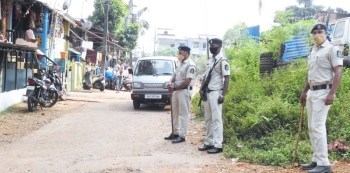
The news emerging from Gogol Housing Board in Margao following the tragic loss of a human life near a place of worship has left South Goa subdued and unsettled. A family has been deprived of a loved one, and a community has been burdened with grief. In such moments, the first response must always be empathy. No political, religious or ideological consideration can ever outweigh the value of a single human life. The law of the land has always recognised that truth, and the Constitution has always been built upon it.
It has been reported that the incident was linked to an internal dispute connected with the administration of a religious institution. That factual details matter. It shows that what unfolded was not a conflict between communities but a breakdown of order within a space meant for peace and reflection. A place of worship is expected to provide spiritual refuge, not to become the setting for confrontation. When such a tragedy occurs in or around a sacred space, it raises not only a criminal law issue but also a constitutional one.
Religious freedom ends
where public order begins
The Constitution of India grants every citizen the freedom of conscience and the right to profess, practise and propagate religion. This freedom is guaranteed under Article 25. Yet the same Article contains an important and deliberate qualification. Religious freedom is protected only so long as it remains consistent with public order, morality and health. This is not a minor limitation. It is the constitutional boundary that ensures faith remains a source of peace rather than a cause of harm.
Articles 26 to 28 reinforce this structure. Religious denominations may manage their own affairs, but only within the framework of secular law. No religion may demand public funds for its promotion, and no religion may be imposed through State institutions. Together, these provisions establish a clear constitutional balance. Belief is protected. Worship is respected. But coercion, intimidation and violence are never permitted to hide behind religious identity.
In the present context, this balance becomes especially significant. When violence occurs near a place of worship, the State is not interfering with religion by enforcing the law. The State is in fact fulfilling its constitutional duty to protect life and preserve public order.
Limits of scripture
Every faith tradition possesses sacred texts, historical narratives and spiritual ideals that command deep reverence among its followers. Yet in a constitutional democracy, no scripture, however sacred, can be treated as a source of legal authority to cause physical harm. Religious teachings may inspire, guide and comfort, but they cannot replace the law of the land.
The Constitution was designed precisely to manage this delicate relationship between faith and civil authority. It does not deny the importance of religion. It simply insists that religion must operate within a legal order that places the right to life at its highest point. Where bodily injury or death is caused, no doctrinal argument can neutralise criminal responsibility.
This principle is essential in a plural society such as Goa. Communities of many faiths have lived together for generations because the law has remained above religious disputes. When that hierarchy is disturbed, when spiritual disagreement turns into physical force, the Constitution must be reasserted without hesitation.
Comparative lessons
History across the world shows that no faith has been entirely free from internal extremism. It is for this reason that constitutional limits exist. In Sikhism, the kirpan is recognised as a religious symbol, and the Constitution itself acknowledges this. Yet it has never been suggested that the symbolic right to carry a kirpan amounts to a right to injure another person. When internal factional tensions have spilled into violence around Sikh religious sites, the law has intervened not against Sikhism, but against the unlawful use of force.
Within Christianity, centuries of theological conflict and power struggles once produced violent outcomes. Modern constitutional democracies do not treat such episodes as continuing authority. Churches are protected. Violence is not.
These comparisons are not made to criticise any faith. They are made to highlight a constitutional truth. The Republic does not judge beliefs. It judges conduct. When conduct crosses into violence, the same law applies to all, without distinction.
Public order duty
The tragedy in Margao must therefore be understood as a test of constitutional maturity. Sympathy for the victim must be accompanied by a clear understanding of how religious freedom functions within the law. Public order is not opposed to religion. It is what allows people of different faiths to worship side by side without fear.
The Constitution does not permit any religious space to become a territory beyond the reach of civil authority. If internal disputes arise within religious institutions, they must be resolved through lawful means. When those disputes turn violent, the response must be firm, neutral and guided by legal principle.
This is not an erosion of faith. It is its protection. A religion that is allowed to be associated with intimidation or bloodshed risks losing its moral credibility. A State that hesitates to enforce the law in such settings risks weakening the Republic itself.
Religious freedom is a cherished right, but it is not a licence to harm. The right to worship exists alongside the right of every person to live in safety and dignity. Where these two values appear to conflict, the Constitution has already resolved the question. Life and public order must prevail.
In remembering the life that has been lost, society is called upon not to retreat into suspicion or division, but to reaffirm the rule of law. That is the only path by which faith can remain a source of unity rather than a cause of sorrow.