One of those 'breaking' news stories caught the eye the other day. It quoted Union road transport minister Nitin Gadkari as saying that a 5.15 km long, six-lane "elevated corridor" with approaches would be built "between Sangolda junction to the Majestic Hotel section" of NH-66. This would cost a total of Rs 641.46 crore!
That's a lot of money, and a lot of concrete. Are we in one mad hurry to concretise our future, and fill up green Goa with a whole lot of grey.
We all know that there are bottlenecks along our highways. Porvorim is, undeniably, one of those. The government spends a lot of money to complete one section of our roads (like the third Mandovi Bridge) and highways. But then it wakes up, only to realise that there is a bottleneck somewhere else.
Goa's vehicle population has been growing with amazing speed. 1.4 million registered vehicles in end fiscal 2019 (statista.com). The tourism boom -- seen in some years, but it lacks regular growth --, has led to many more individuals entering the transport business. Small players have invested in vehicles of their own. Sometimes, their investments has gone down the drain. But this has increased the congestion along the roadsides all the same.
In some cases, the widened roads have ended up as parking spaces for one and all. On Monday, when the chief minister decided to celebrate his 50th birthday in Saligao, an urgent SOS went out on a village network.
It read: "Move your vehicles from the Panchayat-Saligao Deck area urgently or be ready to pay the hefty fines... Request to the owners of those cars which are permanently parked opposite Saligao Panchayat-Saligao Deck area. It has become a nuisance for traffic management. If the car owners do not remove the cars urgently, RTO-Police will take necessary action and the owners will have to recover their cars after paying hefty fines. Car owners better move your cars from that area urgently. There's a CM address on public grievances... and police wants the area to be cleared. Those who know the owners of these cars please pass [on] the message."
Increasingly, the solution we are going in for seems to be: More vehicles? No problems. We'll build more flyovers, and elevated corridors.
Tonnes of money spent, also no problem. If well-connected contractors are happy, then that makes for good politics too.
Around the same time as the Union minister's announcement, a tiny lane in our vaddo (village hamlet) get a coat of new paving tiles. Increasingly, there have been more areas of the village that have coming under concrete, paving tiles, and even bathroom tiles (used in open spaces!) Is the situation the same in your areas?
Of course, we need better roads and spaces. But how 'better' is better? Just because we concretise an area, are we doing something beneficial for the long run?
In the case of the village paim-vatts (pathways used for walking), covering the same with tiling is a complete waste of money. Besides, it is ecologically unfriendly as well.
Our villages are, in many cases, bounded by hills on some (or all) sides. During the monsoons, there is a torrent of water gushing down from the hilltops. This water needs to flush down our rivers, and into the sea. Logic suggests that some of it also needs to be digested into the ground.
Tiles on such paths make the place more concretised, slippery and eco-unfriendly. It is time the Comptroller and Auditor General's office checks whether such works are actually productive or not. In a Goa which is seen as under increasing threat of climate change, the issue becomes even more pressing. We've had three very intense monsoon seasons (2019, 2020 and 2021) and even a cyclone in May 2021. Don't we need to think of our future needs, not just see things from a contractor's eye view?
In the case of building more flyovers and elevated corridors, the issues are even more serious. This issue needs skilled study to know the future impact.
But even at this time itself, we are seeing increasing flooding in areas where flyovers have rampantly come up. This is only to be expected, as these structures were built with little concern for the land and its environment.
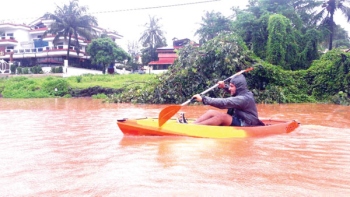
Take the case of Guirim, or even Bambolim. The photo which went viral a year or two ago, showing locals 'kayaking' along the flooded highway at Bambolim, is an important case in point. After the flooding, we forget these issues. But why is it happening in the first place?
Many years back, one had come across a film on the flooding of Bihar. One of the points made there, and still at the back of one's mind, is that the building of railways and roads in a east-west direction (when the rivers flowed north-south) had caused severe problems. These had become into dams of sort, sharply blocking the water flow.
Flooding in Bihar is an issue which arises almost every year. No long-term questions are asked. The economy of an agrarian state has been devastated. Do we want more of the same in green but fragile places like Goa?
Yes, we do need to find solutions to our road congestion and traffic chaos woes. But mindlessly building flyovers and elevated corridors is unlikely to bring in long-term, sustainable solutions.