Goa has undergone a DNA test as far politics goes, and all involved have emerged rather poorly. From the provocative comments, to the knee-jerk responses, and the foot-dragging official reactions, we have all clearly failed in dealing with what should have been seen as bigoted rantings.
Yes, it is indeed hurtful when someone makes a negative comment, that questions your own beliefs. It is even more hurtful when such comments seem aimed to hurt, to insult and offend. Granted that the "clarification" given by Subhash 'DNA' Velingkar rubbed even more salt into the earlier hurt. He seemed to be only further at proving his bias in understanding diversity. But the point is actually somewhere else.
Firstly, if someone says something nasty or distasteful about my beliefs, how does it affect me? In today's India, it is very easy to offend one another over beliefs and faiths.
Yet, what a waste of time to focus all our energies and intentions around just one person's thoughtless (or, maybe, carefully manipulated) comment. It distracts us from so many other more important issues; maybe that was the very intention of doing so.
Just when Goa is questioning its authorities over so many controversial decisions, here comes a neat distraction from it all. Velingkar's comment should have been ignored with the contempt due. Why is he so concerned about a historical figure from a religion he has no connection to?
Secondly, assuming that Velingkar's comment was indeed meant to provoke, aren't those who are responding simply falling prey? Do we oblige and get provoked when someone else wants us to?
In a sense, to respond and react in groups also creates a show of strength. That we have the numbers, we will not take things lying down, and we (as a community) do not want to be taken lightly. But there is a risk in taking such a position.
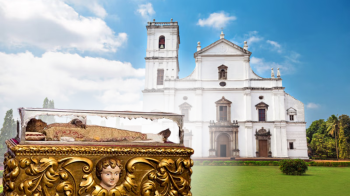
Anyone wanting to provoke you can easily do so, by thinking of a rather bizarre issue out of the blue. Everyone knows that 2024-25 is the year of the Exposition, so why not rake up something related to a figure many Goans (not just Catholics) treat with reverence?
The factory producing controversies over the Basque missionary has been overactive for long now. The willingness to criticise Xavier, or rake up controversy at the slightest excuse, also shows not just a dislike for a sixteenth century historical figure, but for one who lived his beliefs, spread his faith, and dedicated his life to it.
We live in times when the commitment of the State to diversity is itself sometimes suspect. Those offended and outraged should, rather than supplicating the state, instead dedicate time to understand 21st century politics based on the business of hate and bigotry.
In such a context, little can stop anyone with an agenda from making another provocative comment. Firefighting is pointless.
Persistent campaigning online shows the attempts to link Xavier with the Inquisition too. Alan Machado (Prabhu), author of Goa’s Inquisition -- Facts Fiction Factoids, writes: "Xavier was in the vanguard of the Christianisation of Goa. He becomes, therefore, a logical target for sections of society intent on delegitimising Christianity in Goa. These sections, while blackening further the Black Legend, attempt to place the responsibility for the arrival of the Inquisition in Goa on Xavier."
For this, the 'evidence' is a letter Xavier wrote in May 1546 to the King from the Moluccas, urging him to extend the Inquisition's jurisdiction to Asia, to counter those who practised Judaism and Islam in Portugal's overseas fortresses. He was not the first to request this, and died 15 years prior to the Inquisition reaching Goa. Lisbon also took many years to formulate its policy to counter its perceived threat to Portugal's Asian trade from Jewish and Muslim merchants. History of the 16th century is being confused with politics in the 21st.
At other times, the growing inter-religious suspicion across Goa, and the rest of South Asia, takes on strange shapes. During an earlier Exposition, a story was floated that ultras supported by a neighbouring country might disrupt the religious event. In response, there were sandbags placed at some points, making this look like a conflict-zone.
Sensible folk need to shun religious conflict and strife. More so, the religious minorities.
The PTI (Press Trust of India) journalist in Goa, late Flaviano Dias, put it aptly when he would say: "The relationship between minorities and communalism is like that between a watermelon and a knife. Whether the knife falls on the watermelon, or the watermelon falls on the knife, it's the watermelon that always gets hurt."
The Church would meanwhile do well to avoid dependence on the State, even when the carrot of Exposition funding is held out. Politicians, who are quick to show their bias, do not deserve front pews in religious events. To keep it fair, all should be treated equally, just like any other devotees are.
In our times, religious rivalry and conflict has been getting so much legitimacy. Mainstream politics has incorporated quite some of this too. For instance, Chief Minister Pramod Sawant created a false equivalence by comparing Velingkar's distasteful comments with those made earlier by Fr Bolmax, the latter being simply blown out of proportion.
At the end of the day, don't allow provocative comments to attain their goal. That is, to provoke. Not only because "an eye for an eye makes the whole world blind" (Gandhi), and Matthew 5:38-42 ("Do not treat evil with evil, but rather with love"). But also because getting you to react is just what they want you to do....