


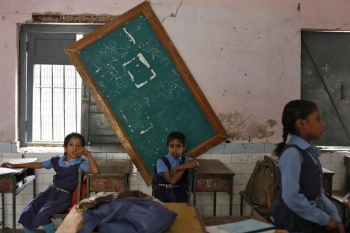
The new education policy defines a good education institution as one in which every student feels welcomed and cared for, where a safe and stimulating learning environment exists, where a wide range of learning experiences are offered, and where good physical infrastructure and appropriate resources conducive to learning are available to all students. Attaining these qualities must be the goal of every educational institution.
The National School Safety Policy Guidelines clearly states that disasters are a critical threat to the well-being of children.
There is enough evidence to reflect that the quality of school premises has a bearing on a child’s vulnerability to disaster risks.
The National School Safety Policy Guidelines apply to all schools in the country “ whether government, aided or private, irrespective of their location in rural or urban areas.
However, the condition of government schools is admittedly pathetic.
Poor and inadequate infrastructure severely hampers the functioning of government schools in India, besides lacking basic facilities such as proper classrooms, clean drinking water, toilets, libraries and playgrounds.
The issue of dilapidated school buildings in schools across the country is definitely concerning and despite interventions by the courts directing state governments to improve the condition of all the tumbledown school structures, hardly has any progress been made in this front.
With the ceilings and walls threatening to collapse any moment, it is difficult to understand the lethargy shown by district administrations in giving repair and maintenance works the priority it deserves.
The national report on ‘Safe and Secure School Environment’ 2019-20 based on a survey of several schools across 12 states carried out by the National Commission for Protection of Child Rights (NCPCR) to examine the safety and security of children in schools in terms of different indicators, observed that about 22 per cent of schools across the country are operating from old or dilapidated buildings, while 31 per cent schools reported cracks in structures.
Nineteen per cent of the schools were located near rail tracks, whereas only one per cent has speed breakers with zebra crossing sign for safety and security of children.
A manual on safety and security of children in schools developed by National Commission for Protection of Child Rights was brought out in 2021 as a compilation of various existing and approved guidelines, circulars, notifications, government orders on safety and Security related issues in schools issued from time to time.
The chapter on Components of School Safety extensively deals with infrastructure.
It says: “As teachers and children spend a substantial part of their day in school, it is essential to keep the school environment, including building, premises, entrance and surroundings that comprise the broader term ‘Infrastructure’ safe and secure. It is important to see that school buildings are built to be more resilient to hazards and ensure ‘life safety’.”
So far I have dealt at length with facts and figures freely available on the net vis-Ã -vis the subject under consideration. Unfortunately, it is observed that there are umpteen guidelines, but no adherence to any of those stipulated which guarantee students safety and security in schools!
The incident at Government High School, Vasco, last Saturday, should serve to jolt the administration out of its reverie!
It was Providence that saved about hundred students of the school as pieces of the overhead concrete slab came crashing down hours before classes could resume for the day.
With many complaining of electric shock from the structure due to some fault in the power circuit, the overall situation was indeed shocking!
Reports that most of the government schools in the state are in a pathetic condition with serious structural issues that pose a risk to students have however not elicited any response from the state administration.
From leaking and collapsing ceilings to faulty wiring, it is as if the students and teachers have been left to fend for themselves in hostile conditions. Is this the sort of safety and security being extended to the youngsters?
Governments over the years have been going gaga about initiatives undertaken to renovate and upgrade many schools in the state from time to time. But the fact remains that these ‘honourable’ intentions pale when compared to the absolute listlessness shown towards many other such institutions which cry for urgent attention.
If it necessitates protests by students and their parents on Day-1 of the academic year to draw the attention of the education department towards the sorry state of their school, as it was done in the case of the government-run Morpila Primary and High School last month, it speaks a lot for the utter callousness exhibited by the department officials towards carrying out repairs and maintenance of the school from time to time.
This brings to fore the ineffectiveness of the government to have a mechanism in place to undertake periodic surveys and structural audits of its schools.
Considering the recent mishaps, it becomes pertinent to have the structural health of the schools being accorded top priority with inspections to that effect being carried out on a regular basis.
Besides, if reports are to be believed; barring a few, most of the government schools in Goa are in a run-down and dilapidated state.
Imagine imparting and acquiring knowledge as those important aspects of teaching and learning being carried out from within the confines of ramshackle buildings, where leaking ceilings and everything that is an antithesis of a clean and healthy environment is an everyday feature of their existence.
The education department needs to ensure that the children, the students, deemed to be the future of tomorrow, are afforded clean, safe and secure environments to pursue their studies.


