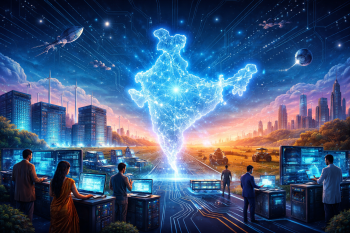
Artificial intelligence is no longer merely a technological advance; it is fast becoming a form of public infrastructure. The ability to build, deploy, and govern AI systems will increasingly shape how states deliver services, regulate markets, manage resources, and protect citizens’ rights. From healthcare diagnostics and climate modelling to welfare delivery and urban planning, AI is being embedded into the everyday machinery of governance. In this sense, AI is not just a question of innovation policy; it is a test of governance capacity and strategic autonomy. Yet India risks entering the AI era in a familiar position: indispensable, but dependent.
India generates some of the world’s largest volumes of data. Through digital public infrastructure”identity systems, payments platforms, and expanding digital health and education networks”the Indian state has enabled data creation at population scale. This achievement is rightly celebrated as a foundation for inclusive digital growth. But data abundance, by itself, does not translate into technological capability or political leverage. Without domestic control over computing infrastructure and foundational AI models, the economic and strategic value of this data is largely captured elsewhere.
Globally, AI capability rests on three interlinked pillars: compute, data, and models. On compute, India remains heavily import-dependent. Advanced semiconductors and large-scale data centres are capital-intensive, geopolitically sensitive, and concentrated in a handful of countries. Recent disruptions”from export controls to supply-chain shocks”have underscored how fragile access to compute can be. On models, the most powerful systems are developed by a small number of firms with access to enormous capital and computing resources, primarily in the United States and China. India’s role, despite its deep engineering talent pool, remains largely downstream”focused on integration, services, and adaptation rather than foundational innovation.
This asymmetry has consequences beyond economics. When core AI capabilities are controlled by foreign platforms, key decisions”about optimisation priorities, language support, pricing, and access”are made elsewhere. Over time, this can constrain policy autonomy in sensitive domains such as healthcare, agriculture, welfare delivery, and public administration. Dependence on external AI systems is therefore not merely a commercial risk; it is a governance risk.
India’s real comparative advantage lies not in scale alone, but in context. Its linguistic diversity, informal economy, uneven infrastructure, and complex social realities create use cases that differ sharply from those of richer economies. AI systems that work in India must operate under tight constraints: low bandwidth, noisy data, multiple scripts, and wide variations in literacy and income. This is where initiatives such as Bhashini, the national language mission, and AI4Bharat, a research collective focused on open, Indian-language AI, become strategically important. They demonstrate that building foundational language models and datasets for low-resource Indian languages is both feasible and necessary for public service delivery. Solutions developed in such environments”whether for diagnostics, agricultural advisories, climate adaptation, or multilingual interfaces”can have global relevance.
However, these initiatives remain exceptions rather than the norm. India’s AI ecosystem is characterised by fragmented research funding, limited access to shared computing resources, and risk-averse public procurement. Promising pilots rarely scale into national capabilities. Universities and public research institutions struggle to retain talent, while intellectual property generated domestically is often commercialised abroad. In this vacuum, private incentives dominate, favouring metropolitan, English-speaking, high-income markets.
This leads to an unavoidable normative question: who benefits from India’s AI trajectory? If AI development is left primarily to market forces, it will likely deepen existing divides”between urban and rural India, between English and non-English speakers, and between large firms and small enterprises.
Technologies optimised for affluent users and global markets will crowd out applications aimed at public services and marginal communities. For a democracy of India’s scale and diversity, such an outcome should be unacceptable.
India therefore faces a strategic choice. It can continue to treat AI as a sector to be enabled through start-ups and foreign partnerships, hoping that capability will emerge organically. Or it can recognise AI as a form of public-interest infrastructure, requiring deliberate state capacity-building. This does not imply technological isolation. It implies sustained investment in applied research, shared compute infrastructure accessible to universities and start-ups, and procurement policies that create reliable demand for indigenous AI solutions in health, agriculture, education, and urban governance.
There is also an opportunity to articulate a distinct model of AI development. Unlike the market-dominated American approach or China’s state-commanded system, India could pursue a third path”centred on open standards, federated systems, and public accountability. Its experience with digital public goods suggests this is possible, but success will depend on coordination across ministries and political commitment beyond pilot programmes.
The window for action is narrowing. AI capabilities compound: early leaders attract more talent, data, and capital, making it harder for late movers to catch up. India’s experience during the software services boom”where it became globally indispensable yet rarely decisive”offers a cautionary lesson.
India does not need to dominate the global AI landscape but it must avoid becoming structurally dependent on technologies it does not shape or control. Moving from being a data mine to a country with meaningful AI capability is not a matter of prestige. It is a test of state capacity, democratic governance, and long-term resilience. The choices made now will determine whether India governs with AI”or is governed by it.
(The author is a security researcher who writes on cybersecurity, technology policy, national security, and defence)