Dr Jaime Rangel
On the birth anniversary of the Father of the Nation, it is perhaps fitting to turn our minds to the teachings of Mahatma Gandhi and, in particular, to one aspect of his political philosophy that remains deeply relevant to India today: The importance of dissent.
In a democracy such as ours, founded on a secular and liberal Constitution, dissent is not an aberration. It is an essential part of democratic life. Yet, across the world and increasingly in India, the space for dissent appears to be under growing pressure. Voices that question authority are often treated with suspicion, and disagreement is sometimes portrayed as hostility towards the nation itself.
Gandhi's own life offers a powerful rebuttal to such thinking. Mohandas Karamchand Gandhi was, in many ways, one of history's most consequential dissenters. His dissent was not born merely of political ambition but of a deeply held moral conviction that injustice must be resisted, and that individuals have a responsibility to oppose wrong even when the authority enforcing it is powerful.
It was a personal experience in South Africa that set him on this path. Gandhi had travelled there to take up work with an English company. Having purchased a first-class railway ticket, he entered the appropriate compartment and took his seat. But railway officials, objecting to his presence because of the colour of his skin, ordered him to move to a third-class compartment. Gandhi refused.
He was eventually thrown off the train by the police. The humiliation he experienced that night at Pietermaritzburg became one of the defining moments of his life. His experience in South Africa transformed him into an outspoken opponent of racial discrimination and injustice.
It was also during his years in South Africa, including his periods in prison, that Gandhi encountered the writings of the American philosopher and writer Henry David Thoreau, particularly his essay ‘Civil Disobedience’.
When he returned to India in 1914, Gandhi brought with him not merely political ideas but a distinctive method of resistance. He turned his attention to poverty, caste discrimination, communal divisions and the struggle for independence. He sought Hindu-Muslim unity and campaigned against the treatment of sections of society then regarded as ‘untouchables’.
His method was revolutionary precisely because it rejected violence. Gandhi called for strikes, protests, boycotts and civil disobedience against British rule. But he was equally prepared to withdraw a movement if it descended into violence.
During one of his trials, Gandhi articulated this principle with characteristic clarity: “In my humble opinion, non-cooperation with evil is as much a duty as is cooperation with good.”
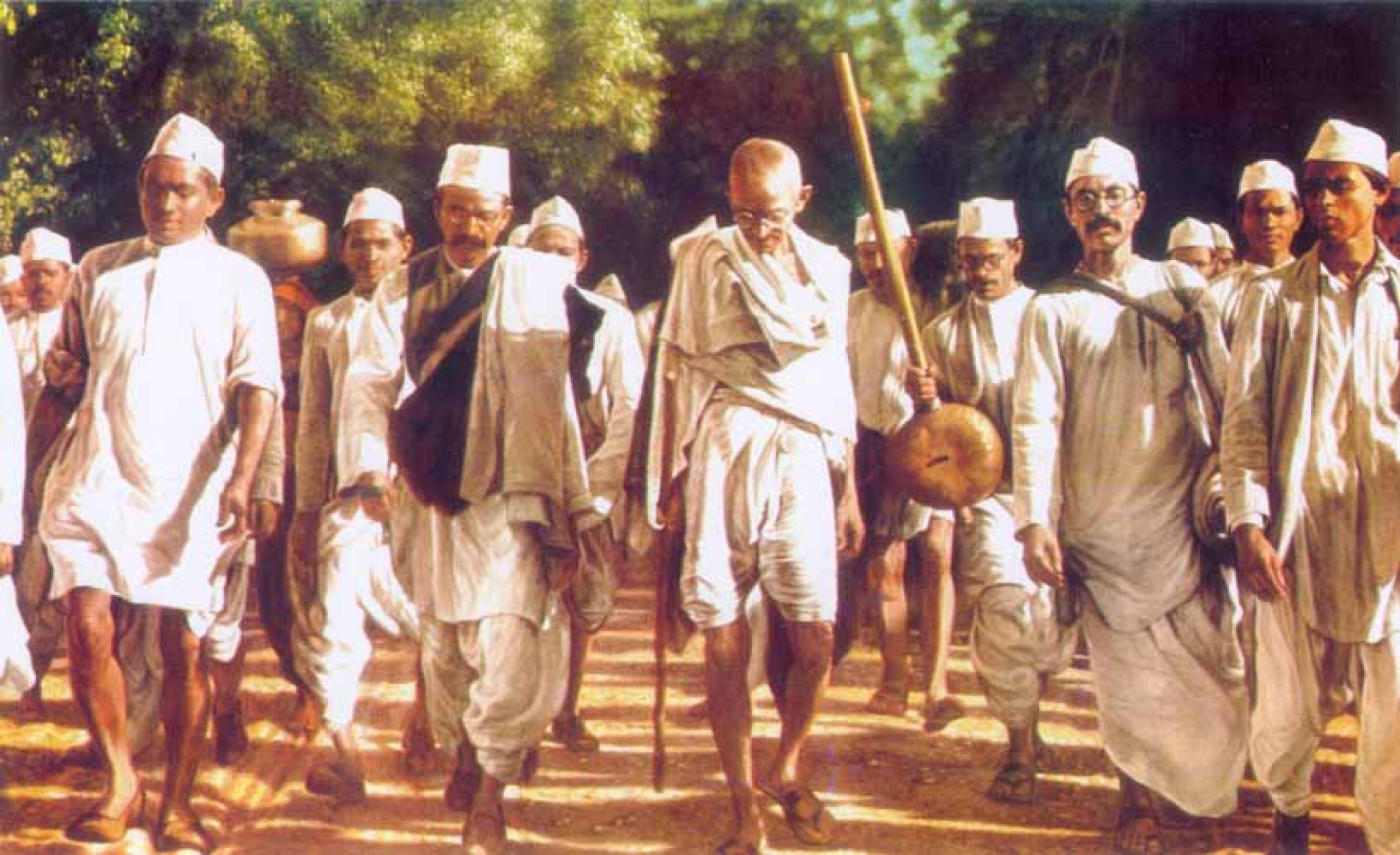
Perhaps no episode demonstrated this philosophy more dramatically than the Salt March of 1930.
On March 12 that year, Gandhi set out from Sabarmati Ashram with a small group of followers to challenge the British monopoly over salt. The salt laws prevented Indians from freely collecting or selling salt and imposed a tax on an essential commodity. Gandhi recognised that salt was not merely an economic issue. It was something used by every Indian, rich or poor, and therefore offered a powerful symbol of the injustice of colonial rule.
Gandhi walked approximately 240 miles to Dandi on Gujarat's coast. What began with fewer than a hundred followers grew into a mass movement as thousands joined along the route. When Gandhi reached Dandi on April 5, the Salt March had become a powerful act of collective defiance.
Dissent is one of the most important non-violent instruments available to citizens when they confront injustice or the abuse of authority. In a democracy, disagreement with a government, a political party or a particular policy cannot automatically be equated with opposition to the nation.
History repeatedly reminds us what happens when dissent is suppressed. The twentieth century witnessed the rise of fascist, communist and military dictatorships that sought to control public thought and silence opposition. The two World Wars demonstrated the catastrophic consequences of allowing authoritarian ambitions to overwhelm institutions, reason and human freedom.
Even governments that describe themselves as democratic can become uncomfortable with criticism. Those who dissent can be mocked, vilified or portrayed as enemies. As playwright Harold Pinter observed, “It's so easy for propaganda to work, and dissent to be mocked.”
The challenge, therefore, is not simply to defend dissent as a political right but to understand it as a moral responsibility. A citizen does not cease to be patriotic merely because he or she questions the government of the day. On the contrary, there are moments when remaining silent in the face of injustice can itself become a failure of civic responsibility.
Gandhi's legacy is particularly important in this regard because he demonstrated that dissent need not be driven by hatred. One can oppose an unjust law without hating those who enforce it. One can resist injustice while remaining committed to non-violence.
That distinction is increasingly important in an age of polarised politics, instant communication and aggressive propaganda. Democratic societies need disagreement, but they also need citizens capable of disagreeing without abandoning civility and humanity.
As we commemorate Gandhi's birth anniversary, his most enduring lesson may therefore be found not simply in the political victories associated with his name but in his insistence that conscience must remain stronger than fear.
Historian and academic Ramin Jahanbegloo has written that Gandhi's universal message can be measured by his immense influence on forms of dissent against unjust regimes. In that sense, Gandhi has become part of what Jahanbegloo describes as the “moral conscience of humanity”. That conscience remains relevant.
Nations are not strengthened when citizens are afraid to question. Democracies do not become stronger when dissent disappears.
Gandhi's life reminds us that dissent, when rooted in truth, non-violence and moral courage, need not weaken a nation. It can be one of the ways in which a nation remains true to its highest ideals.