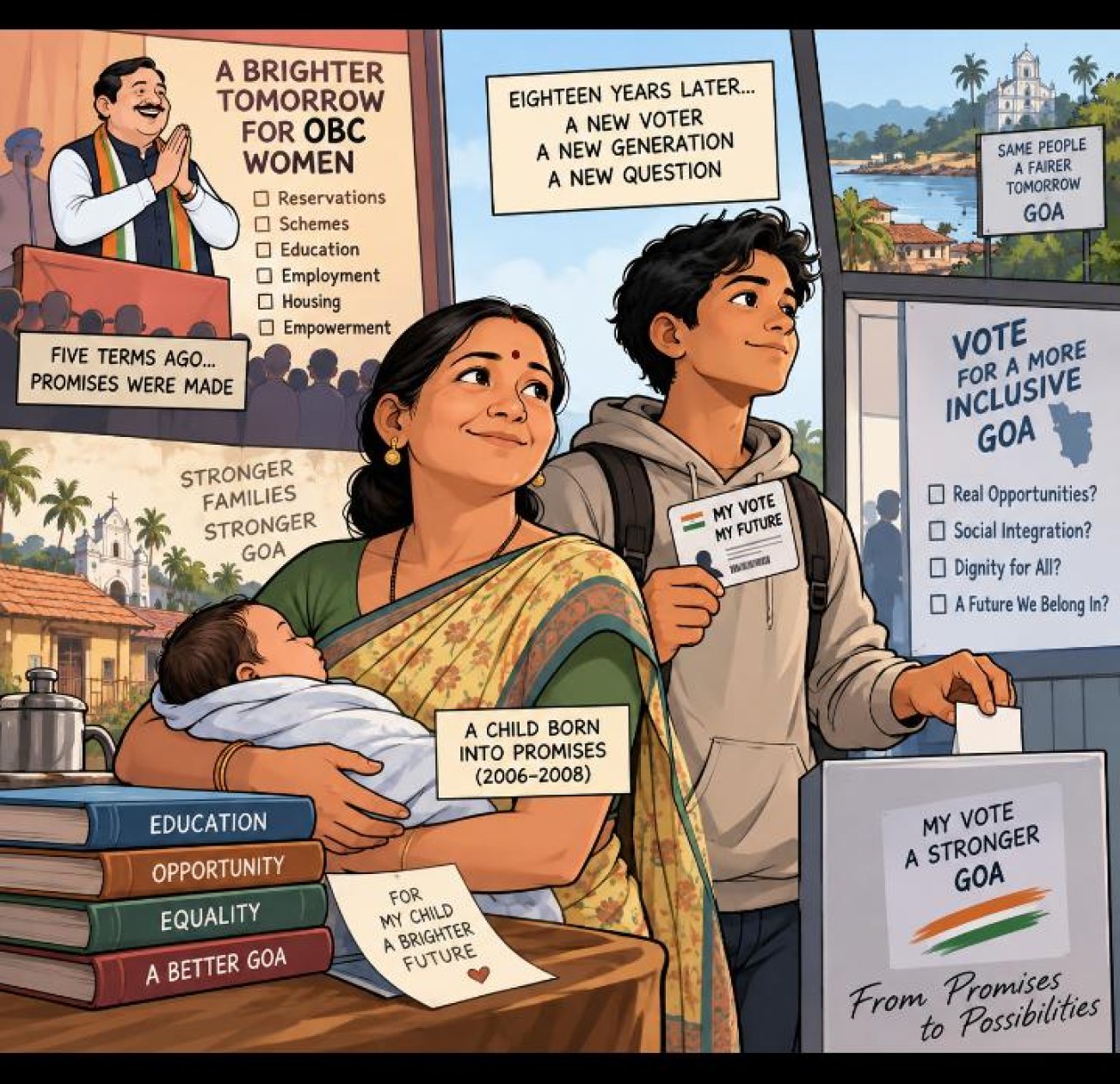
Nearly two decades ago, a woman belonging to an Other Backward Class (OBC) community in Goa could have been promised a brighter future through reservations, government schemes and political representation. Her social advancement was presented as an objective of public policy, while the education and employment of her children were projected as the eventual rewards of empowerment.
The significance of this transition is seldom examined. A generation born into households that experienced the expansion of reservation politics has now become entitled to participate independently in the electoral process. The mother who was once approached as a beneficiary of political promises is accompanied by a son or daughter capable of evaluating their fulfilment.
The electoral consequences of this generational transition deserve examination, particularly in Goa, where caste, migration, local patronage and welfare have become intertwined with constituency politics.
From reservation to
social aspiration
Reservation was conceived as an instrument of substantive equality rather than a guarantee of social assimilation. Yet, across successive electoral terms, the promise of advancement has frequently been communicated through access to education, employment, housing and political office.
The distinction between advancement and integration remains important. A household may acquire a permanent dwelling, a government appointment or improved educational opportunities without necessarily escaping inherited social distinctions. Material advancement may be achieved while caste continues to influence marriage, occupation, social acceptance and access to influential networks.
This phenomenon bears some resemblance to sociologist MN Srinivas' concept of Sanskritisation, through which upward social mobility was pursued by adopting practices associated with traditionally dominant castes.
However, democratic politics introduces another dimension. A community need not merely imitate established social elites when political representation offers an independent route to recognition.
The aspiration of the mother may therefore differ from the expectations of her child. What was once perceived as an opportunity to enter established social structures may subsequently be understood as an entitlement to participate in determining their direction.
The Bharatiya Janata Party's engagement with OBC, Scheduled Caste and Scheduled Tribe communities may be examined through its organisational relationship with the Rashtriya Swayamsevak Sangh and associated social-service networks. Community programmes, welfare outreach, local workers and sustained organisational contact have formed part of this political ecosystem. Such engagement may communicate belonging through participation in a wider national identity, alongside the material benefits associated with government programmes.
The Congress has approached caste representation through a different combination of constitutional commitments, social justice programmes, reservation policy and, more recently, demands for caste enumeration. These approaches are not mutually exclusive. Nor can the preferences of OBC voters be inferred merely from their caste identity.
Nevertheless, an important distinction arises between being recognised through an administrative category and experiencing recognition through sustained political participation.
A voter may encounter a manifesto during an election, but political familiarity can also be developed through years of interaction with local representatives, party workers and community institutions.
In Goa, this relationship deserves scrutiny wherever an MLA belonging to an established social or economic elite has maintained a political relationship with communities historically excluded from comparable influence. The question is whether political proximity has been accompanied by substantive social advancement.
Goa's suburbs and
settlements of hope
Goa's changing residential landscape offers another dimension to this inquiry. The expansion of suburban neighbourhoods, village settlements and migrant residential clusters has created new concentrations of electoral participation. Some households have experienced considerable economic mobility, while others continue to confront insecure housing, inadequate infrastructure and uncertainty concerning land occupation.
However, migration, poverty, OBC status and residence in an informal settlement cannot be treated as interchangeable demographic categories. Their legal and social characteristics differ substantially.
The dependence of a household upon an elected representative for basic services also raises a larger constitutional concern. Access to lawful public entitlements ought not to depend upon personal political allegiance.
Demographic question
The children born around 2006–2008 are now entering adulthood. Yet, their emergence cannot be equated with proof of an OBC electoral majority.
Goa's total fertility rate was recorded at approximately 1.3 children per woman under the National Family Health Survey, 2019–21 (Ministry of Health and Family Welfare, 2021). This is substantially below the replacement level.
Japan provides an instructive comparison. Its total fertility rate stood at 1.20 in 2023, against the background of prolonged population ageing and declining births (Statistics Bureau of Japan, 2025).
Although the two societies differ considerably in population structure and migration, the comparison demonstrates why reproductive behaviour alone cannot explain electoral change.
A sizeable community may contribute a substantial number of newly eligible voters without exhibiting unusually high fertility. Equally, the political significance of a younger generation depends upon its proportion within the electorate, geographical distribution, registration and actual participation.
Goa-specific age-wise and caste-wise electoral data would therefore be necessary before any claim concerning the numerical predominance of newly enfranchised OBC voters could be established.
The womb remains a metaphor for generational succession, not a statistical explanation of electoral outcomes.
Inheritance of
political consciousness
The more consequential inheritance may ultimately be political rather than biological. A child raised during two decades of welfare programmes, reservation debates and increasingly visible caste representation may possess expectations different from those of the preceding generation.
Such expectations cannot be presumed to translate into loyalty towards any particular party or candidate. They may instead produce questions concerning the quality of education, employment opportunities, housing security, discrimination and the accountability of elected representatives.
The next electoral cycle in Goa will consequently offer an opportunity to examine whether political recognition has developed into durable social integration.
The mother was promised advancement. Her child has inherited the right to examine what was delivered. The constitutional achievement lies not in the production of another voter, but in the emergence of another citizen whose political choice belongs entirely to that citizen.