MAPUSA
On paper, the politicalarithmetic in Bardez appears heavily tilted in favour of the BJP. But beneaththe seemingly comfortable numbers lies a more complicated electoral battle,with three political formations taking shape ahead of the 2027 Assemblyelections and the opposition vote once again threatening to be divided.
The seven Bardezconstituencies – Mapusa, Calangute, Siolim, Saligao, Porvorim, Aldona and Tivim– currently present the BJP with a formidable starting position. Six of theseven seats are with the BJP following the defection of three Congress MLAsafter the 2022 election. Only Aldona remains with the Congress.
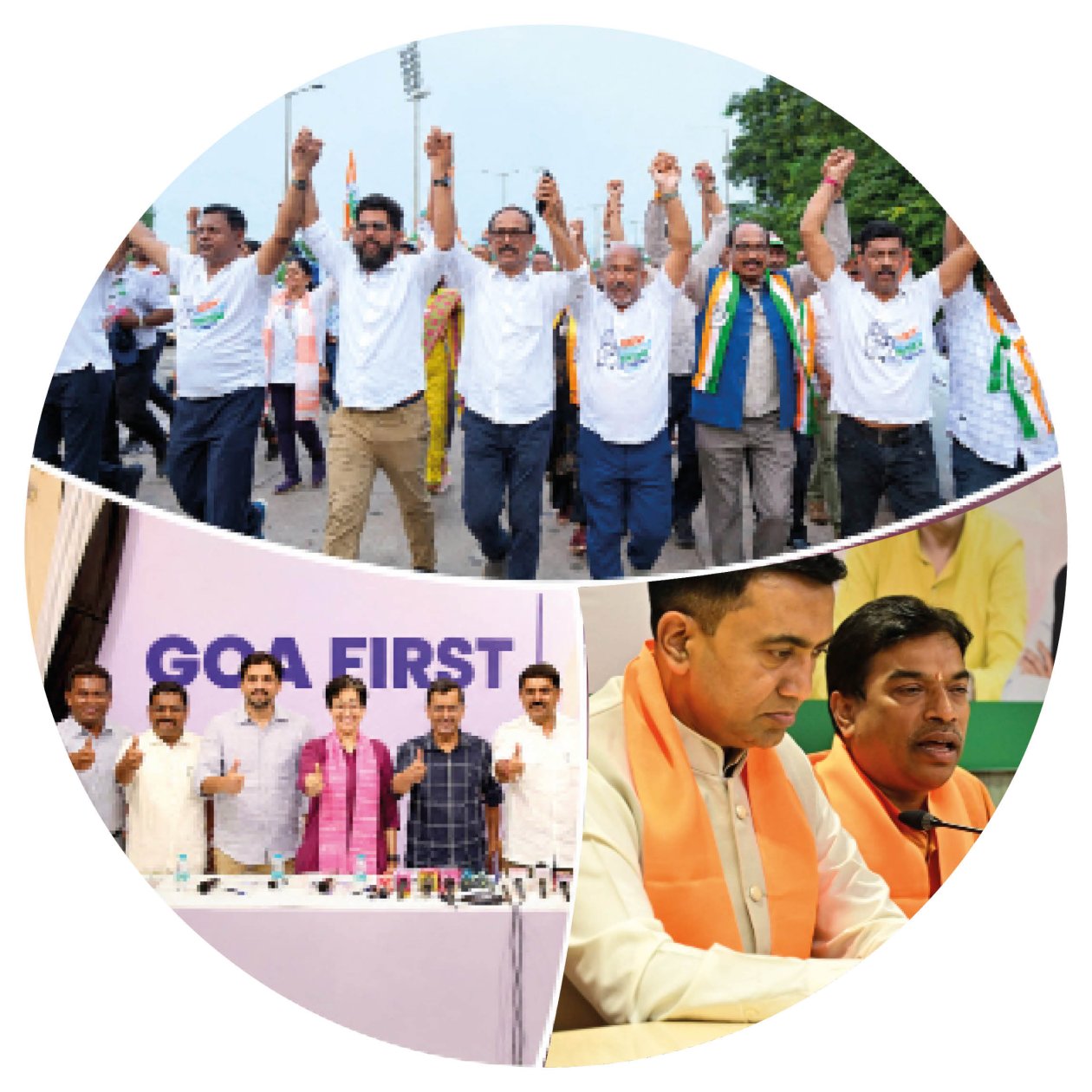
The emerging three-wayalignment is broadly the BJP-MGP combine, the Congress-RGP understanding andthe newly launched AAP-Goa Forward Party alliance, Goa First.
The latter was formallyannounced on September 13 as a non-BJP, non-Congress alliance.
Congress and RGP,meanwhile, have reached an in-principle understanding to fight the electiontogether, although seat-sharing and other details are yet to be finalised.
The immediate questionfor Bardez is therefore whether the opposition alliances can convert theircombined political presence into an effective electoral challenge – or whethertheir separation will leave the BJP with an advantage in constituency afterconstituency.
The 2022 results providean interesting baseline.
The BJP won Mapusa,Porvorim and Tivim, while Congress won Aldona, Calangute, Saligao and Siolim.Congress candidates won all three coastal Bardez seats of Calangute, Saligaoand Siolim, but those victories were followed by defections to the BJP, leavingthe Congress with only Aldona in the taluka today.
The Calangute result wasparticularly significant. Michael Lobo, who had been a BJP legislator, switchedto Congress before the 2022 election and defeated the BJP candidate by 4,979votes. Congress also won Saligao by 1,899 votes and Siolim by 1,727 votes.
Those resultsdemonstrate that the BJP's present hold over six Bardez seats cannot simply beread as the electoral position that existed on polling day in 2022. Thepolitical landscape has subsequently changed considerably.
Congress hasbroadest opposition footprint
Congress remains theprincipal opposition party and has a decent political presence across Bardez.
Its weakness, however,has traditionally been the gap between having party structures on paper andhaving a continuously active election machine on the ground. Local Congressblocks can become considerably more active as an election approaches, but theparty has to rebuild organisational momentum and overcome financialconstraints.
The Congress-RGPunderstanding gives it an opportunity to bring RGP's regional political appealinto constituencies where Congress itself has struggled. But that will dependheavily on seat-sharing and on whether workers of the two parties actuallytransfer support to one another.
RGP has demonstrated anability to attract votes outside the conventional Congress-BJP contest. Butwhether those votes can be transferred to Congress candidates under an allianceis a different question.
Goa First has adifferent challenge
AAP and GFP have chosento occupy a separate political space.
The two parties formallyannounced Goa First on September 13, presenting it as a non-BJP, non-Congressalternative. In 2022, AAP won two seats statewide, while GFP retained itstraditional stronghold of Fatorda.
The challenge for GoaFirst in Bardez is that GFP has little established electoral machinery in thetaluka, while AAP's 2022 performance across most Bardez constituencies did nottranslate into victories.
That does notnecessarily make the alliance irrelevant. AAP brings a statewide organisationand a recognisable political brand, while GFP brings a regional identity andthe political experience of Vijai Sardesai. The question is whether that combinationcan develop a sufficiently strong local leadership structure in Bardez withinthe remaining months.
More importantly, GoaFirst could affect the Congress-RGP equation even without winning a seat. Amodest but concentrated vote share in a closely fought constituency could alterthe result.
BJP's strengthand its potential vulnerability
The BJP enters theBardez contest with the advantage of incumbency in six constituencies and anestablished organisational structure.
The party also hasseveral locally influential leaders. Michael Lobo's political influence extendsbeyond Calangute into neighbouring constituencies, while Porvorim MLA RohanKhaunte has influence in parts of neighbouring Aldona. Such local networks can mattergreatly in an Assembly election where constituency-level personalities oftencompete with party labels.
But the BJP has its ownproblem: too many aspirants.
Several potentialcandidates are expected to seek BJP tickets. If the party is forced to leaveprominent aspirants out, some could potentially look towards oppositionformations. Candidate selection, therefore, could become as important as thealliances themselves.
This is particularlyrelevant in Bardez, where individual political satraps have traditionally hadinfluence beyond their own constituencies.
The arithmeticversus the politics
The simple arithmetic isstraightforward: if the anti-BJP vote is divided among Congress-RGP and GoaFirst, the BJP benefits.
But elections are rarelydecided by arithmetic alone.
The 2022 Bardez resultsthemselves demonstrate the volatility of the contest. Congress defeated BJP infour constituencies despite the BJP's statewide strength, while the BJP wonPorvorim with a margin of 7,950 votes, Mapusa by 1,647 votes and Tivim by1500-odd votes.
That means some Bardezconstituencies are far from being permanently aligned with one party.
The bigger question,therefore, is whether the three emerging formations remain intact, how seatsare distributed within the alliances, and whether local leaders accept thosearrangements.
Political analystTrajano D'Mello sees the present configuration as heavily favourable to the BJPin Bardez and argues that the current alignment could result in a clean sweepfor the ruling party. He also does not see the GFP-AAP alliance as presentlyposing a major disruption to the Congress-RGP space.
That is an assessment ofthe present political configuration, not a certainty about the eventual result.
Because there are stillseveral months before the election, Bardez remains vulnerable to politicalrealignments. Candidate defections, alliance negotiations, ticket distribution,local leadership contests and the eventual campaign issues could all change theequation.