TEAM AUTO
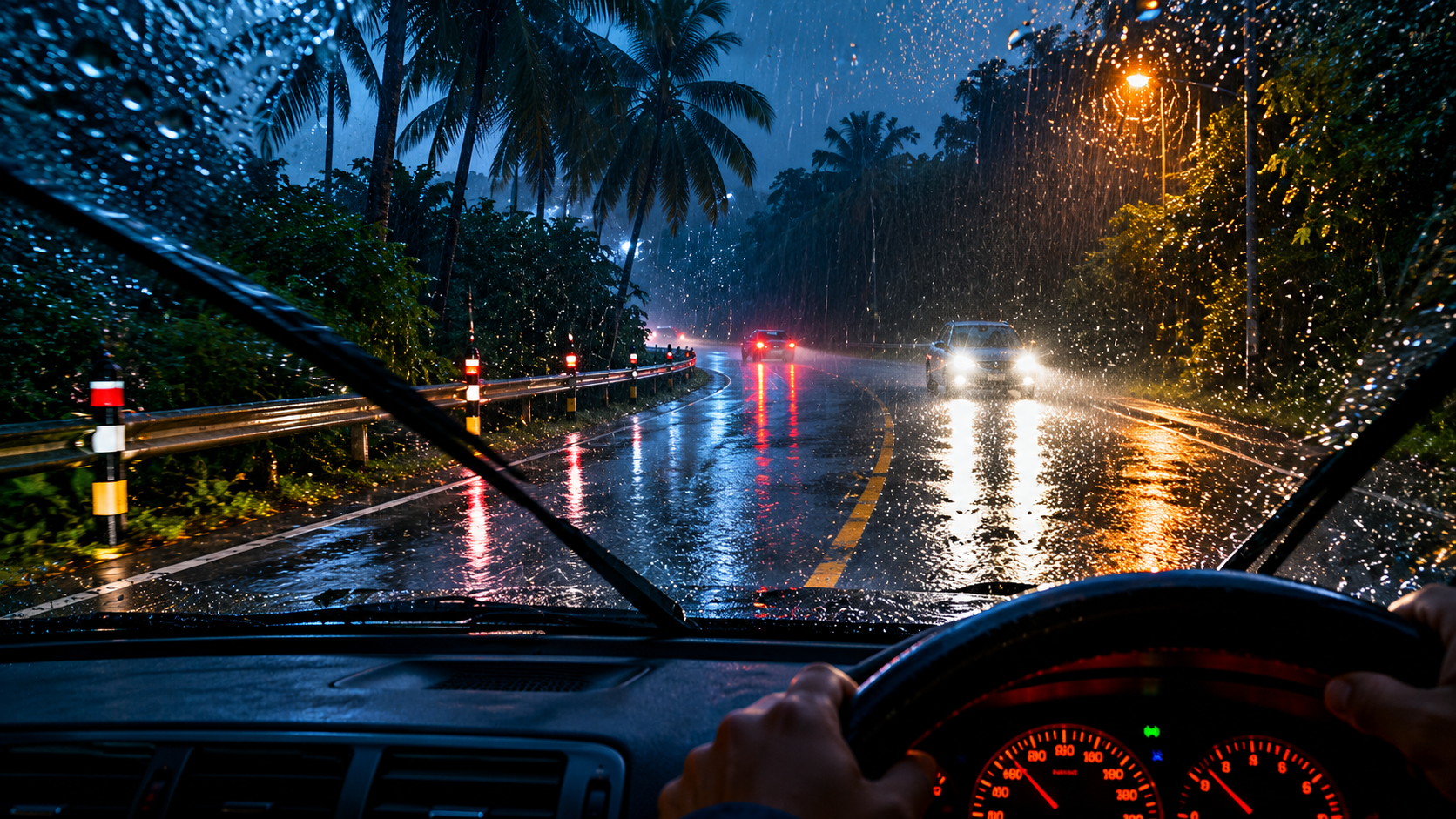
Anyone who drives regularly in Goa during the monsoon knows the feeling. A road you’ve travelled hundreds of times suddenly seems unfamiliar. Rain softens the outlines of buildings, darkness swallows distant landmarks, and visibility shrinks to the patch of road illuminated by your headlights. Nothing dramatic has changed, yet the drive demands more attention than it did a few months ago.
During the day, Goa’s roads are easy to read. The landscape provides constant reference points. Coconut trees, chapels, shops, bus stops and junctions are all visible well before you reach them. Even roads with bends and elevation changes feel predictable because the surroundings help drivers anticipate what lies ahead.
The monsoon changes that equation, particularly after sunset.
Seeing Less
Rain does not merely make roads wet. It alters the way drivers see. Reflections from headlights shimmer across the tarmac. Windscreens collect a fine mist that wipers never seem to completely clear. Signboards that stand out during the day become harder to spot at night. Familiar landmarks disappear into the darkness.
As a result, many drivers find themselves relying less on sight and more on memory.
They know a sharp bend is coming after the next bridge. They know there is a bus stop near a particular junction. They remember that a stretch of road narrows unexpectedly or that a speed breaker lies just beyond a curve. Experience fills the gaps left by reduced visibility.
Guided by Experience
This is especially true on roads outside urban centres. While major highways and city roads benefit from lighting and higher traffic volumes, many village roads and interior routes remain largely dependent on vehicle headlights after dark. On rainy nights, the visible world often extends only a short distance beyond the bonnet.
That is not necessarily a criticism of the road network. It is simply a reality of driving in a state where dense vegetation, winding roads and seasonal weather combine to create unique conditions.
One of the most noticeable changes during monsoon nights is the pace of traffic. Drivers who may comfortably cruise at higher speeds in the dry season often slow down without consciously deciding to do so. The reduced visibility encourages caution.The Pace of the Monsoon
In many ways, this is a natural and sensible response.
When visibility decreases, reaction times become more important. A cyclist without reflective clothing, a pedestrian walking along the roadside, a parked vehicle with dim lights or even a fallen branch can appear with little warning. Slowing down provides additional time to react.
Another challenge is the glare from oncoming vehicles. Modern headlights are brighter than ever, improving visibility for the driver using them but sometimes creating discomfort for those approaching from the opposite direction. When rain is added to the mix, reflections can amplify the effect. For a few seconds, drivers may find their eyes struggling to adjust between the bright lights ahead and the dark road beyond.
The experience is familiar to anyone who regularly drives during the monsoon. It is not necessarily dangerous in itself, but it does require greater concentration.
Small Things Matter
Interestingly, monsoon night driving often reveals the value of seemingly small details in road design. Reflective lane markings, cat’s eyes, roadside delineators and clear signage become far more useful when visibility is limited. During the day, these features may barely attract attention. At night, they quietly guide drivers through curves, junctions and unfamiliar stretches of road.
Vehicle maintenance also takes on added importance. A clean windscreen, functioning wipers and properly aligned headlights may not seem significant on a sunny afternoon. On a rainy night, they can make a noticeable difference. The monsoon has a way of highlighting weaknesses that remain hidden during the rest of the year.
A Different Kind of Drive
Yet for all its challenges, there is something uniquely enjoyable about driving through Goa on a monsoon night.
The roads are often quieter. The air is cooler. Reflections from streetlights dance across rain-soaked surfaces. Villages appear peaceful behind curtains of rain. There is a sense of calm that contrasts sharply with the bustle of the tourist season and the heat of summer.
Perhaps that is why many regular motorists develop a certain respect for monsoon driving. It encourages patience. It rewards attentiveness. It reminds drivers that reaching a destination is not always about speed.
Trusting Your Headlights
A familiar road may feel unfamiliar. Visibility may be reduced. The journey may take a few minutes longer than usual. But in adapting to these conditions, drivers often become more aware of their surroundings and more deliberate in their decisions.
As the rains continue over the coming weeks, motorists across Goa will once again find themselves navigating roads that seem to change character after sunset. The route remains the same, but the experience is different.
And perhaps that is the defining feature of monsoon night driving in Goa. It is not about battling extreme conditions or overcoming extraordinary hazards. It is about adjusting to a landscape transformed by rain and darkness, and learning to trust both your headlights and your memory.