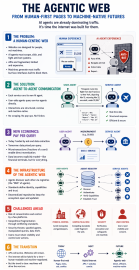
The internet was built for humans. Its architecture”web pages, hyperlinks and browsers”assumes a person squinting at a screen, clicking through layers of information designed as much for persuasion as for clarity. Yet an increasing share of traffic no longer comes from humans at all, but from machines. As artificial-intelligence agents begin to act on behalf of users, the web’s human-first design is starting to look like an anachronism.
Consider a simple task: booking a flight. A human might visit several websites, endure pop-ups, accept cookies and compare prices across cluttered interfaces. An AI agent, acting on the same user’s behalf, must do something more laborious still: parse HTML, navigate anti-bot systems and extract relevant data from pages never meant for machines. The process is computationally wasteful and economically inefficient.
Much of this friction is structural. Websites are optimised for engagement, not interoperability. Anti-bot systems”deployed by firms such as Cloudflare”treat automated access as a threat, even when it is benign. APIs, the official gateways for machine access, are fragmented, rate-limited and often prohibitively priced. The result is a paradox: machines dominate internet traffic, yet must operate through interfaces designed to exclude them.
A different model is beginning to suggest itself. Instead of forcing AI agents to navigate human-readable websites, why not allow them to communicate directly with service-side agents? In such a system, each online service”an airline, a retailer, a bank”would deploy its own AI representative. User-side agents would query these counterparts directly, negotiating access to data and services in real time.
The interaction would be structured, concise and machine-native. A request that today requires scraping multiple web pages”“cheapest round-trip flight from San Francisco to New York, departing March 15th, returning March 22nd, one adult, under $1,200””could be expressed in a compressed, standardised format. Proponents have begun to imagine an “agentic query language”: a hybrid between natural language and code, legible to humans but optimised for machines. The gains in efficiency, both in bandwidth and computation, could be substantial.
Such a shift would not merely streamline the web; it would reshape its economics. Today’s internet is largely financed by advertising and data extraction. Services are nominally free, but users pay with attention and personal information. In an agent-mediated web, access to data could instead be priced per query. Microtransactions”fractions of a cent exchanged instantly”would allow services to monetise information directly, without intermediaries.
This would bring the web closer to existing markets for high-value data. Financial terminals, for example, charge handsomely for real-time information. An agent-based internet could extend similar pricing models to a far broader range of services, from travel to logistics to healthcare. Data would become not just abundant, but explicitly traded.
To function at scale, such a system would require new infrastructure. Agents would need to discover one another through registries, akin to the domain-name system that maps web
addresses today. Standards would be needed to define how agents authenticate, what capabilities they offer and how trust is established. Some envision decentralised repositories, where service agents are publicly listed and continuously updated, allowing user agents to locate and interact with them seamlessly.
Yet the transition would raise difficult questions about power. If a handful of technology firms were to dominate the agent ecosystem, they could entrench their control over digital markets. Alternatively, governments might seek to impose their own standards, fragmenting the system along geopolitical lines. The contest between open protocols and proprietary platforms”familiar from earlier phases of the internet”would play out anew.
Security, too, would be a central concern. Direct agent-to-agent communication expands the attack surface. Malicious agents could impersonate legitimate services, manipulate queries or extract sensitive data. Robust mechanisms for verification and encryption would be essential. So, too, would safeguards to ensure that users retain visibility into, and control over, the actions taken on their behalf.
For all its promise, the agentic web is unlikely to arrive overnight. Existing APIs will not disappear; rather, they may evolve into the interfaces through which service-side agents operate. Human-facing websites will persist as well, if only because people still value direct interaction. For a time, the internet will be hybrid: part human-readable, part machine-negotiated.
Even so, the direction of travel is clear. Machines already account for the majority of internet traffic. As their role becomes more autonomous, the inefficiencies of a human-centric web will grow harder to justify. The question is not whether AI agents will reshape the internet, but how.
Will the next iteration of the web be open and competitive, enabling a flourishing market for machine-mediated services? Or will it be enclosed and controlled, with access mediated by a new generation of gatekeepers? The answer will determine whether the internet’s future is one of greater efficiency and choice”or simply a more sophisticated form of the constraints it was meant to escape.