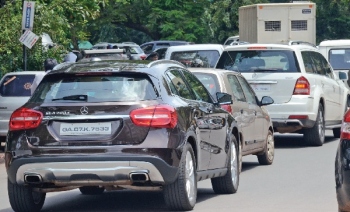
The Goods-and-Services-Tax (GST) Council's decision to hike cess on mid-sized, luxury and sports-utility-vehicles (SUV) cars couldn't have come at a worse time for auto dealers considering that the festive season has almost begun.
As Dussehra approaches, a lot of people used to buy cars earlier, but this year, it's not going to be the case, as the GST Council has increased cess on mid-sized cars (engine < 1500 cc and length > 4 meters) by 2%, luxury cars (engine > 1500 cc and length > 4 meters) by 5% and SUVs (length > 4 meters) by 7%. Such a massive increase, announced in the first half of September, is sure going to result in a bumpy ride for dealers for the rest of the year.
Raj Dabholkar, team lead, Toyota dealership, said, "Due to hike in cess, price of a variant of Fortuner has gone up by Rs 2.5 lakhs. Similarly, the price of Innova has increased by anywhere between Rs 70,000 and Rs 1.5 lakhs. The sales of these cars in September is lesser than what it was in July and August."
Actually, with the roll-out of GST on July 1, the tax burden on luxury cars and SUVs had actually come down. Therefore, a lot of customers had bought these cars in July & August at a lesser price than in June. But, with one stroke in September, the GST Council has increased the tax incidence on mid-sized, luxury and SUV cars sending shock-waves in the industry. A source said, "It sends wrong signal to customers if price varies so significantly from one month to another. In July and August, price of these cars had come down. But, in September, price has again increased. This has left customers really confused."
Prashant Joshi (a dealer of Hyundai), said, "The market of luxury cars and SUVs has clearly come down after the increase in GST. For example, we had reported good sales for Tucson in August. But, sales of this car has come down in September. In earlier years, people used to buy cars from now till Diwali. But, it's not really happening this year."
Certain car manufacturers have even absorbed the increase in GST partially so that customers don't bear the full brunt. For example, Hyundai has absorbed 2.5% of the total 5% cess increase for Verna.
However, at some point, all car-makers will have to pass on the entire tax increase to customers, which is making everyone worried in the industry.
"The taxes on this industry are already very high and this increase in cess rate will be detrimental to the luxury car industry, as we will be forced to hike our prices to levels higher than pre-GST period. This is bound to adversely impact sales by possibly a double-digit reduction", said Rahil Ansari, head, Audi India.
The impact on Goa's automobile market is expected to be more severe than pan-India market. Due to Goa's high per capita income, luxury cars and SUVs form a higher percentage of overall car sales in the state than in other parts of India. Despite Goa's under 15 lakhs population, all major luxury brands like Mercedes, Audi and BMW are present in the state and their sales will be adversely impacted due to increase in GST.
There is another school of thought as well. Some sources believe that price hike will not deter high income customers, who are anyway willing to spend lakhs and at times even crores on cars. But then, it's possible that even the rich customer might opt for a cheaper variant of the same car to save few lakhs price increase due to GST.