PANAJI
Any commentary on the ongoing election cycle for the Coriporation of the City of Panaji (CCP) cannot ignore the jurisdictional conflicts between the capital's civic body and the special purpose vehicle Imagine Panaji Smart City Development Limited (IPSCDL) over the last 6-7 years, rooted in the unexplained decision of the Central and State governments to bypass the CCP and entrust implementation of the Smart City mission entirely to IPSCDL.
This sidelining has left the CCP with little say in projects that directly affect the capital’s infrastructure and residents.
While the corporation is expected to oversee civic governance, IPSCDL has taken charge of roadworks, drainage, and the major public utility project of laying an additional and parallel sewerage line under the Smart City banner.
The overlap created confusion, duplication, and frequent delays, with the CCP reduced to a spectator in its own jurisdiction.
The fallout has been visible on the ground all these years. Mayor Rohit Monserrate has repeatedly lashed out at IPSCDL, accusing its engineers and contractors of “failure” and “stupidity” for the poor quality of work. In April last year, he declared that “everyone is fed up” with the state of the projects, describing them as “horrible” and incomplete.
A year earlier, in April 2024, he blamed Smart City officials for the flooding witnessed in areas where works were underway, alleging negligence and lack of accountability.
His father, Revenue Minister Atanasio (Babush) Monserrate, has also voiced similar frustration multiple times in the past. He publicly criticised the sidelining of the CCP, arguing that the elected body should have been the natural agency to oversee the execution of the Smart City projects.
His outbursts have reflected a broader sentiment that the decision to hand over control to IPSCDL has weakened local governance and undermined accountability to Panaji’s citizens, but ironically the father-son duo were both on the Board of Directors of the IPSCDL.
Public anger and legal scrutiny
The conflict, observers have noted, slowed progress and also eroded public trust. Throughout the implementation of the projects, residents raised a hue and cry over dug-up roads and dust pollution, incomplete drainage, and poor coordination between agencies.
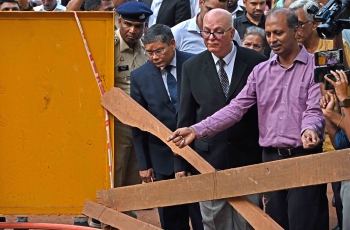
A few public interest litigations were also filed before the Bombay High Court at Goa, one of which even culminated in on-the-ground site visits by the judges of the division bench ” Justices Mahesh Sonak (now Chief Justice of the High Court of Jharkhand) and Valmiki Menezes.
Sonak and Menezes, who were both familiar with Panaji, having lived in the city in their growing-up years and also during professional practice, then ordered a slew of measures to ease the problems faced by residents from dust pollution and traffic congestion due to roads being shut during the execution of Smart City projects.
The CCP, stripped of its role, meanwhile, still struggles to date to respond to citizens' grievances, while IPSCDL faces mounting criticism for execution lapses.
As Panaji heads into the March 11 civic polls, the jurisdictional tussle underscores a larger question: whether the city’s elected representatives will be empowered to shape its future, or whether parallel agencies will continue to dictate the capital’s destiny.