BASILIO MONTEIRO
Amartya Sen, our illustrious Nobel Prize-winning economist, wrote a “fascinating, eloquent, and probing” book on Development as Freedom (1999), passionately advocating for the development of the capabilities of the people, without a single word on the construction of roads or other grotesque and kitsch structures.
The word “development” has grabbed the imagination of the people of Goa as the only “road” to having a “good life” and to “living well”. “Development” symbolises Disneyland; Goa, the splendid varanda on the Arabian Sea, is the play-land to become the nation’s theme park, with incessant hedonism duly promoted by “Unfiltered Goa” social media.
Development and urbanisation are enticing words which generate ideas, and no one ought to be against the idea of ongoing improvement, whichever way one may consider what “improvement” is, whether personal or material. Tragically, commercialised and commodified entertainment is promoted as development and as a critical ingredient of urbanisation, which is a clever idea rigged by the Lords of the Potemkin Village. Amartya Sen would prioritise human capabilities as a process of expanding the real freedoms that people enjoy. Focusing on human freedoms, Amartya Sen contrasts with narrower views of development, such as identifying development with the growth of national product, the rise in personal incomes, industrialisation, technological advance or social modernisation.
Understandably, industrialisation, technological progress and social modernisation do contribute to expanding human freedom and thus human development. Thoughtful, deliberate and well-grounded structural and infrastructural development is necessary, and the governing entities of the State must advocate for it to the extent that it benefits the population.
Sadly, what has become the norm is reckless structural development that benefits construction industry tycoons and the related bureaucrats tasked with legitimising the relevant and necessary structures and infrastructure. Political influence in search of economic gain is a very real phenomenon in the world in which we live. The seekers of profit from captive “development” markets keep the notorious “build-tear-it-down-rebuild” cycle well-greased, fuelling the wealth machine.
The industrialised West is presented as the model for development or what is considered to be developed. It is important to note that development is not necessarily improvement. The industrialisation streak that originated over two centuries ago in the West led to the hasty normalisation of industrialisation in the rest of the world as a sign of progress, which, in many ways, it was and still is. People began to travel beyond their homelands and were enchanted by what they saw as “development” in the West. Reckless industrialisation jeopardised sustainability and produced capitalism-driven mass production using steel and concrete. Living above the ground in “boxed”, multi-storey “flats” became the aspiration and the symbol of “development”.
For the people of Goa, the 70s opened up the gates to the Middle Eastern countries, offering better employment opportunities, and many, understandably, rushed to the land of “golden opportunity”. This opened up an opportunity to move from our humble but cherished “kompti” in the village to a “flat” in an urban area. It was a good thing. However, visions of a “developed” Goa meant reproducing Western living amenities.
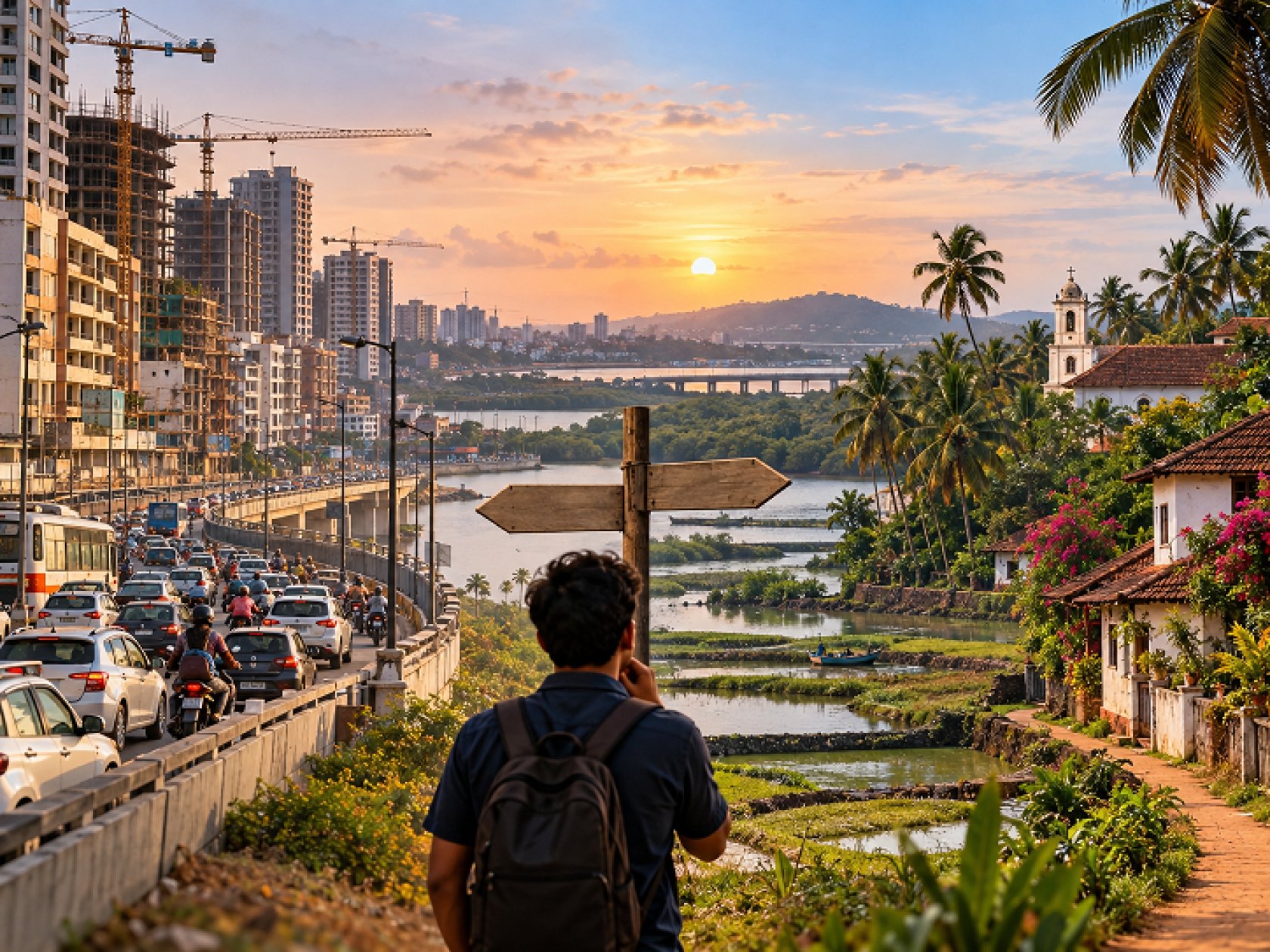
For Goa, being “developed” meant turning it into an urbanised strip layered with concrete. The construction activity on that parcel of land from Patto/Panaji to Merces is a classic example of a disastrous development project where no consideration is given to the fragile ecology of that little but critical geographical area, where the intricate and precarious balance between the khazan lands, the ancient human-engineered wetlands and the mangrove ecosystems is designed to integrate agriculture, aquaculture and flood defence. The village of Merces is now agonising as it tries to navigate the madness hoisted upon this previously idyllic and luscious village. In the prevailing development mania, a village is considered “backward”.
Goa undoubtedly needs development, but not when it is masked as urbanisation. What kind of development is appropriate for Goa? Goa has highly qualified professionals, academics and scholars whom development planners have a professional duty to consult. Olivinho Gomes, in his masterful book, Village of Goa: A Study of Goan Social Structures and Change (1987), gives us a much-needed understanding of how the city is useful, but villages are necessary for living a good, sossegado and happy life.
One of the marks of development is access to mobility and travel, and thus endless highways, which divide and disrupt tightly knit communities. As seductive as travelling in one’s own vehicle may be, it also gives individuals the necessary control over the why, when and where of their lives. However, poorly designed highways and perilous roads lead to a proliferation of road accidents.
Development projects sprout not because of the pressing needs of the people to improve their living conditions, but as a result of self-serving lobbying by interested and invested parties. The grease for the wheels of the money machine ought always to be flowing, and development projects provide the best grease.
Unfortunately, our illusions and delusions have led us to believe that living in an urbanised land is progress and a move up the social ladder, while living in villages nearer to farmland is seen as “backward”. Idyllic living promotes the cherished “sossegado” healthy life. Undoubtedly, there is a place and need for urbanised spaces where life is fast and efficient, but tiresome. Wistfully, the nouveau riche may gloat that they live in the developed world. Are we looking for sudharop, which is more than development?
(The writer is Director of the Institute for International Communication at St John’s University, New York)