


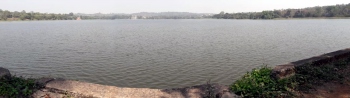
 The farmers claim that Carambolim Lake was a field called ‘Tollem’, where water was stored to supply the same to another field called ‘Savat’ for cultivation. Captured by : Manuel Vaz
OLD GOA
Even as panchayats of Old Goa and Carambolim have sought more time to submit objections to the draft notification to declare Carambolim Lake as wetland, farmers of Tollem-Savat have raised objections to the area of the lake which is earmarked as wetland.
The farmers have opined that the actual area of the lake is less and that the fields, which have been submerged under water due to closure of sluice gate, have also been shown as part of the lake and have been included in the area to be declared as wetland.
The farmers have now urged the Goa State Wetland Authority (GSWA) and other authorities concerned to conduct a re-survey along with the villagers and prepare a correct plan.
They have formed a committee called ‘The Farmers of Tollem-Savat Tenant Action Committee’ under the chairmanship of Vaman Pilgaonkar, to take the issue to its logical conclusion.
Speaking to The Goan, Pilgaonkar, informed that in earlier times, there was a field called ‘Tollem’ where water was stored so that the same could be supplied to an adjacent field called ‘Savat’, where cultivation was done twice a year.
“The ‘Tollem’ was actually a field where farmers used to do cultivation there. The practice of cultivation in the ‘Tollem’ stopped almost three decades back,” said Pilgaonkar.
“Due to closure of the sluice gate at present, the fields remain submerged under water.”
“However in ‘Savat’, farmers used to undertake cultivation but there too, a majority of farmers have given up farming due to entry of saline water in their fields and non-interest shown by the younger generation,” Pilgaonkar informed.
Se Old Goa panch Nilkanth Bhomkar also concurred with Pilgaonkar and informed that Carambolim Lake is not a natural lake.
“It was a field called ‘Tollem’ where farmers were undertaking cultivation once a year and later were using the same to store water to irrigate the fields in 'Savat’ during the summer,” Bhomkar stated.


