


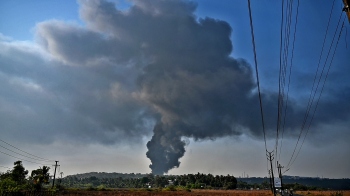
* The chinks in disaster management are showing * Fire services turning out to be lone warrior
-----------------
Many, living in the radius around the Pilerne plateau were earlier this week woken up from their infamous mid-afternoon siesta by dark fumes of smoke rising from the fire that struck the Berger Becker paint factory there. At first, no one knew what was happening, except perhaps the first response firemen who gallantly fought the raging flames with water and foam, led by the Force's senior officer Ajit Kamat.
The flames are long doused now. So, can we tick all the boxes in managing such disasters and minimising the damage they do?
We attempted to find the answers and the story that is emerging is no different from many such disasters which have hit the State in the past. From agencies responsible for auditing the industrial safety aspect of industrial units to those charged with the duty to get into action, multiple authorities have been caught doing what they always do in such situations -- pass the buck.
There is no single entity of officials who will authoritatively take charge, coordinate the effort of the multiple agencies and take responsibility for the ticks and crosses of the job done.
Inspectorate of Factories and Boilers, the Labour Commissioner, Fire and Emergency Services, the police and eventually the district administration (district collectorate) are the multiple government agencies which come into play in the event of such mishaps.
In most past cases, officials manning each of them have generally passed the buck, claiming overlap of jurisdiction.
Technically, the district collector heads the Disaster Management Authority (DMA) and in the case of the Berger Becker plant fire at Pilerne, it was Mamu Hage, IAS, the North Goa Collector who had to adorn the hat.
Health advisory
Other than the health advisory issued by Hage listing the do's and don'ts for people residing within a 5-km radius of the disaster site, given that carbon monoxide fumes rose to the sky and drifted far and wide appearing like dark monsoon clouds, there was little that the young IAS officer could do.
In the initial two-three hours, it seemed like local MLA Kedar Naik and Goa Industrial Development Corporation chairman Aleixo Reginaldo Lourenco were doing the hands-on job at the site, perhaps because the politician-duo projected it thus.
Lourenco, who heads the GIDC which in turn is the 'owner' of the industrial estate, claims the agency has little or no role in such industrial safety matters. Not even coordination. What he admits is that the Corporation is in effect a mere 'real estate' agent, finding and developing land for private industrial purposes. Safety be damned.
Role of Inspectorate of Factories & Boilers
The very title of the department -- Inspectorate of Factories and Boilers -- would lead one to believe that regular inspections from the industrial safety standpoint is its primary responsibility. But beyond coming in to investigate the causes when a disaster or mishap indeed occurs, there is little of note that the department does.
Take the case of the last industrial disaster which killed three workers at the Zuari Agro Chemicals plant in May last. More than seven months later, there is no word on the outcome of that investigation other than the claim that the prima-facie investigation had found a lapse on the part of the company.
The law gives exclusive power and responsibility to the Inspectorate of Factories and Boilers to prosecute for breach of statutory safety stipulations in cases where disasters occur and endanger human life and property. Miraculously, there were no human casualties in the Pilerne inferno.
Poor prosecution
In the case of past industrial mishaps, including fatal ones, government officials argue that overlap of jurisdiction impedes action.
This they argue is the reason for the not-so-encouraging record of the State government in terms of prosecutable action taken against the companies involved.
In as many as 30-odd fatal mishaps reported in the last 10 years (2012 to 2022), in only half of them, criminal action was initiated (only 16 out of the 30), according to information sourced from the records of the Goa legislative assembly. And, there is no record of what the criminal action was or whether it ended up in any sort of prosecution in a court of law to pin responsibility or convict those responsible or complicit for ignoring prescribed safety norms.
Another case in point, where hardly any action is taken in man-made disasters where lives are lost was the collapse of an under-construction block of Ruby Residency in Canacona which killed 31 labourers in January 2014.
Eight years later, the suspension and reinstatement of the then Deputy Town Planner Prakash Bandodkar and Canacona Municipal Engineer Ajay Desai, is all the government has to show in terms of action taken.
A report of a Commission which examined 50 witnesses, including current Speaker Ramesh Tawadkar, then the Canacona MLA and a minister, is gathering dust in some government cellar and has not even been made public.
Tawadkar owned a residence and an apartment which he used as an office in an adjacent block of the same project and was accused of alleged complicity in the block of the project securing completion and occupancy certificates.


