


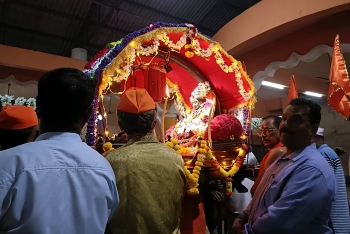
According to Supriya Palyekar of Danddo Vaddo in Siolim, every year, the Palkhi is brought to the Vataar comprising Danddo Vaddo (where the Palyekar family house is located) and the three other Vadde in its vicinity, on the third day after the Mahashivratri festival.
On this particular night, Supriya and the other Savashins from these four Vadde perform the necessary rituals and customs of Vhotti Bhorop of the goddess Sateri in the Palkhi, right near their own houses. It is nearly 3 am when all the stops/halts have been covered. Then the Palkhi (palanquin) is kept overnight in the Mandap (hall) of the Adi Narayan temple at Danddo Vaddo.
The next morning, the fourth day after Mahashivratri, the Palkhi is taken to Sateri temple at Sodiem. From there, on the subsequent days, it proceeds on its visits to other Vataar comprising of different Vadde named Igorze Vaddo, Guddem, Bammon Vaddo, Moddlem Bhatt, Vaddy, Marna, Porta Vaddo, Taricho Vaddo And Bailolem, Naya Baug, etc. It also proceeds to the various Vadde in the villages of Oxel and Sodiem in the following days.
Another interesting fact during the celebration of Palkhi Utsav, is that soon after the Palkhi has finished visiting a particular Vataar (area), the villagers from that Vaddo, hold a performance of a Natak (drama) on a stage near their local temple ground. This Natak is held as entertainment for the locals during the weekly nights of the Palkhi Utsav. The theme of the Natak (drama) is either based on Pauranik (ancient Hindu scriptures or mythology) stories or is based on Samajik (social) issues.
Participants of all these dramas are some enthusiastic youth from the village and the audience consists of the rest of the villagers. My friend, Supriya Palyekar, herself has enthusiastically participated in these Nataks (dramas) quite many times.
In this way, the Palkhi Utsav is celebrated in great pomp and gaiety by all the devotees in every Vaddo where the goddess Sateri is worshipped. This Utsav continues for the entire week and ends on the seventh day after Mahashivratri. The Palkhi is brought to the Sateri Devi temple at Sodiem to celebrate the Sateri Vadd Diwas festival.
SATERI VADD DIWAS
As mentioned, the Sateri Vadd Diwas is celebrated a week after the Mahashivratri, which falls on the Shashti (sixth day) of the Shukla Paksha of the month of Falguna (Hindu calendar). For the Hindu community living in the villages of Siolim, Sodiem, and Oxel, it is a day of a grand celebration at the Sateri temple premises after the conclusion of the week-long Sateri Devi Palkhi Utsav. Now that the goddess has ended her visits to her Vataar and her Palkhi is brought back to the temple, the devotees celebrate this Sateri Vadd Diwas like celebrating the birthday of the goddess.
In the morning of the Sateri Vadd Diwas, a Puja (religious ritual) is conducted by the Bhatt (temple priest) at the temple premises in the presence of devotees. This Puja comprises an Abhishek (ritual of bathing) of the idol of Devi Sateri followed by other rituals of offering the Naivedya (offering food items) and other items to the goddess.
This is followed by the performance of the Maha-Arti (a type of ritual waving lighted lamps) and the offering of the Prasad to all the attendees. After the completion of all these religious rituals, in the afternoon, the temple committee hosts a grand lunch ceremony known as Mahaprasad for all devotees at the temple premises.
The Mahaprasad is a vegetarian meal comprising rice, dal (gravy of lentils), vegetables, Khatkhate (a spicy stew of lentils with dice of yams, potatoes, corn cobs, breadfruit, etc). A Godshe/Soji (sweet dish made with coarse semolina and jaggery) is also served along with pickles and papad.
This meal is served to hundreds of devotes from Siolim, Sodiem, and Oxel, who specially come to the temple to partake in it on the auspicious occasion of the Sateri Vadd Diwas. The number of devotees attending this lunch ceremony is so huge, that the service which starts at about one thirty in the afternoon concludes at almost four thirty in the evening. (To be continued)
[The writer is an architect by profession and is passionate about festivals and traditions in Goa]


