THE GOAN | VASCO
Every litre of petrol reaching fuel stations across Goa now carries an invisible ingredient that has quietly become part of the country's energy policy — 20 per cent ethanol.
Introduced under the Government of India's ethanol blending programme to reduce dependence on imported crude oil and promote cleaner, domestically produced fuel, the blend has become the only petrol available at most filling stations.
While oil companies describe it as a nationally mandated reform, concerns are steadily surfacing among petrol pump workers, mechanics and vehicle owners over its long-term impact, particularly on older vehicles and fuel storage systems.
BLENDING AT TERMINAL
At the oil storage and distribution terminal at Sancoale, the blending process follows a strict protocol. Fuel unloaded from tanker vessels arriving at the port is stored separately, while ethanol is received and maintained in independent storage tanks. Before dispatch to petrol pumps across Goa, the ethanol is blended with petrol in accordance with the Government of India's directive mandating a 20 per cent ethanol mix.
Officials associated with the terminal said the company merely implements the policy framed by the Central Government and oil marketing companies.
According to them, every consignment leaving the depot complies with the prescribed blending norms before being transported to retail outlets across the State.
CONCERNS AT PETROL PUMPS
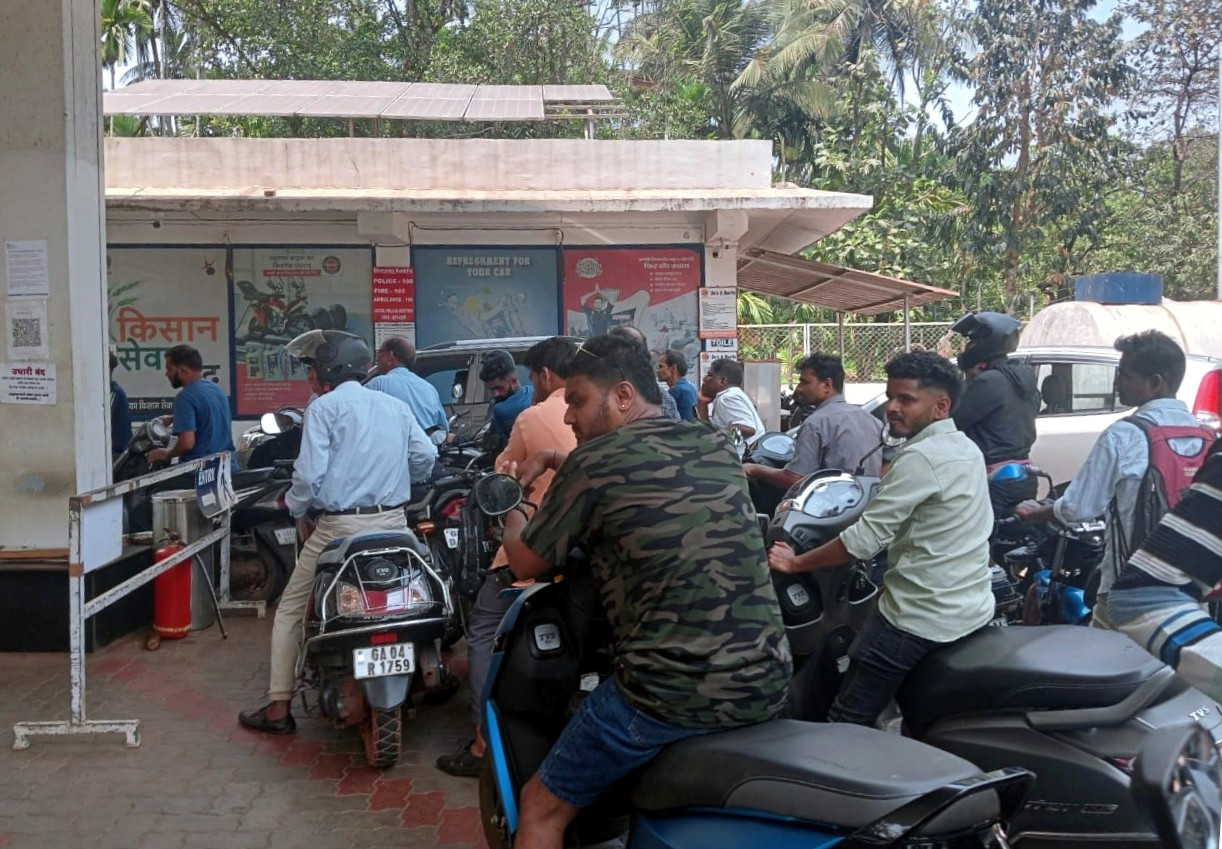
However, the situation appears different at the consumer end, where petrol pump employees say they increasingly face questions from motorists.
Several fuel station workers said customers frequently complain about the presence of higher ethanol content in petrol, particularly owners of older vehicles who believe they are experiencing reduced mileage and performance.
Employees admitted that there is little they can offer by way of alternatives, as only pre-blended ethanol petrol is supplied to retail outlets.
"There is no separate petrol without ethanol available for us to sell. Whatever reaches the pumps has already been blended before dispatch," one employee said.
Some pump operators also expressed concern over a lesser-discussed issue involving fuel storage infrastructure during the monsoon.
According to employees, ethanol has the property of mixing completely with water. They fear that if underground storage tanks at petrol pumps located in flood-prone or low-lying areas develop even minor leakages, damaged gaskets or faulty manhole covers during heavy waterlogging, rainwater could enter the tanks.
Since ethanol readily mixes with water, they believe contamination could occur more easily than with conventional petrol, potentially affecting fuel quality.
Though such situations depend largely on the condition and maintenance of storage systems, workers said the risk deserves attention, particularly during Goa's intense monsoon season when several low-lying areas experience flooding.
CONCERNS AT GARAGES
Automobile mechanics, meanwhile, believe the effects are felt most by owners of ageing vehicles.
A senior mechanic said ethanol blending is a government policy intended to achieve larger national objectives, but maintained that it is not always favourable for older engines that were never originally designed for higher ethanol content.
“Ethanol possesses lower energy density than conventional petrol, which may gradually result in lower fuel efficiency. Some customers have also complained about sluggish initial acceleration, rough idling and occasional misfiring, although such symptoms can arise from multiple mechanical reasons,” said the mechanic.
The mechanic further explained that ethanol naturally attracts moisture from the atmosphere. “Over time, especially if a vehicle remains unused for prolonged periods, moisture accumulation can contribute to corrosion inside fuel tanks, carburettors, fuel lines and certain metallic components. In some cases, prolonged storage combined with moisture contamination may also affect fuel quality inside the tank,” the mechanic added.
He stressed that regular vehicle usage, proper maintenance and timely servicing become increasingly important with ethanol-blended fuel, particularly for older models.
TWO DISTINCT NARRATIVES
The debate surrounding ethanol-blended petrol has therefore created two distinct narratives.
On one side stands, the government's larger objective of reducing crude oil imports, supporting domestic ethanol production and promoting cleaner fuels through mandatory blending.
On the other are motorists, fuel station employees and mechanics who continue to voice practical concerns arising from everyday experience, particularly regarding vehicle performance, maintenance costs and storage safety.
With ethanol-blended petrol now becoming the nationwide standard rather than an option, the discussion is no longer about whether motorists should use it, but about how effectively vehicles, fuel infrastructure and consumers adapt to the country's changing energy landscape.
As E20 petrol quietly becomes the new normal across the country, motorists have little choice but to adapt to the fuel now flowing into their tanks.
While the Government sees ethanol blending as a key step towards energy security, lower crude oil imports and cleaner mobility, questions raised by petrol pump workers, mechanics and vehicle owners continue to fuel the debate over its long-term impact on vehicles and fuel infrastructure.
As E20 petrol becomes the standard fuel across Goa and the rest of the country, every stakeholder finds themselves on a different side of the same story.
With differing views emerging from every link in the supply chain, the debate over E20 petrol is only likely to grow as India's transition towards ethanol-blended fuel gathers pace.
For now, every litre leaving the Sancoale terminal carries not just fuel for the road ahead, but also a policy that is steadily reshaping India's automotive future — one blend at a time.